Online Fortune Sticks vs a Temple Visit: What Changes?
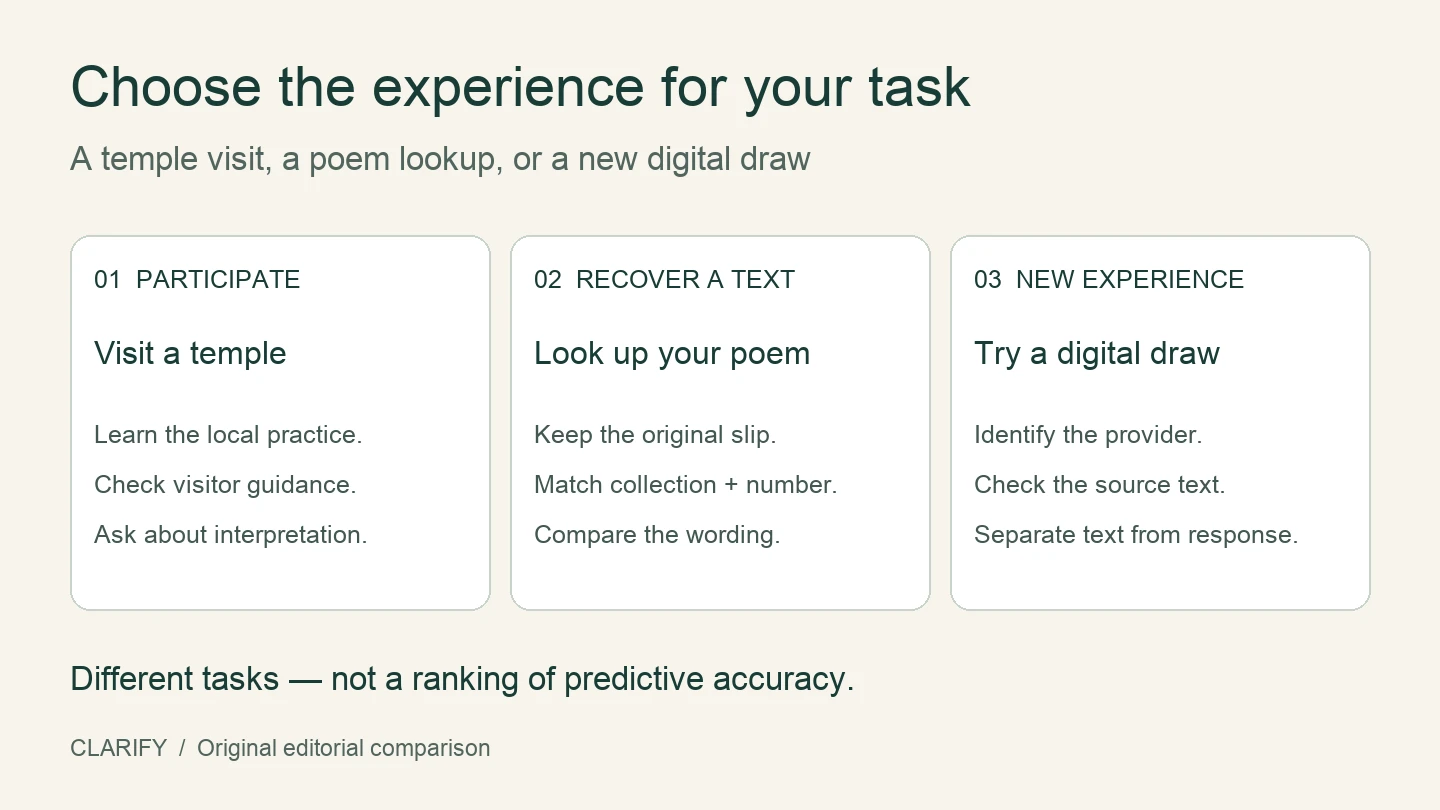
Online fortune sticks and a temple visit can both lead you to a numbered poem, but they are different experiences. A temple consultation takes place within a living religious setting. An online service may let you look up a poem you already drew, make a new digital draw, or receive a modern interpretation. Before choosing, identify which of those you want.
The useful comparison is not which format promises better luck. It is whether you want to participate in a particular temple's practice, recover the text of an existing lot, or pause with a question through a digital experience. Those tasks need different next steps.
First distinguish three different experiences
“Online fortune sticks” is a broad label. A page that retrieves an existing numbered poem does a different job from an app that selects a new sign. Neither is automatically a remote consultation with a temple interpreter.
- A temple visit: you want to participate in the practice of that place of worship. Check its current visitor guidance, local procedure and interpretation arrangements.
- An online poem lookup: you want the text connected to a number you already have. Check the named collection and whether it matches your slip.
- A digital draw or reading: you want a new sign and an interpretation or reflection experience. Check the operator, source collection, explanation method and information requested.
This distinction also avoids a false divide between “temple” and “internet.” A religious organisation can offer digital resources. For example, Sik Sik Yuen's Tao-Net homepage lists a Stick Enquiry alongside other online services. The existence of an independent app does not make every online resource independent, and the existence of a temple website does not make every similarly named app official.
What a temple visit adds
A visit situates the consultation in a particular place, community and religious tradition. The Hong Kong Tourism Board's account of Wong Tai Sin Temple describes seekers shaking a bamboo cylinder until a stick falls out and having it interpreted at stalls. That is an example from one setting, not an instruction sheet for every temple.
If participating in that practice is your aim, check the temple's own visitor information. Ask where to obtain the correct slip, which steps apply there, and how interpretation works. Do not assume that a ritual described by an app or another temple applies to your visit.
Being present can also give you an opportunity to ask a person about an unfamiliar word or local instruction, where that service is available. Confirm language, availability and any fee before relying on it. This guide does not quote current prices or promise that an English-speaking interpreter will be available.
A phone screen can display a poem, but opening it is not the same event as participating in the temple's practice. Whether an online activity has religious significance for you is a matter of belief and tradition; this comparison cannot certify that status.
What changes when the experience is online?
The way a sign is selected
For a lookup, you bring the number. For a digital draw, the service supplies a selection process. An animated cylinder does not, by itself, tell you how selection works. Check what the provider explains, and leave the method unknown if it is not disclosed.
Do not infer that every site uses the same collection. The Taiwan Religious Culture Map's English-friendly temples page, for example, presents a draw interface with a 60-Jiazi explanation heading. It is a concrete reminder to identify the system before comparing its numbers with another collection. This observation does not validate the interface's accuracy or its selection algorithm.
The text and the explanation
A digital result can contain several layers: source poem, translation, general explanation and an application to your question. Look for labels that tell you which is which. Fluent, personalised prose may feel more specific than a short poem, but specificity alone does not show that it is an accurate translation or a reliable prediction.
Useful questions for a provider include: Which collection supplies the poem? Is this a translation or a new paraphrase? Who or what writes the personalised response? Can I still read the source text? If an answer is missing, do not silently fill it in with “official temple meaning.”
What you share
When a service asks you to type a question, read its explanation of how that information is used. You can usually express a decision without names, private messages or identifying documents: “How should I approach this conversation?” carries less personal detail than pasting an entire exchange.
For any sharing feature, inspect the preview and check whether it includes your question or just public poem text. A private reflection and a public share card are different things. These are practical checks to make, not a claim that every online service handles information in the same way.
Worked example: three readers, three sensible starting points
These fictional examples illustrate choosing a service, not predicting an outcome.
Mina already has a paper slip
Mina returns from a temple with a numbered poem but cannot read all the characters. Her task is to understand that existing text. She records the temple name, collection if shown, number and opening line, then looks for the matching resource.
If a website offers a new draw, using it would create a different reading rather than translate her slip. Even a matching number is only a starting point: Mina should compare the wording or ask the original temple which source to use. Our worked guide to reading a Chinese fortune stick explains how to separate the poem from later interpretation.
Leo wants to experience a temple tradition
Leo is planning a visit because he wants to understand the religious setting and follow its local practice. A digital reading might introduce some vocabulary, but it does not complete that visit for him. His next step is to consult visitor guidance and ask staff what is appropriate on the day.
He does not need to memorise a universal sequence assembled from unrelated websites. The point is to learn about this particular place, rather than assume that the most detailed online ritual is the correct one everywhere.
Ari wants a quiet moment with a current question
Ari is at home, considering how to approach an ordinary conversation, and wants a digital experience. An independent app may fit that preference if its purpose and reading layers are clear. Ari can write one question, read the response and note which idea is useful to consider.
The later conversation still provides the actual person's views. The digital reading has not taken place at a temple, confirmed those views or guaranteed how the conversation will go. For help narrowing the question, use our fortune-stick question guide.
A short checklist before you choose
- Name your task: participate in a tradition, look up a previous poem, or make a new digital draw.
- Identify the operator: read the organisation's own information rather than treating a temple name or image as proof of affiliation.
- Identify the collection: keep its name with the number and text.
- Identify the explanation: distinguish translation, general commentary and a personal response.
- Check practical conditions: language, access, any charges and handling of your question.
You do not need to use both formats to validate a reading. Using another service may simply introduce a different selection, source or interpretation. That difference is something to understand, not an automatic sign that the first result was wrong.
Common questions
Do online fortune sticks use the same poems as temples?
Some services name a particular source collection; others offer adaptations. Check the actual source and wording rather than assuming a shared number proves a shared poem. A lookup for an existing slip needs a match, while a new digital draw begins a separate experience.
Are online fortune sticks less accurate?
The sources cited here describe practices and interfaces, not comparative studies establishing predictive accuracy. They do not justify ranking online or temple readings by success rate. You can compare traceable text, understandable explanations and a service's fit for your purpose without assigning either format a percentage.
Is an online draw disrespectful?
There is no single answer this guide can give on behalf of every religious community. If your concern is observance within a particular tradition, seek guidance from that community. An independent digital product should not be treated as speaking for a temple merely because it uses traditional imagery.
Where Ask a Sign fits
Ask a Sign by Clarify is a digital starting point for a question and a sign. Choose it if you want to explore that online experience; for participation in a particular temple's practice, consult the temple itself. Keep the source poem and your personal response separate when reflecting on what you read.
If you are deciding between a question-led sign and a birth-chart reading, our BaZi versus fortune sticks guide explains that different choice. Neither an online reading nor a temple visit replaces the real information you need for consequential decisions.