How to Ask Chinese Fortune Sticks a Clear Question
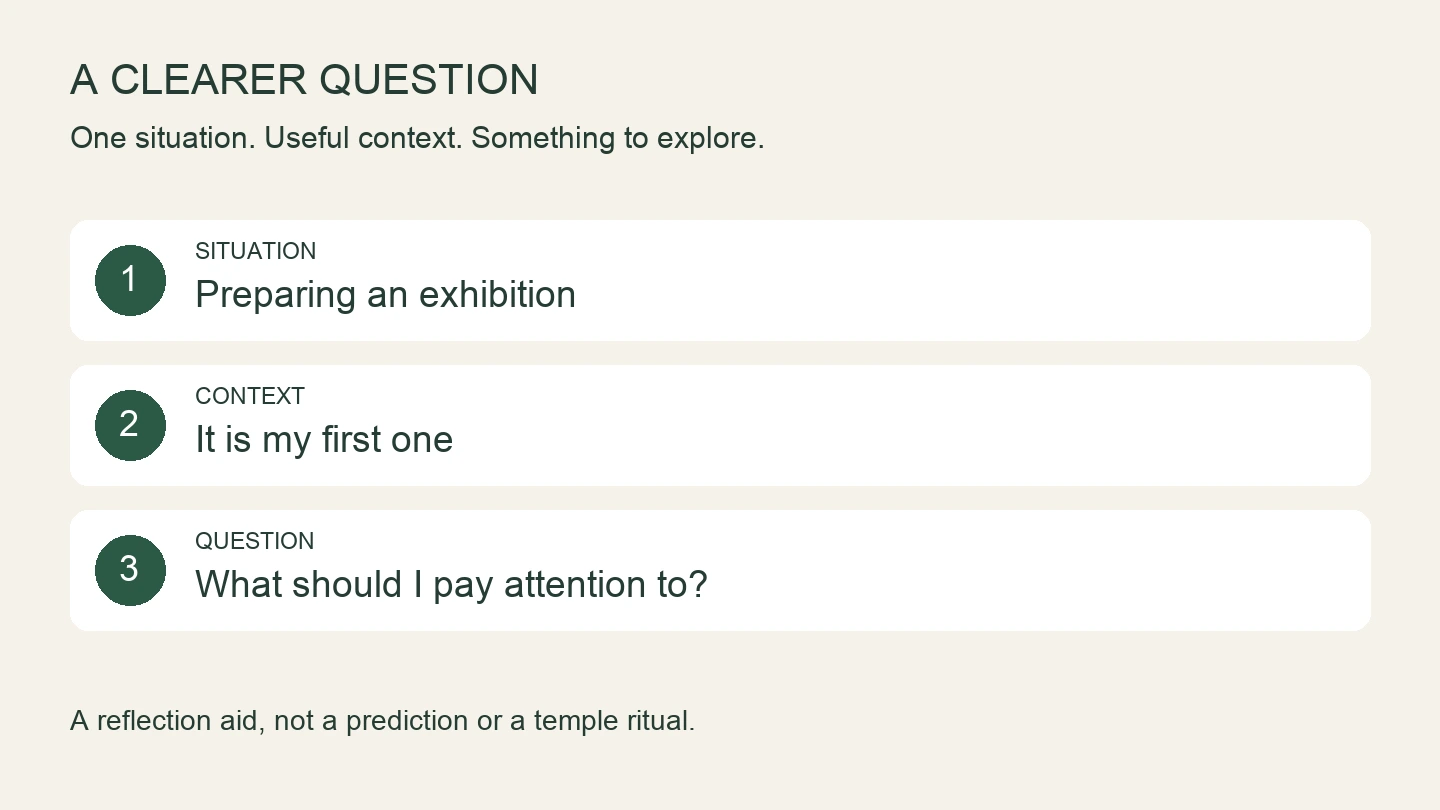
Choose one situation, add the context that matters, and ask about something you can reflect on or do. For example, “Will my project succeed?” becomes “What should I pay attention to as I prepare my first public exhibition?” A clearer question gives you a more useful starting point for reading; it does not make a fortune stick predict the future more accurately.
If you are trying Chinese fortune sticks, often called kau cim, the hardest part may be deciding what to ask. You might have several worries at once, want a yes-or-no answer, or worry that your wording must be perfect. This guide offers practical question examples and a short worksheet you can use before and after a reading.
The question-writing method below is Clarify's modern editorial approach to reflection. It is not a compulsory religious formula or a claim about what every temple requires.
What you are asking when you draw a fortune stick
The Hong Kong Tourism Board's Wong Tai Sin Temple guide describes kau cim as a practice in which a person shakes a bamboo cylinder until a stick falls out, with interpretation offered at nearby stalls. This is a description of a living religious and cultural practice, not evidence that a draw establishes future events.
At a temple, follow that temple's instructions. An online experience may use a different procedure. A writing exercise cannot tell you how many times a particular temple expects you to draw, what confirmation steps it uses, or which text collection belongs to a given number.
Fortune sticks also differ from a birth-chart reading. If you are still choosing between formats, read BaZi vs fortune sticks. Here, the task is narrower: turning the situation already on your mind into one question you can understand when you return to it later.
Build your question in three steps
1. Name one situation
Start with an ordinary description: “I am preparing a small exhibition,” “I want to restart a neglected hobby,” or “I am unsure how to begin a conversation with a friend.” These are fictional examples, not customer stories.
A question such as “What will happen with my work, friendships and move?” bundles separate uncertainties together. If an interpretation mentions change, you will not know which part you meant. Pick the matter you most want to examine now and leave the others for separate reflection.
2. Add only the context that changes the question
“Before my first exhibition” tells you more than “someday.” “I have four weekends to prepare” may be useful context for planning. You do not need to narrate your entire life or identify everyone involved.
A time frame defines the situation you are considering; it is not a deadline by which a sign must come true. Use “while preparing for next month's exhibition” to keep your attention on preparation, rather than demanding that a verse supply an exact date for success.
3. Ask about an aspect you can examine
Try a stem such as “What should I pay attention to…?”, “What assumption could I reconsider…?” or “What would help me approach…?” Finish it with your actual situation.
This makes room for reflection without treating the answer as an instruction. A useful question can still lead you to conclude that a passage does not fit. You do not have to force every image into a personal message.
Six question examples, with the reason for each rewrite
Starting a creative project
First version: “Will my exhibition be successful?”
Focused version: “What should I pay attention to as I prepare my first exhibition?”
The second version leaves “success” to be defined by you. You can decide whether your practical goal is finishing six pieces, showing them clearly or inviting a few people. A draw cannot measure those goals for you.
Restarting a hobby
First version: “Am I meant to learn the guitar?”
Focused version: “What assumption about restarting guitar practice would be useful to reconsider?”
This shifts attention from a fixed identity to something you can investigate. Perhaps you have assumed that a practice session must last an hour. Whether a shorter session works is a question you can actually test.
A conversation with a friend
First version: “What is my friend secretly thinking?”
Focused version: “How can I approach a conversation about our cancelled plans with more clarity?”
A symbolic reading cannot verify another person's private thoughts. The revised question concerns your approach. Your friend's explanation still needs to come from your friend.
Choosing between two activities
First version: “Which class should I join?”
Focused version: “What should I consider when choosing between a drawing class and a pottery class this term?”
Keep the real comparison alongside the reflection: schedules, travel, fees and what each class teaches. Do not turn a drawn number into a ranking system that the reading never supplied.
A busy month
First version: “Will October be lucky?”
Focused version: “What should I pay attention to while balancing my two planned activities in October?”
The month is context, not a promise of a monthly forecast. The revised version gives you a concrete situation to revisit without making every event evidence for or against “luck.”
After receiving an unwelcome answer
First version: “Can I draw again until I get a better sign?”
Focused reflection: “Which part of this answer am I resisting, and does it actually fit my situation?”
This is a question to ask yourself after reading. A practical stopping rule is to keep the original question and draw together, then take time to reflect. Repeating until you like the wording changes the exercise into selecting a preferred answer.
A worked example: from question to a grounded next step
Imagine that you have four weekends before a small exhibition. You have six unfinished pieces and are worried about showing anything at all. Your question is: “What should I pay attention to as I prepare my first exhibition?”
Suppose a passage you read makes you think about patience. No traditional verse is quoted or simulated here; “patience” is simply an illustrative theme. There are at least two possible interpretations: reduce the number of pieces so you can finish them carefully, or postpone showing your work. The theme alone does not tell you which is appropriate.
Now check the facts. Is the date fixed? Must all six pieces be included? How long does one piece take to finish? A small next step might be to ask the organizer whether three completed pieces would be acceptable. That answer supplies information the symbolic reading cannot provide.
Your note can end: “The theme prompted me to reconsider scope. I will check the minimum display requirements before changing my plan.” You have preserved the reflection without pretending that the reading decided the exhibition's outcome.
A short note to keep with your reading
- My question: Copy the exact wording before you draw.
- My context: Write one sentence about the situation and any relevant time frame.
- The source: Record the service or collection, the stick number if shown, and the text you actually received.
- My interpretation: State the connection you see, plus one alternative reading or reason it may not fit.
- My next step: Choose one small action or fact to check independently.
Keep the received text separate from your interpretation. A translation, a traditional saying and a service's additional explanation are different layers. Recording them separately makes it easier to notice where your own assumptions enter.
Try your question in Clarify
Ask Clarify is Clarify's digital experience inspired by traditional Chinese fortune sticks. Its current entry offers “Type a question” and “Ask without writing a question.” The typed option opens a “Your question” field. If you want to try the exercise, prepare one sentence first, then choose the entry that suits you.
These controls were checked on September 24, 2026. They do not imply a temple affiliation or a promise of predictive accuracy. Avoid including unnecessary identifying details about yourself or other people. A question is a starting point for reflection; the decision remains yours.
Common questions
Do I have to ask a yes-or-no question?
Follow the instructions of the temple or service you use. For the reflective method in this guide, an open question usually leaves more to examine than a demand for a verdict. That is an editorial suggestion, not a universal rule of kau cim.
Can I keep my question private instead of typing it?
Clarify's public entry includes an option to ask without writing a question. That describes an available way to begin, not a claim about every service's privacy or retention practices. Consult the service's own privacy information before entering personal details.
Will better wording make a prediction more accurate?
No predictive improvement is established here. Clear wording helps you identify what you asked and avoid attaching an answer to unrelated events. That benefit is about understanding your own question.
What if the answer does not make sense?
Leave the uncertainty visible. Check that you have the correct text and understand its translation, then consider whether your interpretation is doing too much work. “I do not see a useful connection” is an acceptable conclusion. Do not use an unclear reading to settle consequential decisions that require direct evidence or qualified advice.
Sources and scope
The Hong Kong Tourism Board source linked above supports the brief description of kau cim at Wong Tai Sin. It does not prescribe this worksheet or validate divination. The product descriptions come from Clarify's public entry and its “How it works” panel. All six rewrites, the exhibition example and the note format are original editorial teaching aids. No real customer information, invented expert endorsement or purportedly authentic fortune-stick verse is used.