How to Read a Chinese Fortune Stick: A Worked Example
To read a Chinese fortune stick, first match its number to the correct collection. Read the poem itself, identify what changes within its images, and then consider how that movement relates to your question. Keep the original text, its translation and your personal interpretation separate. End with something you can check or do, rather than treating the verse as a guaranteed outcome.
That sounds simple until a slip says “bad fortune” or compares your situation to a lamp, a mountain or a hidden treasure. What does the image actually tell you? This guide walks through one complete example: sign 10 from an 1884 Guanyin collection, followed by a fictional question about restarting a creative hobby.
Start with the collection, not just the number
A fortune-stick number is useful only alongside the text it identifies. If you received a slip at a temple, keep the temple name and the slip together. If you used a digital service, note its collection and the actual verse. A search result for “number 10 meaning” is not enough to establish that you have found your poem.
The Hong Kong Tourism Board describes kau cim at Wong Tai Sin Temple as shaking a bamboo cylinder until a stick falls out, with interpretations offered by stall owners. Our example below comes from a different, explicitly identified source: an 1884 printing of Guanyin lots. Do not substitute it for a Wong Tai Sin slip merely because the number matches.
Before interpreting, write down the collection or temple, the number, the first line and the language of the text you are reading. If two websites disagree, compare those details first. If the source remains unknown, you can discuss the words you have, but should not claim you have identified the correct traditional explanation.
The example: Guanyin sign 10, in the 1884 edition
The source is the scanned 1884 Guanyin collection held by Tianjin Library. Sign 10 appears on PDF page 5, in the second panel from the right. This is the edition used for the example in Clarify's source materials; it is not a claim that all Guanyin collections have identical wording.
The printed grade is 下下, rendered “Strong caution” in Clarify's English edition. The story heading concerns King Zhao seeking the jade of Zhao. The heading, grade, poem and accompanying commentary are separate parts of the page. Here we concentrate on the four-line poem, rather than inventing details of the story to fit a modern problem.
Original poem and Clarify's editorial English translation
- 櫝藏無價寶和珍
A priceless treasure lies within its box. - 只管他鄉外處尋
Yet you keep searching far away in other lands. - 好似將燈來覓火
It is like carrying a lamp in search of fire. - 不如安靜莫勞心
Better to rest quietly than wear your heart out.
The Chinese is transcribed from the historical printing, with modern line separation. The English is Clarify's modern editorial translation of that text. It is not a personalized AI answer, a quotation from a contemporary temple interpreter or a prediction about the reader.
Step 1: Explain the literal scene before applying it
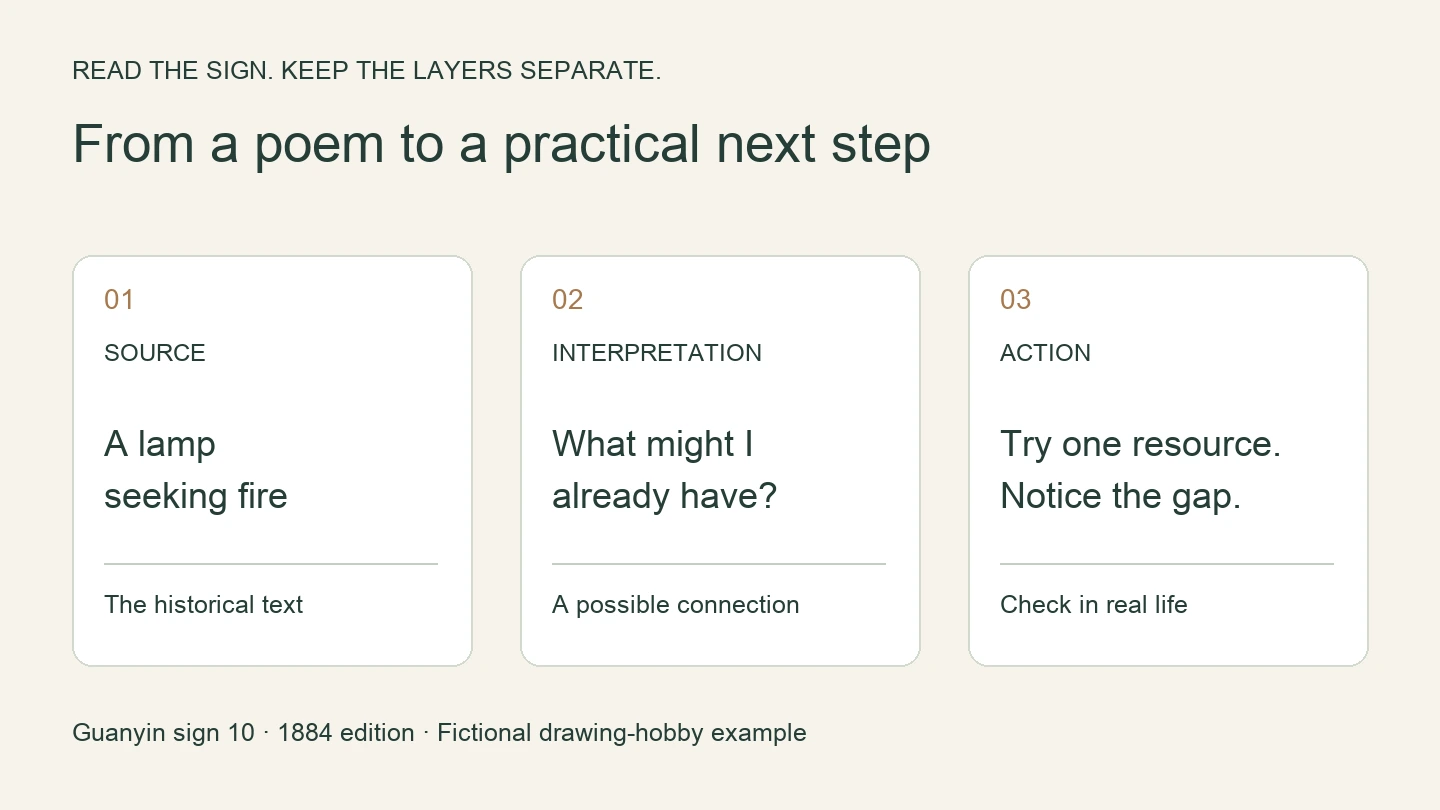
The poem puts something valuable nearby, then describes someone searching elsewhere. The lamp image sharpens that contrast: the seeker carries something associated with the fire being sought. The final line recommends quiet rather than further exhausting effort.
A compact reading of the movement is: look again at what is already available before extending the search. That is an interpretation of the images, not a hidden instruction to keep a particular job, stay in a relationship or refuse help. Nothing in the four lines identifies those things.
This distinction is especially useful with a striking metaphor. “Treasure” need not mean money. “Other lands” need not tell you whether to travel. First describe the contrast the poem creates; only then consider a possible connection with your situation.
Step 2: Read the grade alongside the text
“Strong caution” can sound frightening. It is a traditional category attached to this sign, not a measured probability of disaster. The verse itself directs attention to a potentially misplaced search. Reading only the grade would lose that specific idea.
The accompanying commentary also matters. In this printing, it returns to the lamp-seeking-fire image and ends with language about matters developing over time. Some earlier wording is compressed or uncertain, as Clarify's translation notes. The cautionary grade and that developing conclusion coexist; we should not erase one to produce a tidier message.
For this example, the useful question is “Where might extra searching be wasting effort?” It is not “What bad event is now destined to happen?” A favourable grade likewise would not establish that a plan will work.
Step 3: Return to one question
Fictional situation: Alex wants to restart sketching. They own an unused sketchbook, a pencil and a beginner lesson, but keep comparing courses. Their question is: “What should I pay attention to as I restart drawing this month?” No customer experience or actual generated reading is being reported.
If your own question is still too broad, use the examples in how to ask fortune sticks a clear question. Here, the question is already settled, so we can work on reading the response.
Connection Alex could make: “Perhaps I am looking for a better starting point while overlooking the materials and lesson I already have.” This connects the nearby treasure and distant search to known facts.
An alternative: “Perhaps I do need guidance, but comparing everything is tiring me out. I could ask one specific question of a teacher.” This also takes the final line seriously without declaring all outside help unnecessary.
What the poem cannot establish: It does not prove that the existing lesson is good, that Alex has exceptional talent, or that a new class would be a mistake. Those claims would need information beyond the verse.
Step 4: Turn the interpretation into a small test
Alex chooses a modest experiment: complete the first exercise in the existing lesson, using the materials already available, then note the precise point where help is needed. That choice comes from Alex's circumstances. The poem did not prescribe an exercise, a schedule or a purchase decision.
Afterwards, there are several possible outcomes. If the lesson is enough to begin, Alex can continue. If a technique remains confusing, Alex can seek targeted instruction. If the lesson is unsuitable, a different resource may be appropriate. The exercise is useful because real feedback can change the plan.
The final note might read: “The poem made me notice how much time I spend comparing resources. I will try what I have once, identify the gap, and decide what help to seek.” This preserves the insight while leaving the decision open to evidence.
A copyable reading note
- Source: Collection or temple, edition if known, number and opening line.
- Question: The exact question I brought to the reading.
- Literal scene: What happens in the poem, without mentioning my situation yet?
- Possible connection: Which known detail in my situation makes the image relevant?
- Alternative or limit: What else could it suggest, and what does it not establish?
- Next step: One practical action or piece of information I can check.
If you use an AI interpretation, compare its explanation with the quoted poem. An added sentence about your question is a new interpretation, not another line of the original. Check that it has not invented a deadline, another person's intention or a specific outcome.
Common questions about fortune-stick meanings
Does a bad fortune stick mean something bad will happen?
A cautionary grade does not establish a future event. Read the actual verse and its source notes. In this example, the image concerns searching while overlooking what is near, which is much more specific than “everything will go wrong.” If no connection fits your circumstances, leave it unresolved rather than manufacture a threat.
Can I turn the poem into a yes-or-no answer?
You can decide what to do after reflecting, but the verse does not provide a universal yes-or-no code. Sign 10 does not automatically mean “no.” A traditional ritual may have its own confirmation procedure; follow the relevant temple's guidance rather than borrowing a rule from a different system.
Why does the same number have another meaning online?
Check the collection and wording. The number alone does not identify an edition. Even when the Chinese text matches, translation choices and later explanations may differ. Compare the original verse before deciding which interpretation is relevant to your slip.
Should I draw again if I dislike the answer?
For personal reflection, a useful stopping point is to keep the first question and text together, write your response, and come back after something in the situation changes. This is an editorial suggestion, not a rule for every religious practice. Repeating until a pleasing answer appears makes it harder to notice what the first reading prompted you to consider.
Bring your own question to Ask a Sign
Open Ask a Sign by Clarify to explore Clarify's digital fortune-stick experience. Keep the source poem and the explanation for your question distinct, just as in this example. This guide does not promise a chosen sign or a lookup service for every temple's numbered slips.
If your question is about a recurring personal pattern rather than one situation, BaZi vs fortune sticks explains the difference between the two formats. You can then explore Clarify's personal readings if that approach matches what you want to understand.
Sources and example notes
The historical poem, grade and commentary were checked against the 1884 scan linked above, PDF page 5. The English lines follow Clarify's editorial translation; the Alex scenario and its practical steps were created for this article. The tourism-board source describes a temple practice and does not validate this hypothetical reading. Clarify's exercise is a modern reflective approach, not a statement of what every practitioner believes.