BaZi vs Fortune Sticks: What’s the Difference?
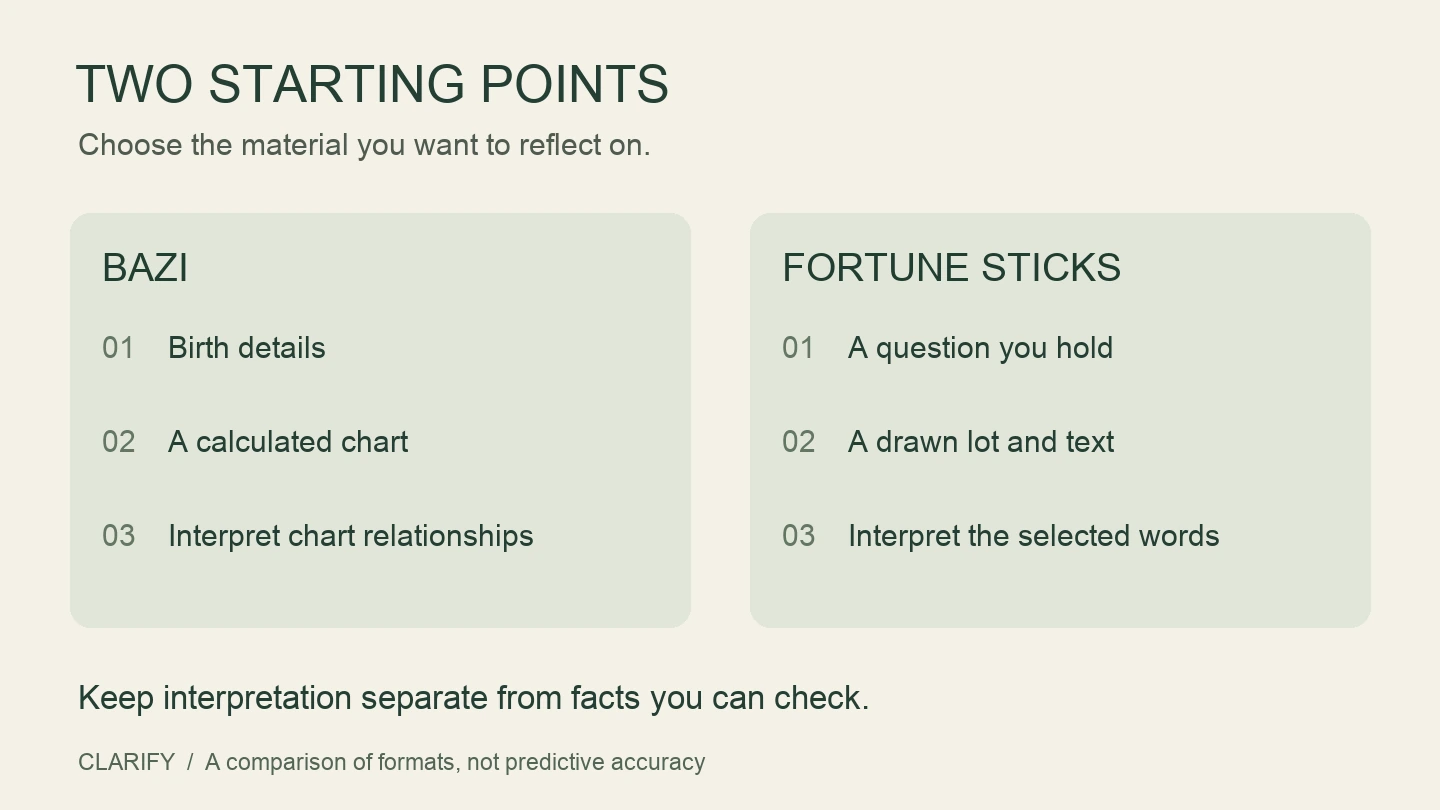
BaZi starts with a birth chart. Chinese fortune sticks, often called kau cim, start with a drawn lot and its associated text. Both involve interpretation, but they give you different material to interpret. A chart reading can support reflection on recurring themes; a stick reading can give you a symbolic prompt for a question you are holding now. Neither format establishes what will happen.
If you are deciding which to try, start with the question you want to explore. Below is a practical comparison, followed by one fictional situation written as two different reading briefs.
The main difference is what the reading starts from
In BaZi, or Four Pillars, the chart represents the year, month, day and, when known, hour of birth using pairs of traditional calendar symbols. The interpretation considers relationships within that chart. You are not drawing a new natal chart each time you ask another question.
For fortune sticks, a drawn number points to a corresponding saying or verse. For example, the Hong Kong Tourism Board’s description of Wong Tai Sin explains the use of numbered bamboo sticks and accompanying text, with interpretation available nearby. That is a description of one setting, not a universal procedure for every temple or online service.
Starting material
- BaZi: Birth details converted into a chart.
- Fortune sticks: A drawn lot and its associated text.
What you interpret
- BaZi: Relationships among chart symbols, sometimes with timing layers.
- Fortune sticks: Language and imagery in the selected text, considered with your question.
A useful focus
- BaZi: A recurring theme you want to examine across several experiences.
- Fortune sticks: One situation or uncertainty you want to reflect on.
What to check first
- BaZi: Input accuracy, missing details and calculation conventions.
- Fortune sticks: Which collection the text belongs to, its translation and the service’s procedure.
What it cannot settle
- BaZi: Whether an interpretation is true of your life merely because it fits the chart.
- Fortune sticks: Whether a future outcome will occur merely because a verse suggests it.
The suggested focus above is a way to choose a format, not a rule restricting every practitioner. A BaZi consultation may address a current situation; a fortune-stick interpretation may raise a long-standing theme. The underlying material is still different.
What information do you need?
For BaZi: check the birth inputs and the method
A full Four Pillars chart needs a birth time for its Hour Pillar. Services differ in how they handle unknown time and calendar boundaries, so ask what was actually used. Do not supply a guessed time just to make every field look complete.
In Clarify, birth date is required; birth time and place are optional. Without a known time, the Hour Pillar is omitted and the report states reduced precision. The methodology page explains how chart calculation is separated from the written interpretation. An explanation based on a partial chart should not quietly claim the detail of a complete one.
For fortune sticks: check the question and the text
Birth details are not the mechanism that selects a stick’s corresponding text. A practitioner or service may still request context. Follow the actual service’s instructions rather than assuming a universal ritual, number of sticks or question format.
Before treating a translation as a personalized answer, distinguish three things: the original saying, the translation, and the interpreter’s additional explanation. If a website adds advice, that advice is a further interpretive layer. It is not automatically part of the traditional verse.
One fictional situation, two useful reading briefs
Imagine someone considering a trial session with a local community choir. This is a made-up planning example. No real birth chart, customer story or supposedly drawn verse is involved.
Brief A: use a BaZi reading to examine a recurring theme
Question: “I often enjoy a new group for a few weeks, then find regular attendance difficult. Which part of this reading suggests a theme I could compare with those experiences?”
Context to bring: Two ordinary examples: one group you kept attending and one you left. Note concrete differences such as travel time, rehearsal frequency and how you felt about asking for help.
Useful follow-up: “Which chart detail supports that interpretation, and what experience would count against it?” This asks for an explanation you can examine. It does not ask the chart to prove whether you are a committed person.
Brief B: use a fortune-stick reading to reflect on one uncertainty
Question: “What assumption about trying this choir would be useful for me to reconsider?”
Context to hold: You are deciding whether to attend one introductory rehearsal, not making a promise to join indefinitely.
Useful follow-up: After reading the selected text, write its relevant image in your own words. Then ask: “What other interpretation is possible?” Do not invent a favorable verse in advance or treat repeated draws as a way to obtain permission.
The practical next step is the same
Check the actual rehearsal date, journey, accessibility and trial-session terms. A small next step could be contacting the organizer to confirm whether newcomers may observe before joining. Record that action separately from either symbolic interpretation.
A simple note might read: “The reading prompted me to think about consistency. The timetable shows weekly rehearsals. I will try one session before making a longer commitment.” This keeps the prompt, the verifiable fact and your own decision distinct.
What if a BaZi reading and a fortune stick disagree?
Do not turn the two readings into a vote. First identify what each statement refers to. A chart interpretation about a recurring habit and a verse that you connect with today’s hesitation are not necessarily answering the same question.
Write down the exact claim, its basis and its limits. If both readings are being used to predict the same event, neither resolves the disagreement simply by sounding more certain. Look at what you can directly check about the situation. Our guide to comparing conflicting BaZi readings offers a structured way to separate inputs from interpretations; a stick reading adds a different source text, not an extra birth-chart calculation.
Which Clarify entry fits your purpose?
If you want a birth-chart-based introduction, start with the Free Life Book. Your first complete eight-chapter report is free to read online, without an email, account, card or payment. It gives you written material to examine at your own pace; it does not verify future outcomes.
If you want to pause around one question, Ask a Sign is a separate Clarify experience. Its current public screen offers a question-led interaction with a sign box, including a typed-question option or holding your question silently. It is a digital experience, not a visit to Wong Tai Sin or a claim of temple endorsement.
You do not need to use both. Choose the format whose starting material interests you, and keep the decision itself grounded in the facts of your situation.
Common questions
Is BaZi the same as drawing a fortune stick?
No. BaZi uses a chart calculated from birth information. Fortune sticks use a drawn lot linked to a text. Calling both “fortune-telling” does not make their inputs or procedures interchangeable.
Does a more detailed BaZi report make it more accurate?
Detail can make an explanation easier to inspect. It does not, by itself, demonstrate predictive accuracy. This comparison does not rank either practice by success rate; no such measurement is provided here.
Can I try a reflective reading without knowing my birth time?
Clarify’s BaZi reading can begin with a date and explicitly omit the unknown Hour Pillar. Its Ask a Sign entry starts with a question. Those are different ways to begin, not equivalent substitutes for missing birth information.
Sources and scope
- Hong Kong Tourism Board: Wong Tai Sin cultural guide supports the local example of numbered sticks, corresponding text and interpretation.
- Clarify: What Is BaZi? explains Four Pillars terminology; Clarify Methodology documents this product’s calculation and interpretation boundaries.
- The Free Life Book page and Ask a Sign public entry support the product descriptions above, checked on 16 September 2026.
The comparison questions and choir example are editorial suggestions, not a traditional verse, a personalized reading or evidence of predictive performance. Religious meanings and local practices deserve their own context; this article focuses on helping a first-time reader distinguish the two formats.