I Ching vs Fortune Sticks: Hexagrams or a Poem?
The I Ching and Chinese fortune sticks use different kinds of results. An I Ching consultation produces a six-line hexagram, sometimes with changing lines. A fortune-stick consultation leads to a lot and its associated text in a particular collection. To read either carefully, keep the original result and identify the source before interpreting it.
If you are deciding which to try, start with what you want to engage with: a line-based reading from the Book of Changes, or a sign and poem within a fortune-stick tradition. Neither the number of possible results nor a more elaborate procedure establishes predictive accuracy. This guide compares the records you need and walks through a small example so the two systems are harder to mix up.
The central difference is the reading you take away
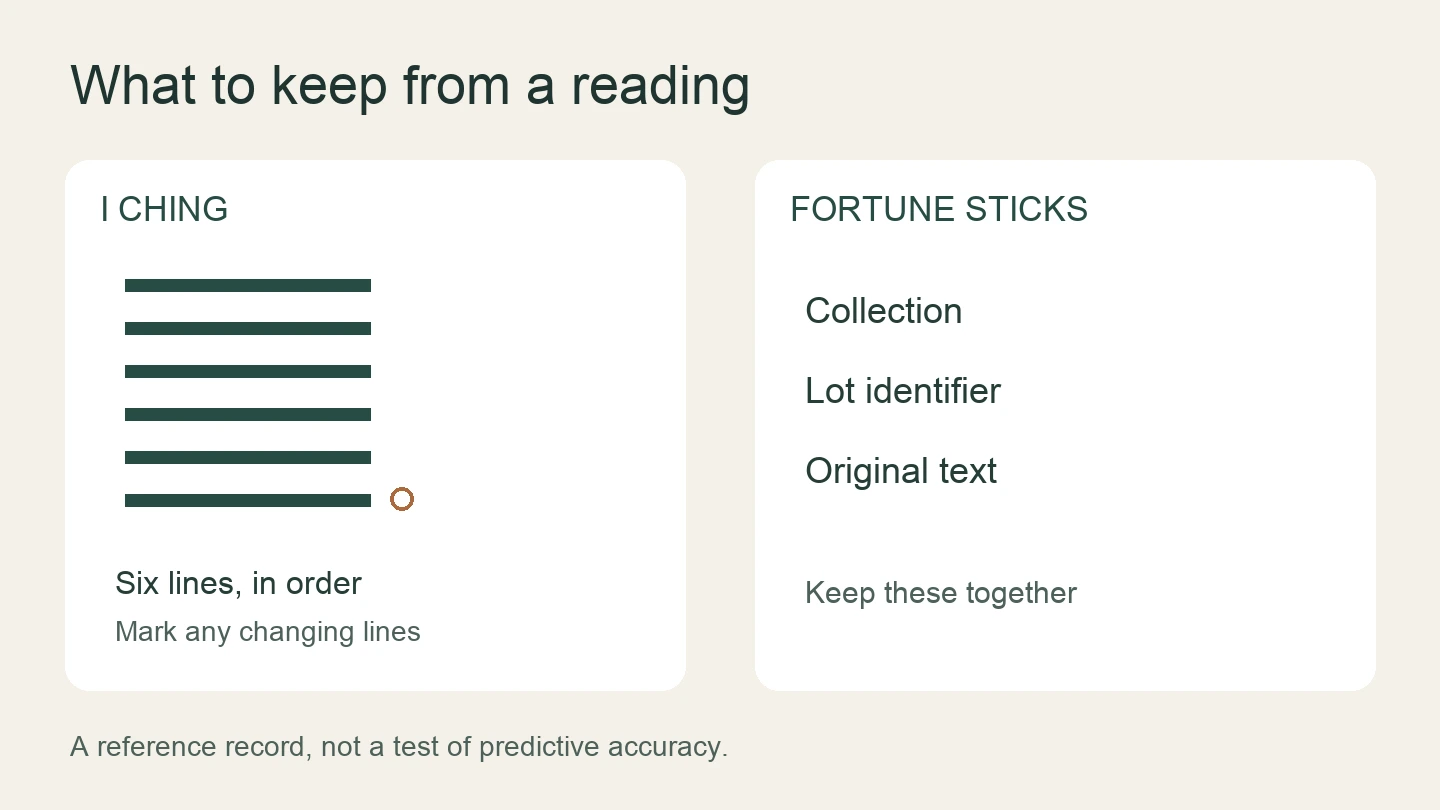
- I Ching: retain the six lines in their correct order, any marked changes, and the edition or translation used to read them. A single hexagram name can leave out part of the consultation.
- Fortune sticks: retain the lot identifier, collection or temple, and the actual text. A number without its collection is an incomplete reference.
For a concrete local practice, the Hong Kong Tourism Board describes people shaking a bamboo cylinder at Wong Tai Sin until a stick falls out, with interpretation offered by stalls. That is evidence about this temple's practice, not a rule for every temple or online service. See its Wong Tai Sin guide.
The difference is easy to lose when an app calls both outputs a “reading.” Look beneath that label. Does the result contain a six-line figure and marked line positions? Or does it identify a lot and present a poem? The format tells you which source to consult next; the marketing label alone may not.
A small I Ching example: why line order matters
Here is one three-coin convention: assign heads 3 and tails 2, add each toss of three coins, and place the six results from bottom to top. A total of 6 is broken and changing; 7 is solid and stable; 8 is broken and stable; 9 is solid and changing. Changing lines switch between solid and broken. These mechanics follow UAYA's published three-coin instructions; follow your chosen method's convention consistently.
Synthetic example, not a personal reading: the first toss is three heads, giving 3 + 3 + 3 = 9. Each remaining toss is one head and two tails, giving 3 + 2 + 2 = 7. The bottom-to-top record is therefore 9, 7, 7, 7, 7, 7: six solid lines, with only the bottom line marked to change. In the resulting figure, only that bottom line becomes broken.
Writing the first toss at the top would mark a different position. Adding all six values would give 44, but that sum is not a hexagram lookup rule. Preserve the ordered lines instead.
A digital tool may keep these details for you. For example, Eclectic Energies' own I Ching interface describes six virtual tosses and displays the hexagram and changing lines before showing the texts. This is an example of that service's interface, not a claim that every online oracle works this way. Its page also uses “Yijing,” another spelling of I Ching.
A fortune-stick example: why the collection matters
Imagine you saved a photograph of a fortune slip but typed only “number 12” into your notes. Later, a search returns several different poems. You cannot resolve the mismatch simply by choosing the interpretation you prefer.
A better record would say: “Lot 12, collection shown on the slip, photograph of the original text, translation source.” Here, 12 is an invented identifier for this filing example, not a quotation from a real collection or a reading of its meaning. The point is to preserve enough information to recover the same text.
Start with the name and wording printed on the slip. If the collection is unclear, retain that uncertainty rather than attach a poem from another source. Our worked fortune-stick reading guide explains how to move from the original text to a bounded interpretation.
This is a different task from reconstructing six coin tosses. A fortune-stick number does not become an I Ching result because both systems use numbers. Keep the two records separate even if you consult both about the same question.
Which fits the experience you want?
If you want to study a line-based text: choose an I Ching edition or service that explains how its result is formed and how it handles changing lines. Before a first consultation, check whether you can retrieve the original figure and distinguish the source text from added commentary. You do not need to decide in advance that a more detailed reading is a better prediction.
If you want to engage with a sign and poem: start with a clearly identified fortune-stick collection or experience. If you want a religious visit, the particular temple and its guidance matter. If you want a digital pause with a question, examine what the online service actually presents. The separate online-versus-temple comparison covers that choice.
If you already have a result: begin by recovering its source, not by starting a new consultation. A lost translation and an unanswered life question are different problems. A fresh result cannot identify the edition of the one you already hold.
If you need factual information: seek it directly. An unanswered message, an unclear contract term or a missing travel document needs an actual response or record. A symbolic reading can help frame a question, but it cannot supply another person's undisclosed intentions or verify an agreement.
Using the same question without turning it into a contest
Consider this fictional situation: you are planning a small exhibition and deciding whether to invite a collaborator. A useful starting question might be, “What should I pay attention to before proposing a shared exhibition?” It leaves room to reflect without pretending that the collaborator's answer is already known.
Whichever method you use, write three notes separately:
- The result: the exact figure and changes, or the identified lot and text.
- Your interpretation: for example, “I am reading this as a reminder to clarify responsibilities.” Label this as your application, not the collaborator's opinion.
- A checkable next step: ask about availability, propose a division of work and agree how costs would be shared.
If a second reading feels different, record the difference rather than hold a vote between oracles. “One said yes and one said no” can hide how much of each answer you supplied yourself. Return to the original wording, your interpretation and the information still missing.
A practical next step with Clarify
If the fortune-stick route suits you, open Ask a Sign on Clarify and bring one clear question. The coin example above is educational; it does not describe a Clarify I Ching feature. Keep your question and the result you receive together so you can revisit what you actually asked.
If you are instead interested in a birth-based personal framework, BaZi versus fortune sticks explains that separate choice. There is no need to combine every method into one reading. Choose the experience whose source and output you can understand, then connect your reflection to something you can do or verify.