How to Decide Between Two Good Options
When both options are genuinely workable, choose by comparing what each asks of your actual week, not by trying to prove that one is perfect. First check your non-negotiables. Then name the few differences that matter, test the biggest unknown, and choose a trade-off you can explain. A short comparison can help; a score is a record of your preferences, not a prediction.
This guide gives you an original worked example and a copyable decision sheet for an everyday choice. You can complete it without a reading or an account. If you want a reflective prompt afterward, there is an optional way to bring the unresolved question to Ask Clarify.
Check that both options really are available
Write each option as an action with a time frame: “Join the Tuesday photography group for four weeks” or “Take the Saturday photography course for four weeks.” That is more useful than comparing “community” with “learning,” because either activity might offer both.
Next write the conditions an option must meet. These are pass-or-fail requirements, not bonus points: an accessible venue, a schedule you can attend, a maximum commitment you can keep. An attractive feature cannot compensate for a requirement that makes participation impossible.
If neither option passes, change the question. Could you wait for another session, take a shorter introduction, or keep your current arrangement? Two appealing choices do not create an obligation to pick either one today.
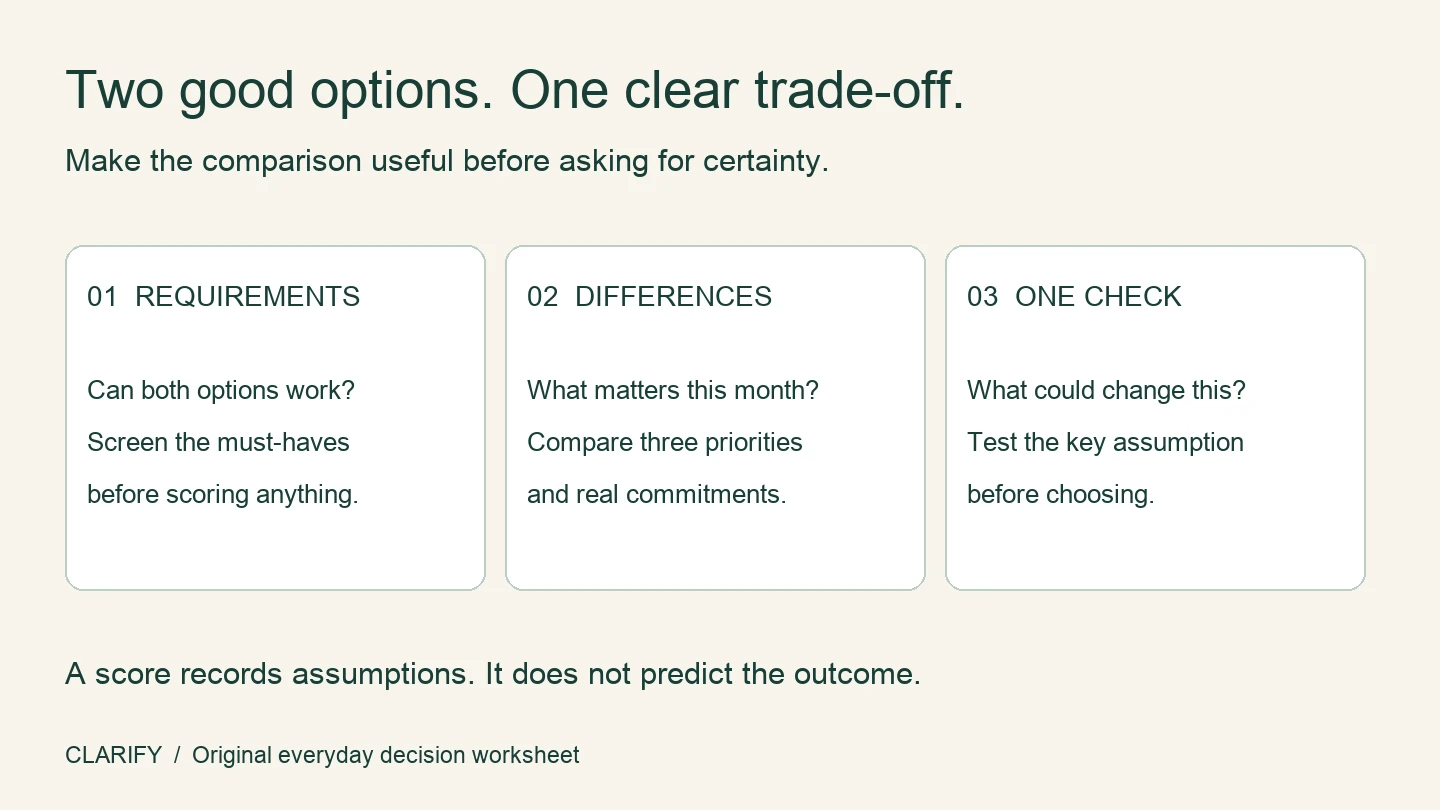
A worked example: two ways to spend the same free time
Fictional example: Jamie wants to spend the next month taking photographs with other people. Two beginner activities have places available. All details and ratings below are invented teaching material, not recommendations for real providers.
- Option A: a Tuesday group, four 90-minute sessions, with a 15-minute journey each way. Members practise together; the description does not promise individual tuition.
- Option B: a Saturday course, four 120-minute sessions, with a 30-minute journey each way. The advertised format includes instructor demonstrations and feedback.
Jamie can attend either schedule and has checked that both fit the amount set aside for the activity. The remaining question is how to use limited free time: an easy weekly social routine, or more structured instruction.
The time comparison is concrete:
- A: 4 × (90 + 15 + 15) = 480 minutes, or 8 hours across the month.
- B: 4 × (120 + 30 + 30) = 720 minutes, or 12 hours across the month.
- B uses 4 additional hours, assuming those journey times. Preparation and any optional practice are excluded.
Neither total decides the choice. Twelve hours may be worthwhile for structured teaching. Eight hours may fit Jamie's goal better if the priority is a routine that leaves time for other plans. “More time” needs a meaning before it becomes a reason for or against an option.
Compare three meaningful differences
A decision matrix puts options against the same criteria. ASQ's guide to decision matrices describes weighting criteria and cautions that the highest total need not determine the choice. Keep the scale consistent: a higher rating should always mean a better fit. The small example below is our own everyday application.
Jamie assigns importance before rating the activities: easy weekly fit gets 3, structured learning gets 2, and chances to talk with others gets 1. For this example, ratings mean 1 = weak fit, 2 = mixed fit, and 3 = strong fit. An unknown stays unknown; do not quietly turn it into a middling score.
- Weekly fit, importance 3: A rates 3; B rates 2. Jamie prefers to keep most Saturdays free, though either schedule is possible.
- Structured learning, importance 2: A rates 1; B rates 3, based on the advertised formats.
- Conversation, importance 1: A provisionally rates 3; B provisionally rates 2. These are expectations from the descriptions, not observations of a session.
Multiplying importance by fit gives A: (3 × 3) + (2 × 1) + (1 × 3) = 14. B: (3 × 2) + (2 × 3) + (1 × 2) = 14. The tie exposes the trade-off. It does not mean the options have identical value, a 50% success rate, or a mathematically correct winner.
If numbers feel artificial, use the same three rows with short explanations instead. “Easier to keep attending; less teaching” versus “More teaching; less free weekend time” may already say everything you need. Avoid counting several versions of the same advantage, such as short travel, convenient location and easy commute, as three independent benefits.
Test the assumption that could change your choice
Jamie has not attended either activity. The most useful next question is whether the Tuesday group actually leaves room for conversation. Jamie can check the session format with the organiser or observe a session if that is offered. This is a question about an available activity, not a request for certainty about future friendships.
If the group turns out to be mostly silent individual practice, Jamie's conversation rating for A might change from 3 to 1. Its total would become 9 + 2 + 1 = 12, while B remains 14 under the original assumptions. That single check matters more than adding another dozen speculative criteria.
Preferences can also change the result. Keeping the original ratings but making structured learning most important gives weights of 2 for weekly fit, 3 for learning and 1 for conversation. Then A totals 6 + 3 + 3 = 12; B totals 4 + 9 + 2 = 15. Nothing about the activities changed. Jamie answered a different question about what matters most.
Do not keep changing weights until your preferred option wins. If you dislike the result, write the missing reason in plain language. Perhaps you want unstructured time more than you initially admitted. That is useful information about your preference; it does not need to be disguised as an objective calculation.
If both still look good, choose a manageable commitment
Check what can actually be changed after choosing. Is there a single-session option? Can you switch dates? Is a full month required? A trial is useful only if it is really available and its terms work for you. Do not assume a cancellation, refund or transfer policy.
Jamie might choose A because maintaining a social routine matters more this month, while accepting that it offers less instruction. Another person could reasonably choose B for its teaching. A complete decision sentence names both the benefit and the cost: “I choose A for the easier weekly rhythm, and I accept less structured feedback.”
Use a real booking deadline if there is one. Otherwise choose a practical point to stop comparing, proportionate to the choice. Reopen the decision when a relevant fact changes, rather than treating every passing doubt as new evidence.
Copy this two-option decision sheet
- My choice: A is ___. B is ___. I am choosing for the period ___.
- Must-haves: The conditions both need to meet are ___. A passes / fails / unknown. B passes / fails / unknown.
- Three differences that matter: ___, ___ and ___. The most important one for me now is ___.
- Actual demands: A requires ___ time and commitments. B requires ___. My estimates exclude ___.
- One uncertain detail: I am assuming ___. I can check it by ___ before ___.
- My accepted trade-off: I choose ___ because ___, while accepting ___.
- What would justify reconsidering: A new fact or practical checkpoint would be ___.
This is a personal note you can keep in a notebook or document. It is not a built-in Clarify comparison feature. For an employment choice, MIT's choosing-between-offers worksheet provides a career-specific comparison of personally weighted factors. Our career reading worksheet instead explains how to keep reflection separate from verified job information.
Use Ask for the unresolved reflection, if it helps
After the practical comparison, you may still be unsure which value you want to prioritise. You can open Ask Clarify and choose “Type your question.” A focused prompt might be: “What am I overlooking about the trade-off between an easy routine and more structured learning?”
Keep factual questions with the people who can answer them: a reading cannot establish a class format, create a free place or change a booking deadline. Treat its response as material for your own reflection. It is not evidence that one option will succeed, and you do not need a sign's permission to decide.
For more help with wording, see how to frame a question for a reading. If you already have a reading and want to record what follows, the fortune sticks journal separates your first interpretation from the later outcome. You can also finish the decision sheet and stop there.
Sources and scope
The ASQ resource supports the brief explanation of a weighted comparison; MIT provides a separate employment worksheet. Neither source endorses Clarify or divination. Jamie's activities, arithmetic, ratings, sensitivity checks, diagram and seven-field sheet are original editorial examples. This guide addresses ordinary personal choices, not specialist medical, legal or financial decisions, and makes no claim that scoring or a reading guarantees a better outcome.