Fortune Sticks for Career: A Job Decision Worksheet
You can bring a career question to a fortune-stick reading, but a drawn sign cannot verify an offer, reveal a manager's intentions or choose a job for you. A useful approach is to name one decision, separate confirmed facts from unknowns, then use the reading to examine what deserves attention before you act.
This guide takes that approach through a fictional job offer, a promotion conversation and a small project decision. The worksheet and examples are modern reflection tools created for this article. They are not traditional rules, predictions or a career assessment.
What does a career fortune-stick reading involve?
Chinese fortune sticks are also called kau cim. In its account of Wong Tai Sin Temple, the Hong Kong Tourism Board describes drawing a stick from a bamboo cylinder and seeking an interpretation. That describes a cultural practice; it does not establish that a sign can predict recruitment results.
If you already have a numbered poem, first identify its collection and actual text. The same number is not a universal message across different sets. Our worked example of reading a Chinese fortune stick explains how to distinguish the poem, its interpretation and your own application.
For a work decision, add another distinction: an image in the poem is material for reflection, while the offer, deadline and employer's answers are evidence about the job. Keep both visible without treating them as interchangeable.
Frame the decision before you draw
Start with a short sentence you could also explain to someone unfamiliar with fortune sticks:
I am deciding whether to accept this role by Friday. The main uncertainty is whether its on-site schedule fits the time I can give it.
Then turn the uncertainty into a question about your approach:
What should I examine about the everyday demands of this role before deciding whether to accept it?
This is more usable than asking whether your entire career will be lucky. It also leaves room for an answer you had not hoped for: perhaps the issue is missing information, rather than courage or timing. For the basic wording principles, see how to ask fortune sticks a question.
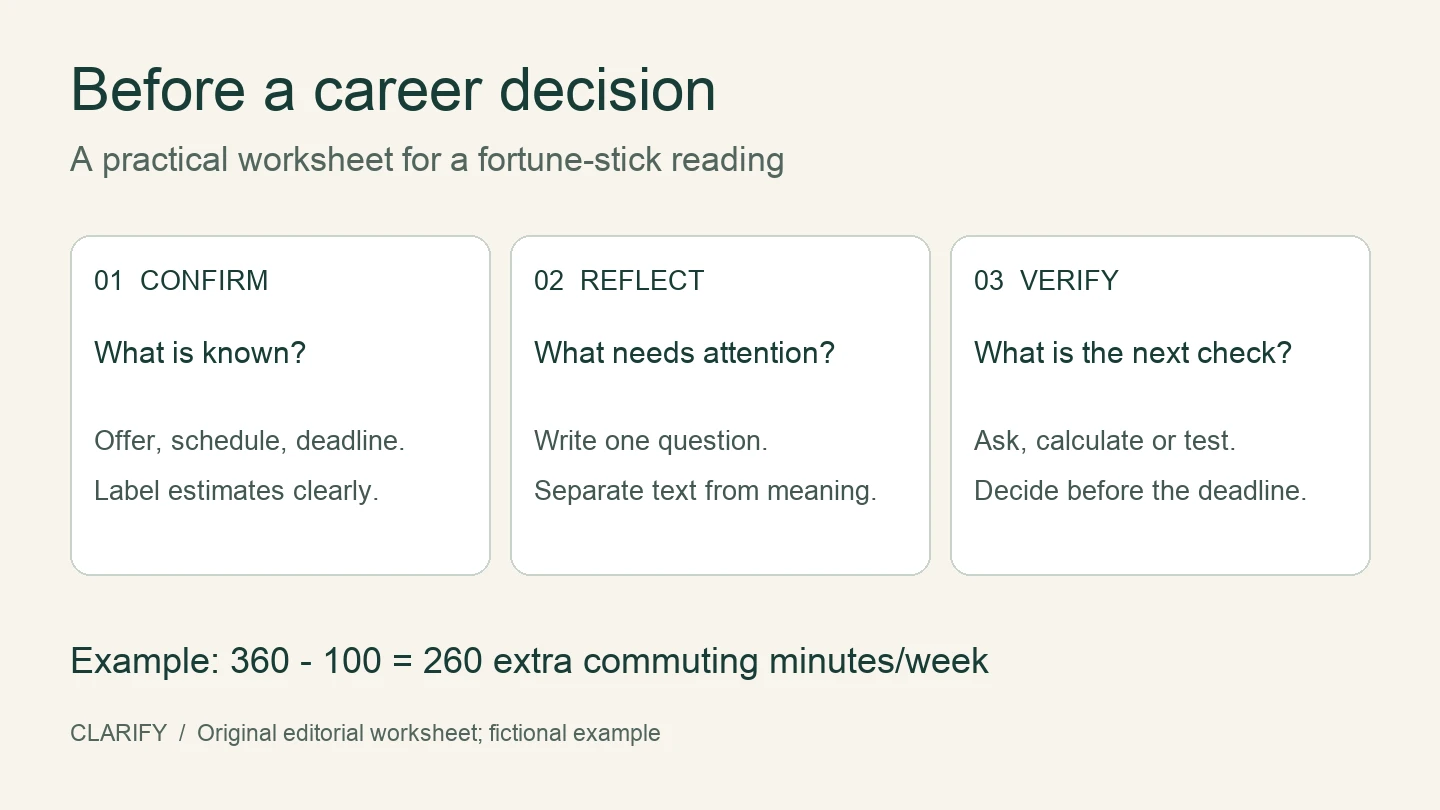
Worked example: a new role with a longer commute
Imagine Sam has a written offer for a role that sounds more interesting. Sam currently travels to the office two days a week, with a 25-minute journey each way. The new role requires four office days, with an estimated 45-minute journey each way. The offer expires on Friday. All names, figures and circumstances here are invented.
Before drawing, Sam writes three separate notes:
- Confirmed: the stated office-day requirement and offer deadline.
- Estimated: the new journey time, which has not yet been tried during the morning rush.
- Unknown: whether office days can be fixed, and how often late meetings occur.
A simple calculation makes one trade-off concrete:
- Current weekly commuting time: 25 minutes × 2 journeys × 2 office days = 100 minutes.
- Possible new weekly commuting time: 45 minutes × 2 journeys × 4 office days = 360 minutes.
- Difference: 360 − 100 = 260 minutes, or 4 hours 20 minutes each week.
This calculation uses the stated assumptions. It excludes delays, lunch arrangements and work done at home; it is not a complete comparison of the two jobs. Its purpose is to reveal a question Sam can investigate instead of leaving “longer commute” as a vague worry.
CareerOneStop's offer-evaluation guidance recommends examining responsibilities, schedule, commuting and other conditions when judging an offer. That practical guidance supports checking the real arrangement. It does not endorse fortune telling.
How could a reading help Sam reflect?
Suppose Sam notices an image of preparation in the poem they receive. This is a hypothetical reading response, not a quotation or meaning assigned to a particular numbered lot. Sam might ask: “Am I ready for the actual weekly routine, or only attracted to the role's title?”
The next step is specific: ask the recruiter whether the four office days are fixed, then test the journey at the relevant time. If the journey takes an hour instead of 45 minutes, the weekly estimate changes to 60 × 2 × 4 = 480 minutes. Compared with the current 100 minutes, that is an additional 6 hours 20 minutes.
Nothing about the drawn sign decides whether that trade-off is worthwhile. Sam may value the work enough to accept it, or decide the routine would conflict with other commitments. The useful output is a clearer comparison based on checked information.
If the poem seems to encourage patience, Sam should not infer that the Friday deadline has disappeared. Sam can ask whether an extension is available; only the employer's response establishes that. A reading does not change an agreement or create more decision time.
Two other career questions, with different next steps
“Will I get promoted?”
You may want certainty about a manager's decision. A sign cannot supply it. A question you can work with is: “What should I prepare before discussing progression at my next review?”
In a fictional example, Alex has taken on extra coordination work but has never asked what the next role requires. Alex's reflection might concern recognition, confidence or readiness. The practical step is to collect two examples of that work and ask the manager what criteria, evidence and review process apply. The response may expose a gap between doing more tasks and meeting the requirements of the next role.
Keep “I feel ready” separate from “my manager confirmed I meet the criteria.” Neither a favorable grade nor a discouraging poem tells you which of those statements is true.
“Should I take on this extra project?”
Try: “What am I overlooking about the capacity needed for this project?” Unlike an offer decision, this may allow a limited experiment.
Suppose Jo has three genuinely unallocated work hours each week, while a project is estimated to need five. The initial gap is two hours a week. Before agreeing to the full scope, Jo could ask which existing work would be removed, whether the scope can be reduced, or whether a short trial is possible. These are options to discuss, not arrangements a reading can authorize.
If the poem brings up persistence, that does not add two hours to the week. Jo can reflect on willingness to learn while still checking whether the workload is feasible. Record the actual agreement before treating the capacity problem as resolved.
Copy this career decision worksheet
Use one sheet for one decision. Leave unknowns blank or label them unknown; do not fill them with what you hope the sign means.
- Decision and deadline: What choice is available, and who set the response date?
- Available options: What can you actually choose today? An imagined offer is not an available offer.
- Facts and assumptions: Which details are confirmed, estimated or missing?
- Your priorities: Which conditions matter most to you, and which would make the option unworkable?
- Reading: Record the collection, number and relevant text if available. Keep your personal interpretation in a separate sentence.
- Next check: What information, conversation or small test would help before the deadline?
- Decision and review: What did you choose, why, and what new fact would lead you to reconsider?
Sam's completed next-check line could be: “By Wednesday, confirm the office-day arrangement and test the journey. Recalculate the weekly time before deciding on Friday.” It is useful even if the poem remains ambiguous.
Common questions about career fortune sticks
Does a bad sign mean I should reject a job?
A negative label does not establish that the employer is unsafe or that the job will fail. Read the full text in its own collection, notice the concern it brings up, and check that concern against actual information. Do not turn an interpretation into an allegation about a company or person.
Can I ask a yes-or-no career question?
You can phrase a question that way, but it can hide the trade-off you need to examine. “Should I accept?” becomes more useful when you also write what acceptance requires, what remains uncertain and when you must respond. A yes-or-no reading cannot verify those details.
What if I do not have an offer yet?
Focus on the action currently available: preparing an application, requesting information or choosing which skills to practice. “What should I improve before this interview?” gives you something to examine. “When will they hire me?” asks for a date the reading cannot establish.
Should I draw again if I am still unsure?
First identify what is missing. If it is an answer from the employer, another draw will not provide that answer. Save your original question and notes, then do the next check. This is a practical suggestion for this worksheet, not a universal temple rule about how often to consult.
Bring one concrete question to Ask a Sign
Once you have named the decision, you can open Ask a Sign by Clarify and choose “Type your question.” Keep it focused on the situation and your own approach; company secrets, colleagues' names and private documents are unnecessary.
Use your worksheet after the reading to record what it prompted you to consider. If your interest shifts from this one decision to a broader traditional self-understanding framework, you can explore Clarify's personal readings. A BaZi reading is a different experience; it does not confirm an offer, predict a hiring result or replace the factual checks above.