Fortune Sticks Journal: A Record You Can Review Later
A useful fortune sticks journal keeps two dated entries: what you asked and understood at the time, then what actually happened when you returned to it. Save the received text separately from your interpretation. Record a concrete next step, choose a review date, and leave the first entry unchanged. A later event should not quietly rewrite an earlier reading.
This guide provides a copyable journal and a complete fictional follow-up. It is for someone who already has a reading and wants to learn from the experience. For help understanding the verse itself, start with our worked fortune-stick reading. The task here is different: preserve your first impression, check your action, and decide what remains unresolved.
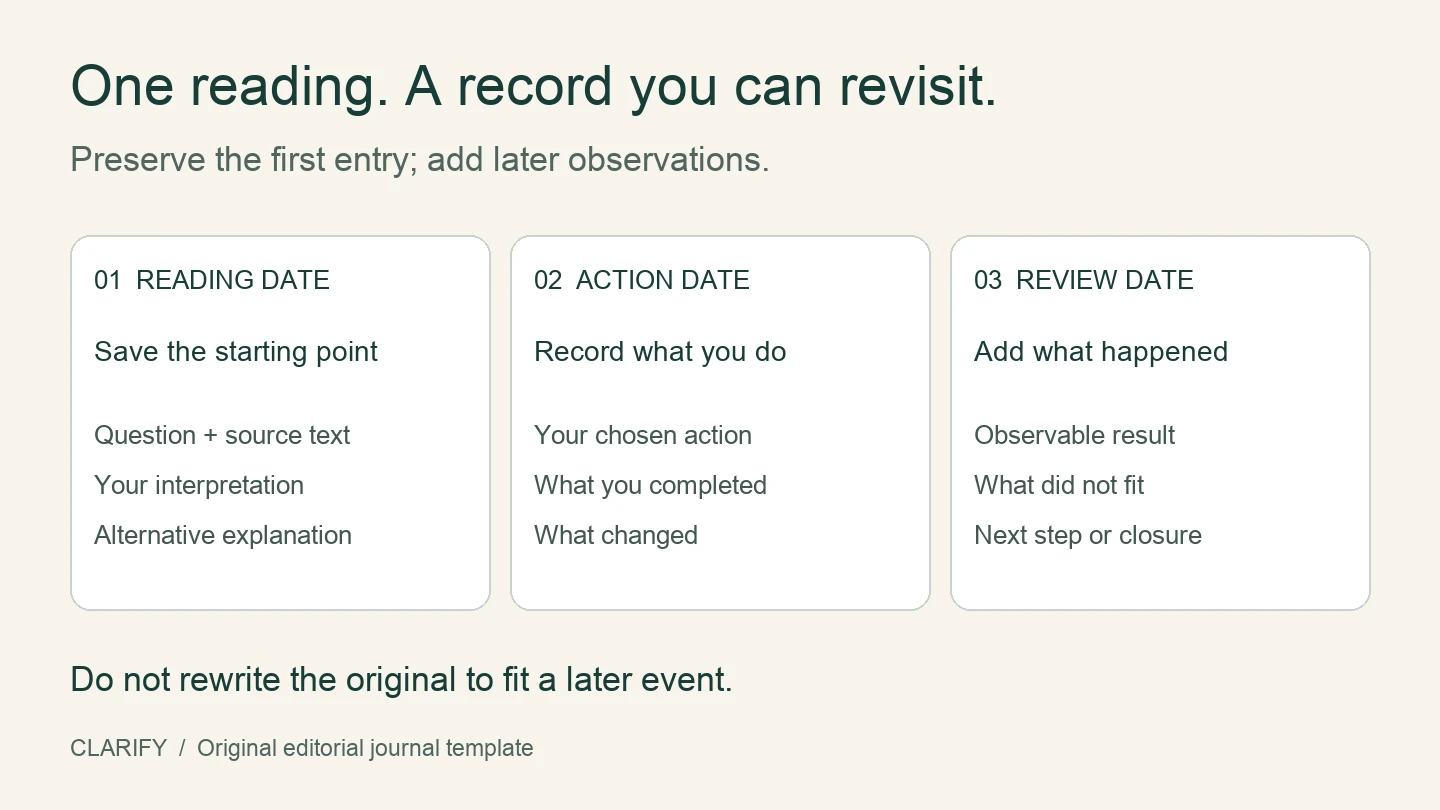
Keep the received text and your own explanation apart
Begin with enough information to identify the reading: the date, collection or service, number if supplied, and the words you received. If you have a paper slip, keep it with your note. The Hong Kong Tourism Board's description of Wong Tai Sin Temple distinguishes the drawn stick from the interpretation offered by fortune-telling stall owners. Your journal can preserve that same practical distinction between an item received and a person's explanation of it.
Use separate headings for the source text, translation and added explanation. If an explanation came from an AI service, label it that way; if you wrote it yourself, say so. Do not fill a missing collection name or original verse from memory. Write “source not identified” or “original wording not saved” so the gap remains visible.
You can keep this record in a notebook or a document you control. This guide does not require a Clarify journal, export function or account feature. Store only the context you need. Initials or a general description are usually enough for a personal example involving someone else.
A copyable template with two dates
The first entry is a record of your starting point. Complete it before the relevant outcome is known. The second is a separate review, rather than an edited replacement.
Entry A: at the time of the reading
- Reading date and question: Copy your question exactly. If it was unspoken, write the wording you remember and label it a reconstruction.
- Source record: Collection or provider, number, original text, translation and any added explanation. Identify each layer.
- Known facts: What could you already verify before the reading?
- My interpretation: One sentence describing the connection you made. Add one alternative explanation or reason it may not fit.
- My action: One thing you choose to do or check. Describe what completing it would look like.
- Review date or event: Choose a practical checkpoint, such as after the first class or after receiving a reply. This is your schedule, not a date predicted by the sign.
Entry B: at the review
- Review date: When are you looking back?
- Action completed: What did you actually do? Include changed or abandoned plans.
- Observed result: What happened, and what supports that description?
- What did not fit: Keep contradictions, missing information and uncertain connections.
- What I learned: Did the exercise help you identify a question, seek a fact or change a habit?
- Next step or closure: Continue, change the plan or close the entry. Another draw is optional, not a required review step.
If you discover an error in Entry A, add a dated correction. For example: “I wrote Tuesday, but the class confirmation says Thursday.” Preserve the original mistake alongside the correction. That makes the sequence understandable later.
A complete example: returning to a drawing practice
Fictional teaching example: Sam has a sketchbook and a beginner lesson but has not used either recently. This is an invented journal, not a customer story or a real generated reading. No authentic fortune-stick poem or number is invented for it.
Entry A, October 8
Question: “What should I pay attention to as I restart drawing this week?”
Source record: For this example, assume Sam has saved the received text privately. We do not reproduce or assign a traditional verse. The theme Sam takes from the experience is “make use of what is already available.” That sentence is Sam's summary, not a quotation from a sign.
Known facts: Sam already owns the materials and a lesson. The first exercise takes roughly twenty minutes according to its instructions. There are three free evenings before the chosen review date.
Interpretation: “I may be delaying practice while searching for better supplies.” Alternative: the supplies may be adequate, but the lesson might still be too difficult. The reading alone cannot decide between these explanations.
Action: Try three twenty-minute sessions using the existing materials. After each session, note whether the exercise was finished and where help was needed. Three sessions would be 3 × 20 = 60 minutes of planned practice. That is a plan Sam made, not a number obtained from the reading.
Review: Return to this entry on October 15, after the three available evenings have passed. Success for the action means attempting those sessions and identifying a specific obstacle; it does not mean producing beautiful work or proving the reading true.
Entry B, October 15
Action completed: Sam practised twice for twenty minutes, so 2 × 20 = 40 minutes were completed, compared with 60 planned. The third evening was used for another commitment. Two sessions out of three is about 67% of the session plan, not a divination accuracy score.
Observed result: Both sessions used the original pencil and sketchbook. Sam finished the first exercise but struggled with perspective in the second. The evidence is the two dated sketches and the unfinished exercise.
What did not fit: Using existing supplies was possible, but supplies were not the whole obstacle. The lesson needed more explanation. The missed evening also shows a scheduling issue that Sam's original interpretation did not mention.
Learning and next step: “Starting helped me find the actual difficulty. I will ask a specific question about perspective and plan one shorter session.” Sam keeps the original interpretation intact. The review neither turns the missed session into a secret prediction nor claims that two sketches validate fortune telling.
Review usefulness without inventing an accuracy score
There are several different questions you might ask of an entry. Did you preserve the text correctly? Did you complete the action? Did the reflection help you identify something useful? Did a precise prediction match an outcome? Those questions require different evidence and should not be collapsed into a single “right” or “wrong.”
An interpretation such as “be patient” has no defined event or time limit. You cannot fairly count it as a successful forecast merely because something later took time. Mark it as a broad reflection. A personal journal of flexible interpretations does not establish predictive reliability.
One reason to retain the earlier wording is illustrated by Jeffrey Rudski's 2002 study of hindsight and confirmation biases. In an exercise involving 48 students and supposed telepathy, responses recorded before feedback differed from judgments recorded after the answer was revealed. This was not a study of fortune sticks or a test of this journal. It supports a narrower caution about judging a prior impression after learning an outcome.
The two-entry method here is an editorial recordkeeping suggestion. It is not a traditional ritual requirement, a validated psychological treatment or evidence that writing changes the accuracy of a draw.
When the result is unclear, close the gap honestly
The event has not happened: Write “not yet observable.” If you choose another review date, keep the original date and explain the practical reason. Do not continually move a prediction's deadline until something fits.
Your circumstances changed: Record the change. A cancelled class or a different question may make the original action irrelevant. You can close that entry without forcing a verdict.
You see no useful connection: Say so. Retaining an unhelpful reading is more informative than keeping only the examples that felt meaningful. A blank conclusion does not require a replacement draw.
You drew again: Give the second draw its own date and question, linked to the first entry. Do not replace the earlier text with the answer you prefer. For the initial wording, use the question-writing guide.
Start with one reading, then return to your own notes
If you want a new digital reading, you can visit Ask Clarify. Keep a record of the text you actually receive and add your own interpretation separately. This worksheet also works with a reading you already have; there is no need to draw again to start a journal.
For an ongoing personal pattern rather than one immediate question, the existing BaZi and fortune sticks comparison explains the different starting points. Choose the next step that fits your question. A completed journal entry can also simply be the end of the exercise.
Sources and scope
The tourism source supports the brief description of the Wong Tai Sin practice. The linked research abstract supports the limited discussion of recording responses before feedback; no claim about fortune-stick efficacy is drawn from it. The worksheet, dates, diagram and Sam example are original editorial teaching aids. This article does not describe a built-in product journal, report a customer outcome or promise a better prediction.