The simple definition
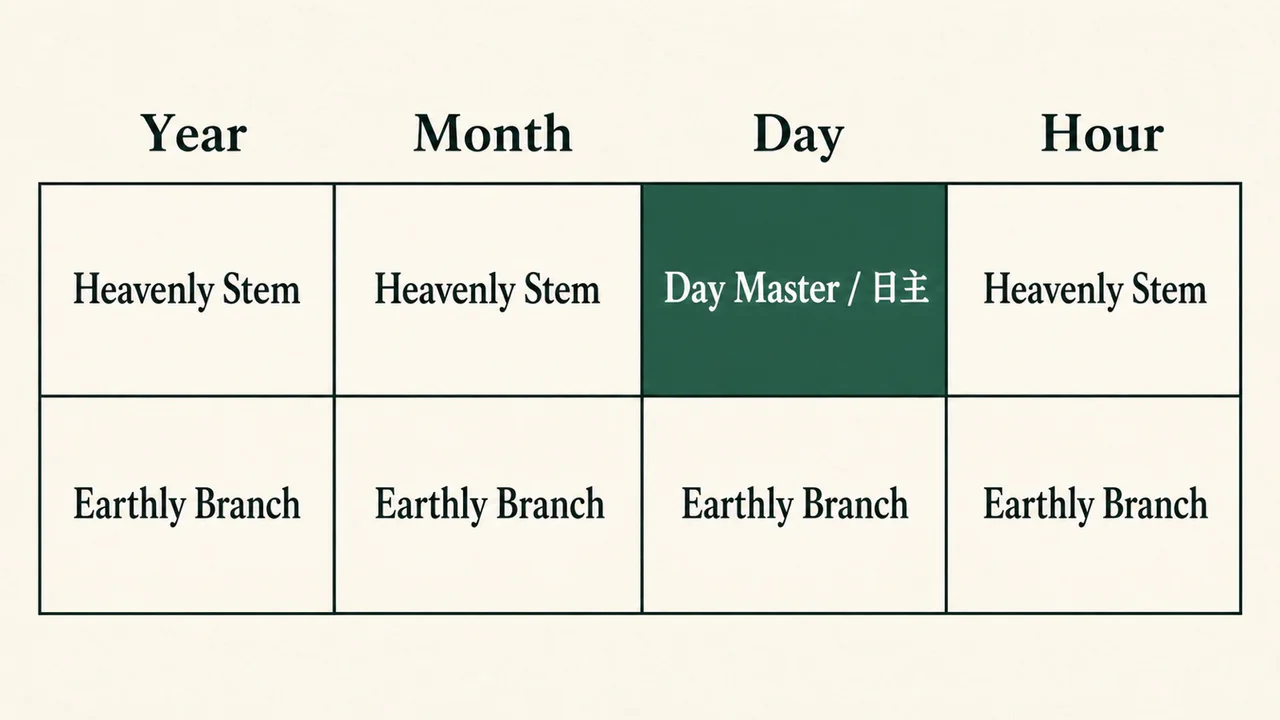
The Day Master is the Heavenly Stem of the Day Pillar in a BaZi chart. Within traditional BaZi practice, it becomes the reference point used to describe relationships among the chart’s other stems, branches and elements. This is a traditional interpretive convention, not a scientific classification.
BaZi is often translated as “Eight Characters.” A traditional chart records the year, month, day and hour using one Heavenly Stem and one Earthly Branch for each pillar. Four pairs produce eight characters. The Hong Kong Observatory documents the stem-and-branch cycle as a system used to designate years, months, days and hours.
The Day Pillar contains two characters. Its upper character is the Heavenly Stem; that character is the Day Master. Professional BaZi teaching materials published by Joey Yap Research International identify the same location as the Day Master or Day Stem. Because the ten Heavenly Stems combine five elements with yin and yang qualities, there are ten possible Day Master types.
How to find your Day Master
- Generate your BaZi chart. Use a calculator that asks for your birth details and explains its time and calendar rules.
- Find the Day Pillar. In a four-column chart it is usually labelled Day.
- Read the Heavenly Stem at the top. The upper character in that Day column is your Day Master.
- Check the element and polarity. Match that stem to the ten-stem table below.
Why the chart inputs matter
- Birth date: establishes the calendar day used to calculate the Day Pillar and its Heavenly Stem.
- Birth time: supplies the Hour Pillar for a complete chart. It can also help resolve births close to the calculator’s change-of-day boundary.
- Local time: keeps the recorded birth moment tied to the place and civil date where it occurred; a calculator should state how it handles time zones or local solar-time adjustments.
- Calendar boundaries: day transitions and solar-term boundaries can affect pillar calculations, so the calculator’s convention should be visible rather than assumed.
Your zodiac animal alone cannot reveal your Day Master. The zodiac animal is associated with the birth year’s Earthly Branch, while the Day Master comes from the birth day’s Heavenly Stem.
The ten Day Master types
The names below are transliterations of the ten Heavenly Stems. The element and polarity grouping belongs to the traditional correspondence system.
| Stem | Element | Quality |
|---|---|---|
| Jia 甲 | Wood | Yang |
| Yi 乙 | Wood | Yin |
| Bing 丙 | Fire | Yang |
| Ding 丁 | Fire | Yin |
| Wu 戊 | Earth | Yang |
| Ji 己 | Earth | Yin |
| Geng 庚 | Metal | Yang |
| Xin 辛 | Metal | Yin |
| Ren 壬 | Water | Yang |
| Gui 癸 | Water | Yin |
A useful reading does not stop at the Day Master name. It considers season, the balance of the full chart and the relationships among all eight characters. Two people with the same Day Master can therefore receive very different traditional interpretations.
Day Master vs Chinese zodiac animal
Your zodiac animal is linked to the Earthly Branch of your birth year. Your Day Master comes from the Heavenly Stem of your birth day. They are different parts of the same broader calendrical tradition.
This is why knowing only your zodiac animal is not enough to identify your Day Master. Finding the Day Master requires the calculated Day Pillar, not a lookup based on the year animal.
Common questions
Do I need my birth time to find my Day Master?
Usually, the birth date is enough to identify the Day Stem when the local date is unambiguous. The birth time is still needed for the Hour Pillar and is useful near a change-of-day boundary, so include it when you know it and use a calculator that explains its convention.
Can two people have the same Day Master but be very different?
Yes. There are only ten Day Masters, while a full BaZi chart also includes the other stems and branches, season and their relationships. The shared Day Master is one reference point, not a complete personality profile.
Is the Day Master the same as my Chinese zodiac sign?
No. The Day Master is the Heavenly Stem of the Day Pillar. The familiar zodiac animal comes from an Earthly Branch associated with the birth year, so one cannot be substituted for the other.
What a Day Master can—and cannot—tell you
Used carefully, the Day Master can provide a consistent lens for reflection: how a traditional reading organizes the chart around one point of view, and how the same symbol can be described differently in a different chart. It is most useful when the interpretation connects the full chart to choices you can actually examine.
A reflection framework, not a verdict
BaZi is a traditional interpretive practice, not a scientific diagnostic tool. A reading should not decide your identity, guarantee an outcome, or replace medical, legal, financial or mental-health advice.
Clarify uses this framework to organize a personal reading into plain-language themes. To see how the reference point connects to the rest of the chart, continue with the Five Elements, the Ten Gods, and Day Master strength and balance. Treat the result as a prompt for noticing patterns and planning—not as permission to hand your decisions to a chart.
Try it with your own chart
See your Day Master in context.
Get a free personal Reading and complete eight-chapter Life Book. You can begin without an email address or card.
See my free personal ReadingSources and further reading
- Joey Yap Research International: The Basics of BaZi & Ten Day Masters
- Shelly Wu, The Definitive Book of Chinese Astrology, Red Wheel/Weiser
- Hong Kong Observatory: Heavenly Stems and Earthly Branches
- Hong Kong Observatory: The 24 Solar Terms
- Hong Kong Observatory: The 12-Year Animal Cycle
- Kenyon College: The Ten Heavenly Stems and Twelve Earthly Branches