BaZi foundations
What Are the Five Elements in BaZi?
The Five Elements are best understood as five traditional phases in relationship—not as substances, personality boxes or a shopping list of cures.
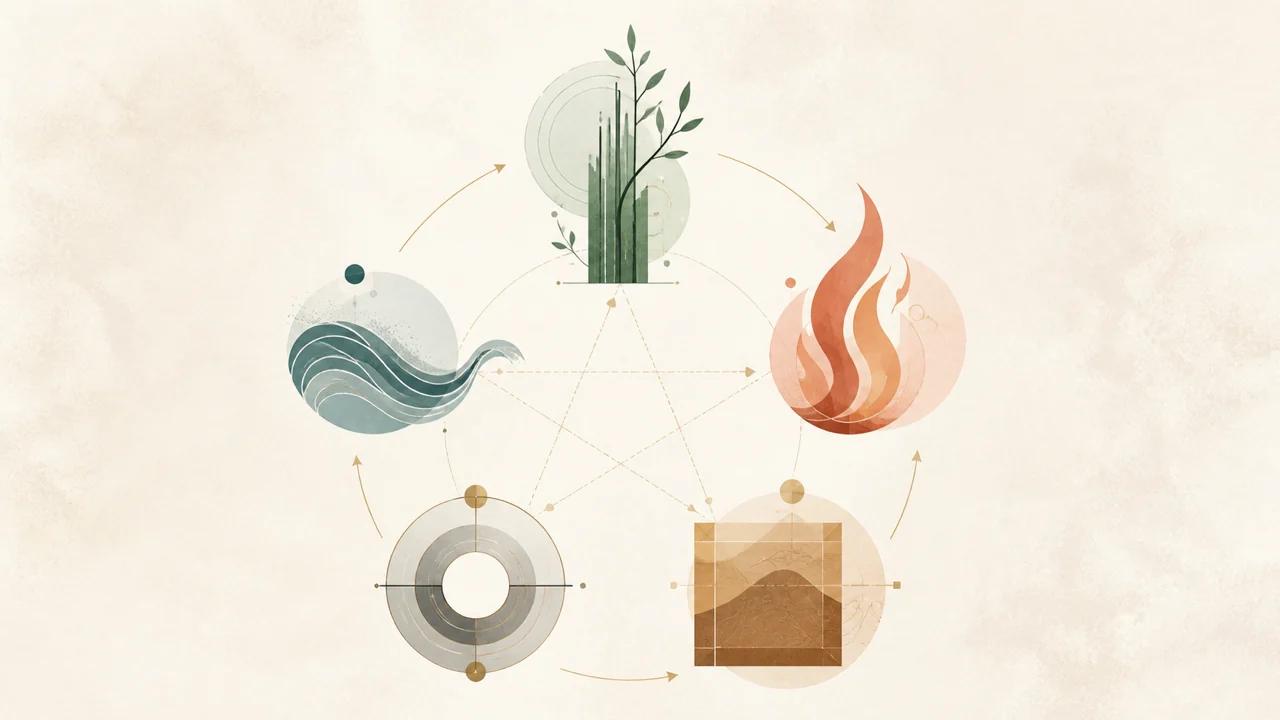
The short answer
In BaZi, Wood, Fire, Earth, Metal and Water are symbolic categories used to describe change and relationship. Each Heavenly Stem and Earthly Branch is associated with one of these phases. Practitioners compare how the phases generate, control and balance one another within the full chart.
The Chinese term Wu Xing is frequently translated as “Five Elements.” Academic references note that “Five Phases” or “Five Processes” better conveys its dynamic character. That distinction helps prevent a common mistake: treating Wood, Fire, Earth, Metal and Water as literal materials inside a person.
The five phases at a glance
| Phase | Traditional image | Useful plain-English cue |
|---|---|---|
| Wood | Growth and extension | Initiating, developing, reaching |
| Fire | Heat and rising activity | Expressing, illuminating, accelerating |
| Earth | Ground and transformation | Holding, integrating, stabilizing |
| Metal | Consolidation and form | Refining, defining, separating |
| Water | Flow and storage | Adapting, gathering, descending |
These cues summarize common traditional imagery. They are not psychological test results. A person with a Wood Day Master is not automatically “creative,” and a chart with prominent Metal does not diagnose rigid behavior.
The generating cycle
The generating sequence describes one phase supporting the next:
- Wood generates Fire.
- Fire generates Earth.
- Earth generates Metal.
- Metal generates Water.
- Water generates Wood.
Traditional explanations use familiar images: wood feeds flame; ash returns to earth; mineral forms in earth; metal can be associated with collecting water; water nourishes growth. These images explain the model’s order. They are analogies, not claims about modern physics or chemistry.
The controlling cycle
A second sequence describes regulation or constraint:
- Wood controls Earth.
- Earth controls Water.
- Water controls Fire.
- Fire controls Metal.
- Metal controls Wood.
“Control” does not mean that one phase is evil or that conflict is guaranteed. Within the traditional framework, generation and control are both normal relationship patterns. A chart is not improved by maximizing generation or removing every controlling relationship.
Where the elements appear in a BaZi chart
A BaZi chart contains four Heavenly Stems and four Earthly Branches. Each visible symbol has an element association. Traditional practice may also discuss element associations contained within branches, but the basic chart already shows why an eight-character chart can contain repeated or absent visible phases.
The Heavenly Stem of the Day Pillar is the Day Master. Its element becomes the reference point for naming several relationships:
- the same element as the Day Master;
- the element that generates the Day Master;
- the element generated by the Day Master;
- the element controlled by the Day Master; and
- the element that controls the Day Master.
With yin and yang polarity added, those five relationships become the ten traditional categories commonly called the Ten Gods.
Why season matters
Counting elements is not the same as interpreting a chart. In traditional BaZi, the Month Pillar is tied to solar-term months, and the seasonal context influences how practitioners discuss the relative condition of the phases. Two charts can show the same number of Wood symbols but place them in different seasonal settings.
This is one reason a simple “you have three Water, therefore…” formula is too crude. Position, season and relationships all affect the traditional reading. A bar chart can summarize distribution, but it cannot finish the interpretation by itself.
Does a missing element need to be fixed?
No automatic rule says that every chart must visibly contain all five elements or that an absent element is harmful. A missing visible phase is a chart observation, not a diagnosis. Traditional interpretation considers the whole pattern before discussing whether a phase is useful in a particular context.
Be cautious with products that jump from “missing element” to urgent purchases, medical claims, fear-based advice or guaranteed luck. Colour, jewellery, food and décor can have personal or cultural meaning, but they should not be marketed as certain corrections for a chart.
Balance does not mean equal amounts
In ordinary speech, balance can sound like five equal slices. That is not how the model works. A traditional reading asks whether relationships are workable in context, not whether every phase occupies exactly 20 percent of a chart.
This also means “strong” and “weak” are technical labels inside a particular interpretive method, not judgments about a person’s strength, worth or resilience. Clarify keeps those meanings separate.
Common questions
Which element am I?
When people ask this in a BaZi context, they often mean the element of the Day Master. The complete chart still contains other elements and relationships, so one label is not a full identity.
Are the Five Elements scientific?
Wu Xing is a historical philosophical and correlative framework. It should not be presented as modern scientific measurement or used to diagnose health.
Is more of my Day Master element always better?
No. Quantity alone does not establish what is useful within the traditional framework.
Do generating relationships mean good luck?
No. They describe one kind of traditional relationship. They do not guarantee an event or outcome.
Use the model as a language, not a prescription
The Five Elements can give a reading a consistent vocabulary for support, expression, resources, constraints and change. They cannot determine your identity, certify compatibility or replace medical, legal, financial or mental-health advice.
Move from counting to context
See how the five phases relate in your chart.
Clarify’s free Reading explains the traditional pattern in plain English and keeps uncertainty visible.
Explore your free Reading