Should I Text Again After No Response?
A second text can be reasonable when it adds a clear invitation, corrects a practical detail or resolves a plan. Before sending it, check what your first message asked, whether contact is welcome, and what you will do if there is still no reply. If someone has asked you to stop contacting them, do not send another message. If you have already followed up on a casual invitation, you can leave the next move with them.
There is no universal number of hours that turns a second message into the right choice. A dinner reservation and a new dating conversation have different needs. This guide offers a small decision card and original example messages for ordinary, voluntary communication. It cannot explain someone else's private motives or guarantee a response.
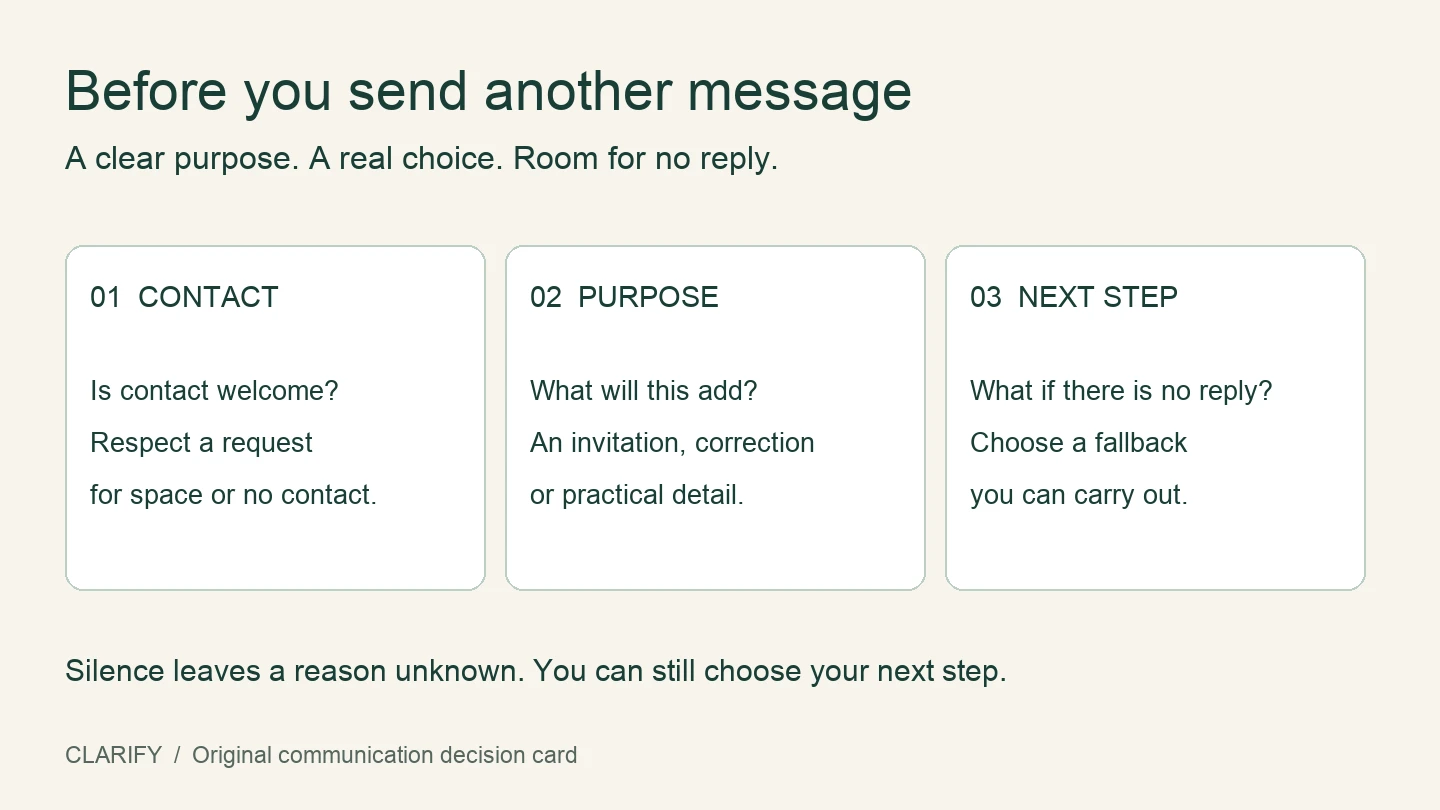
First, identify what is actually unanswered
Read your last message once, as if you were receiving it. Did you ask a specific question? Did you send a photo or a comment that could reasonably end the exchange? Did you propose a plan without a date? The task may be to make an invitation clearer, rather than to ask why someone is silent.
- A comment: “That exhibition looks interesting.” You have shared an observation; you have not yet invited them.
- An invitation: “Would you like to see the exhibition with me on Sunday?” There is a question they can answer.
- A practical confirmation: “Are we still meeting at the north entrance at two?” An existing plan needs a detail confirmed.
Also separate the observable fact from your interpretation. “My message has no reply” is a fact you can check. “They are testing me” is a story you cannot establish from that fact alone. You do not need to solve the story before deciding how to spend your afternoon.
Choose the situation that fits
You sent a casual comment or an unclear invitation
If contact has been welcome and you want to invite them, send the invitation you actually mean. For example: “I realised I only mentioned the exhibition. Would you like to go together on Sunday afternoon?” That adds a concrete choice. Avoid turning the same message into a complaint about the earlier silence.
If you only wanted to share something and do not need a reply, leaving the exchange there is also an option. Not every conversational ending needs to be repaired.
You are waiting on a plan with a real deadline
State the practical reason for following up and your fallback. For example: “I'm booking the workshop tonight. Would you like me to include you? If I haven't heard by six, I'll book just my place.” Use a genuine booking deadline, not a countdown invented to force attention.
The fallback should be something you can do yourself. Booking one place is within your control; making the other person explain their silence is not. If money or another obligation is already shared, use the arrangement you agreed on rather than treating this casual-message guide as a way to cancel it.
You have started dating and want to meet again
If you have not already followed up, a direct invitation can make your intention clear: “I enjoyed our walk. I'd like to meet again. Would you be interested in coffee next week?” You can choose to send that once, then leave room for an answer. This is an editorial stopping rule for an optional invitation, not a scientific claim about the ideal number of texts.
If you already sent a clear invitation and another follow-up, a further version is unlikely to add a different question. You can stop initiating this exchange without declaring that you know why they did not reply. A reply later gives you a new choice; it does not commit you to keeping the invitation open indefinitely.
An established friend or partner has different texting habits
A repeated mismatch may need a conversation about expectations when you are both available. An opening could be: “When we make plans by text, I sometimes don't know whether they are confirmed. Could we agree to say yes or no by the evening before?” This asks about a specific arrangement rather than constant access to the other person.
Love is respect's guide to digital boundaries includes texting expectations among the matters partners can discuss and agree on. It emphasises mutual respect when those arrangements change. That supports discussing the expectation; it does not establish a response-time rule for every relationship.
They asked for space or no contact
Follow the boundary they communicated. Do not use a different number, another account or a mutual friend to deliver the same invitation. A “final” message is still contact. If they gave a clear arrangement for reconnecting, follow that arrangement instead of inventing an earlier check-in.
A positive sign, a reassuring interpretation or a friend's guess does not override someone's stated wishes. You can write what you wanted to say privately without sending it.
How long should you wait?
Use the context you actually have: their usual availability, any agreement between you and whether a practical decision has a deadline. Avoid treating 24, 48 or 72 hours as a test that reveals interest. An elapsed time can tell you that a booking decision is due; it cannot tell you what another person feels.
For a non-urgent message with no established expectation, give the conversation room before deciding whether there is anything useful to add. For a time-sensitive plan, communicate your real deadline and fallback. For an urgent safety concern, this article's casual-texting approach is not the appropriate response; use suitable direct help.
Love is respect's respectful-texting guidance advises allowing a partner the chance to respond and avoiding repeated demands for an answer. The examples and decision card here are Clarify's own editorial suggestions, not a method endorsed by that organisation.
A worked example: a booking, not a test of affection
Fictional example: On Thursday, Alex asked Morgan about joining a Saturday pottery session. It is now Friday morning. The studio requires booking by 6 pm Friday, and Alex can attend alone. Morgan has not requested space; they have previously made plans together.
Alex has two separate uncertainties: whether Morgan wants a place and why Morgan has not answered. Only the first is needed to make the booking. Alex sends: “I'm reserving my pottery place by six today. Would you like to join? If I don't hear back, I'll reserve one and we can find another time.”
At 6 pm there is still no reply, so Alex books one place. The deadline comes from the studio, not from a rule about Morgan's feelings. The useful result is that Alex can make a plan without buying an unwanted second ticket or sending escalating messages.
If Morgan later replies, Alex can say the group booking has closed and decide whether to make another plan. If there is no reply, Alex has already chosen a workable next step. This invented example demonstrates the decision process, not a successful relationship outcome.
Copy this before-you-send card
- What I sent: Summarise the last message without adding an explanation of their motives.
- Whether contact is welcome: Note any request for space, no contact or an agreed check-in.
- What another message would add: One invitation, correction or practical question. If nothing new, consider leaving it.
- Any real deadline: Write the actual event or “none.”
- My message: One clear purpose, in language I would normally use.
- My fallback: What I will do without a reply, without requiring another person's cooperation.
Use a private note rather than uploading a screenshot of the conversation. Remove names and identifying details if you use a reflection tool. The card does not need a score: one explicit request for no contact matters more than a list of reasons you would like to send something.
If you want a reflection before deciding
You can use Ask Clarify to reflect on your own choice. One possible question is: “What am I hoping another message will achieve, and what is within my control?” Treat the response as material to consider, not evidence of the recipient's feelings, a prediction of their reply or permission to cross a boundary.
For help wording that kind of prompt, see the question-writing guide. The existing relationship-question examples cover how to frame a question for a reading. This page instead helps you decide what, if anything, to send. You can finish the card and make your choice without drawing a sign.
Common questions
Is double texting always a mistake?
No. A correction, a clear invitation or a booking detail can have a useful purpose. Count the purpose and the context, not just the bubbles on the screen. A second text still needs to respect a stated boundary.
Should I send “Did you see my message?”
For an ordinary invitation, restating the actual question is usually more informative than asking about the screen. If the concern is a practical delivery problem, name the detail that needs confirming. Avoid using read receipts or online activity as proof of someone's motives.
Do I need a final message for closure?
You can decide to stop initiating without announcing it. A private note can record what you wanted and what you are choosing now. If there is a shared practical responsibility, handle that specific responsibility through the appropriate agreed channel.
Sources and scope
The two love is respect resources linked above support the limited points about respectful texting and discussing digital expectations. All sample messages, the six-part card, diagram and Alex example are original editorial material. They are not therapy, a diagnostic test or research findings. No response rate, hidden motive or guaranteed outcome is claimed.