Fortune Sticks for Love: Relationship Questions You Can Use
A useful relationship question for Chinese fortune sticks focuses on your next choice, while leaving the other person's feelings and consent for them to express. Instead of “Do they secretly love me?”, try “What should I clarify before inviting this person on a date?” The reading can offer a theme to reflect on; it cannot verify attraction, promise a reunion or give permission to cross a boundary.
This guide works through three different situations: asking someone out, thinking about contacting an ex, and discussing communication in an existing relationship. Each example separates what is known, what remains unknown, the question to bring to a reading and the conversation that still needs to happen. All situations and sample messages are fictional teaching examples.
The method is Clarify's modern reflective exercise, not a traditional rule for every temple or a relationship counselling method. If you need the basics of question wording first, start with how to ask Chinese fortune sticks a clear question.
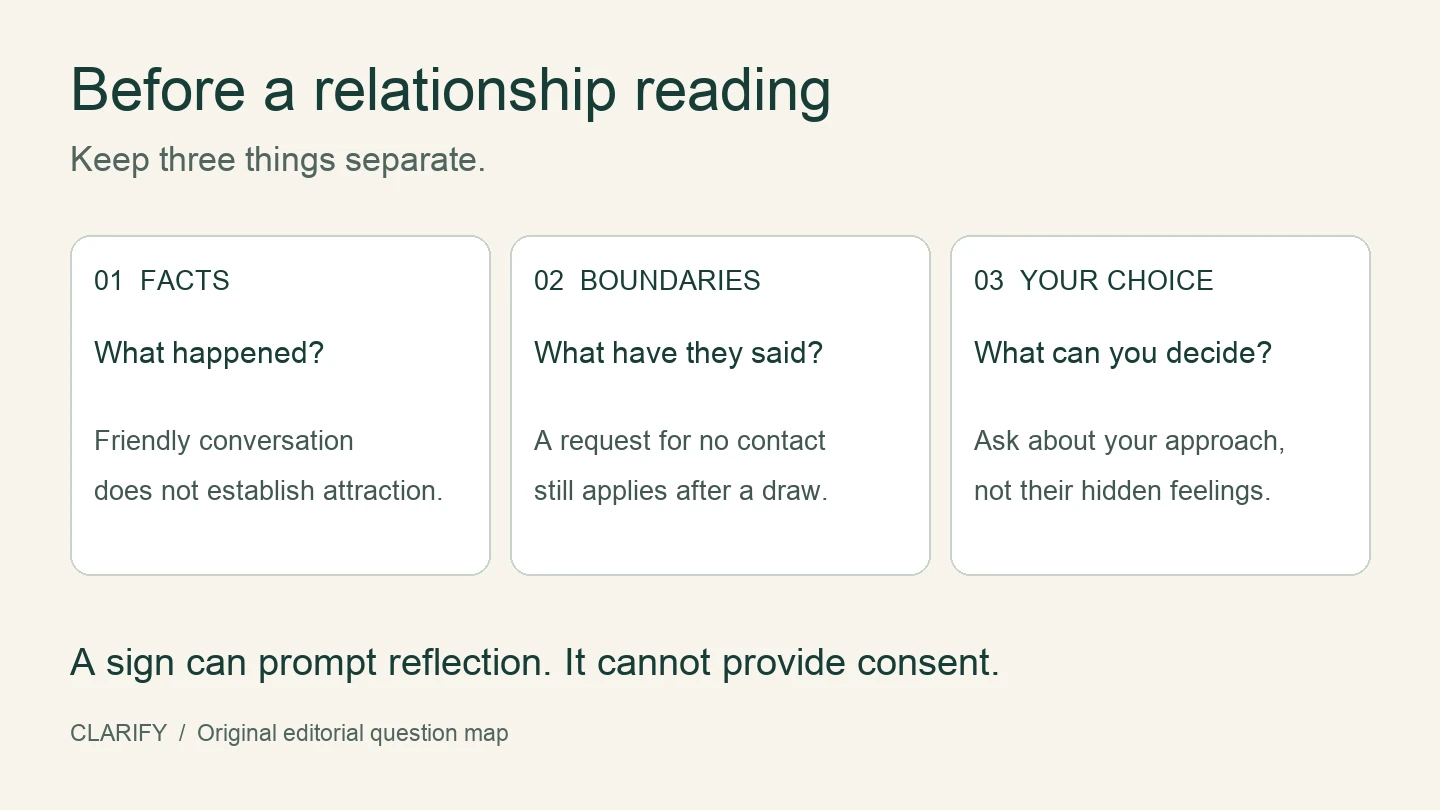
What a love fortune-stick reading can and cannot tell you
Chinese fortune sticks, often called kau cim, belong to a living divination tradition. The Hong Kong Tourism Board's guide to Wong Tai Sin Temple describes shaking a bamboo cylinder until a stick falls out and having the fortune interpreted at nearby stalls. That cultural description does not establish that a draw can reveal another person's mind.
For this exercise, use the text as a prompt to examine your expectations. A passage that brings patience to mind might help you notice that you want an immediate answer. It does not show that waiting will make someone want a relationship. A passage that feels encouraging is not evidence that another person has agreed to contact, a date or reconciliation.
Keep three things separate: the text you received, the meaning you attach to it, and the information you have from the person involved. For an actual poem with those layers shown explicitly, see our worked example of reading a Chinese fortune stick. No invented verse or numbered love prediction is used here.
Situation 1: “Do they like me?”
Imagine you enjoy talking to someone at a weekly language exchange. They often stay to chat afterward. You are considering asking them for coffee outside the group.
- Known: You have friendly conversations at a shared activity.
- Unknown: Whether they are interested in dating you.
- Your choice: Whether and how to make an invitation.
Question to bring: “What should I consider before inviting someone from my language group on a date?”
This question leaves you room to consider clarity and the shared setting. Friendly conversation alone does not settle romantic interest. If the reading makes you think about openness, one possible reflection is that your invitation should be understandable without making the other person responsible for your hopes.
An illustrative message is: “I've enjoyed talking with you. Would you like to get coffee as a date sometime? It's completely okay if you'd prefer to keep things at the group.” Use your own words; this is an example, not a script guaranteed to produce a yes.
Reality check after the reading: Their response supplies information the sign cannot. If they decline, the reading is not a reason to keep asking. If they are unclear, do not convert ambiguity into a hidden yes. You can leave the invitation open without pressing for the answer you wanted.
Situation 2: “Will my ex come back?”
This question asks for an outcome controlled by two people. Before rewriting it, check whether contact is welcome. If your ex has asked you not to contact them, a favourable sign does not cancel that request.
Consider two versions of the situation. In one, you have agreed not to be in contact. Your question can stay entirely with your own response: “What expectation am I holding onto as I adjust to this relationship ending?” A practical next step might be writing a private note you do not send. You do not need another person's reply to begin that exercise.
In the other version, you still exchange occasional friendly messages and neither person has requested no contact. You are wondering whether to ask about meeting. A more specific question is: “What do I need to clarify for myself before asking my ex whether they want to meet?”
Write down your actual purpose. Is it returning an item, apologising, catching up or exploring reconciliation? These are different conversations. A vague invitation can leave the other person answering a question you did not intend.
Reality check after the reading: A theme of renewal could prompt you to examine what you hope would change. It does not mean the relationship will restart. Ask yourself what has actually changed since the breakup, what has not, and whether you can accept a refusal. If you cannot identify your purpose yet, you can pause without drawing again for a deadline.
Situation 3: “Why do they take so long to reply?”
Imagine you and your partner have different texting habits. You prefer a short message during the day; they often answer in the evening. You have not discussed what either of you expects.
Question to bring: “What should I clarify before discussing our different expectations about texting?”
In your notes, separate the observable pattern from the story you have attached to it. “Their last two replies arrived in the evening” describes what happened. “They no longer care” is an interpretation. Neither a delayed reply nor a fortune-stick reading establishes that interpretation.
The relationship education resource love is respect's guide to digital boundaries identifies texting and social-media expectations as topics partners can discuss. It also emphasises that boundaries can change and that those changes deserve mutual respect. It does not prescribe one correct response time for every couple.
An illustrative opening is: “I notice I expect a daytime reply, but we haven't talked about that. What kind of contact works for each of us while we're busy?” This gives both people something concrete to answer.
Reality check after the reading: If a theme of balance feels relevant, use it to consider both people's preferences. Do not turn it into a demand for constant availability, passwords or access to private messages. The useful information comes from the conversation and whether the arrangement works for both of you.
A worked note: when the same theme could lead to different actions
Return to the texting example. Suppose the interpretation you read makes you think about patience. This is an illustrative theme, not a quotation from a traditional sign.
You could interpret it as “I should say nothing and wait indefinitely.” You could also interpret it as “I should choose a calm moment to explain my expectations rather than sending a string of frustrated messages.” The theme alone cannot choose between these actions.
Here is a completed note that keeps the uncertainty visible:
- Fact: We have not agreed on daytime texting expectations.
- My assumption: A late reply means I matter less.
- Reflection: The theme of patience reminded me to slow down before treating that assumption as fact.
- Next step: Ask whether we can discuss what kind of contact suits us both.
- What would change my view: Their explanation and our actual experience of any arrangement we agree on.
No score is calculated, and there is no compatibility percentage. You are checking an assumption against a conversation, rather than measuring a relationship through a random draw.
Before you use your question in Ask a Sign
Choose the one situation that matches your decision. Remove unnecessary names, addresses, screenshots of private messages and other identifying details. Keep enough context to understand your own question.
To try it, open Ask a Sign by Clarify and choose “Type your question.” The current entry opens “What are you deciding?” with a “Your question” field. The entry also offers “Draw without a question.” These entry controls were checked on September 29, 2026; they are not a claim that a reading can establish what someone else feels.
If your real interest is a recurring pattern in your own choices, rather than this one conversation, Clarify's personal readings offer a separate starting point for exploring its BaZi products. They are not a two-person compatibility test and cannot verify a partner's intentions. You do not need to buy another product to use the question exercise above.
Common questions about fortune sticks and love
Can a fortune stick tell me whether someone loves me?
A drawn text is not evidence of another person's private feelings. You may find a useful reflection about your own expectations, but the other person's words, choices and boundaries remain separate sources of information.
Does a good sign mean I should contact someone?
It does not grant permission. Consider whether contact is welcome and what you actually want to ask. A clear request for no contact takes priority over your interpretation of a sign.
Does a bad sign mean we should break up?
Do not treat a grade or an unsettling image as a verdict on a relationship. Read the actual text and identify what, if anything, connects to your situation. If you feel afraid, threatened or controlled, prioritise appropriate support and safety rather than using divination to decide whether that concern matters.
Should I draw again if I dislike the answer?
For this exercise, keep your original question and response, then step away before deciding what to do. Repeating until you receive reassuring wording does not provide independent evidence about the relationship. Temple-specific procedures may differ; follow the instructions where you are visiting.
Sources and scope
The Hong Kong Tourism Board source supports the short description of kau cim at Wong Tai Sin. The love is respect source supports the point about discussing digital boundaries. Neither source endorses Clarify, validates divination or supplies the fictional cases in this article. The cases, question rewrites and worked note are original editorial examples for reflection, not customer stories, counselling or predictions.