Should I Reach Out to an Old Friend? What to Say
If you lost touch through ordinary life changes, still want to know this person as they are now, and have no reason to think contact is unwelcome, a brief message is a reasonable way to find out whether they would like to reconnect. You do not need an impressive life update or a special anniversary. You do need to leave them free to choose whether to respond.
If they asked you not to contact them, respect that. If the friendship ended with unresolved harm, a cheerful catch-up message may skip the very thing that needs acknowledging. The examples here are for a first contact after drifting apart, with a separate note on when that approach does not fit.
A first message you can adapt
For a friendship that simply went quiet, try something specific and small:
“Hi Morgan, I found the playlist we made for our long bus rides and thought of you. It's been a while! I'd enjoy catching up if you're open to it. How have you been?”
Replace the memory with something true. You can remove the question and just send a warm hello if you are not ready to start a longer conversation. This is an original example, not a script tested to produce a particular response.
If you want to meet and already know you will be nearby:
“Hi Morgan, I'll be near the old library next Thursday afternoon. Would you be interested in a short coffee catch-up? If that doesn't suit, it's still nice to say hello.”
Keep a genuine invitation separate from a request for a favour. If you need a reference, introduction or other help, say so honestly; do not disguise that request as a reunion.
Which kind of distance are you dealing with?
- You gradually stopped talking. A move, graduation or different routines left the friendship without a regular meeting place. A simple hello can acknowledge the gap without treating it as a wrongdoing.
- You left a specific message unanswered. Briefly own it: “I never replied to your message about the move. I'm sorry I left it there. I'd like to hear how you're doing, if you'd like to catch up.” You do not need a lengthy defence.
- Something hurtful happened. Decide whether your purpose is to take responsibility or ask about reconnecting. Those are different conversations. Do not make forgiveness the price of receiving an apology, or assume a friendly opener repairs the issue.
- They explicitly wanted contact to stop. Time passing does not cancel that request. Do not use another account, a surprise visit or a mutual friend to get around it.
These distinctions are practical editorial guidance, not a diagnosis of the friendship. “We haven't spoken in years” tells you the length of the gap; it does not, by itself, explain why the gap exists.
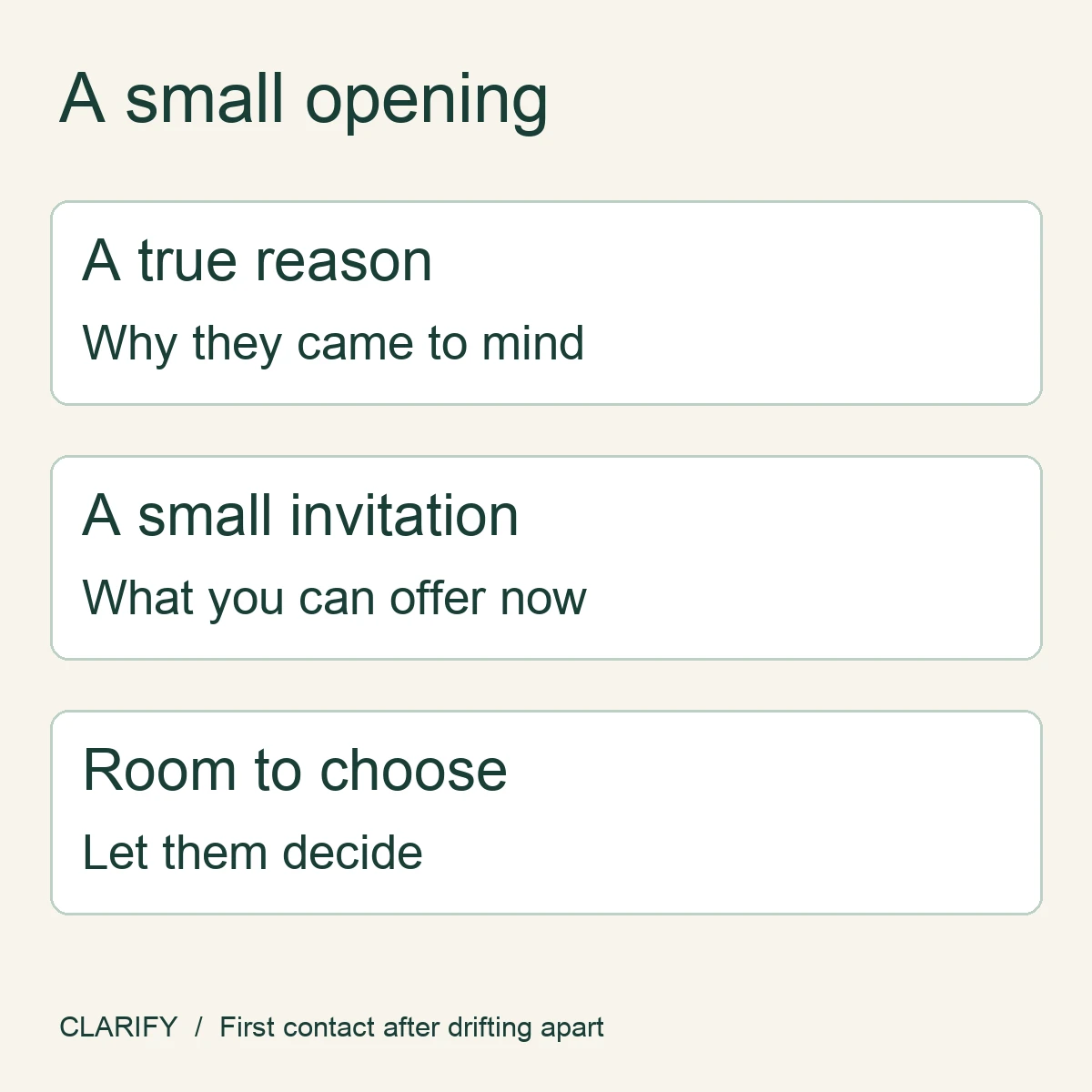
Make the invitation fit what you can actually offer
Before sending, choose a realistic next step. Are you offering a brief exchange, a call or a visit? “We must catch up properly” can be sincere, but it leaves both people with the work of turning it into a plan. A modest suggestion is easier to understand than a promise to become inseparable again.
Fictional example: Alex wants to contact Morgan after three years without a conversation. They stopped seeing each other when their evening class ended; neither asked the other to stop messaging. Alex drafts a long account of everything that has happened since, then realises the immediate wish is just to see whether Morgan would enjoy talking.
Alex sends the playlist message above. Morgan replies warmly and says a short call would be nice. Alex can offer Tuesday from 7:00 to 7:30; Morgan is free from 7:10 to 7:40, in the same time zone. Their shared window is 7:10 to 7:30, or 20 minutes. Alex suggests that specific window rather than promising an open-ended evening. These times and people are invented to show how to turn mutual interest into a manageable plan.
If they live in different time zones, include the date and zone when proposing a time, and confirm the conversion. If a call does not work, an exchange of messages can remain the whole plan. A friendly answer is not a commitment to any particular format.
Leave some of the catching up for the conversation itself. Ask about their present life without assuming that an old job, relationship or living situation still applies. Share a little about yourself too; this need not become an interview or a comparison of achievements.
What research can tell you about the hesitation
Aknin and Sandstrom's 2024 research found that people could remain reluctant to message an old friend even when they wanted to reconnect and believed the friend would appreciate it. The findings suggest that hesitation alone is not reliable evidence that contact would be unwelcome.
Separately, research described by the American Psychological Association found that people underestimated recipients' appreciation of reaching out. That is a finding about participants in those studies, not a forecast for your particular friend. Neither study tests the messages on this page or establishes that you should ignore a boundary.
You can use this distinction without trying to talk yourself into certainty: “I feel awkward” is something you know about your experience. “They will be annoyed” is a prediction you may not have evidence for. An explicit request for no contact, however, is information you should act on.
Let their response set the next step
If they respond with interest, answer what they actually said and suggest one manageable next step. If they are friendly but unavailable, you can acknowledge that without trying to solve their schedule for them. “Good to hear from you. I hope the move goes smoothly” is a complete response; a reunion does not have to follow immediately.
If they decline, accept the answer. If they do not reply, leave the invitation with them rather than turning it into a demand for an explanation. There is no universal number of hours that tells you what silence means. For an already unanswered message, our separate guide to whether to text again after no response covers follow-up situations; this page focuses on deciding whether and how to make the first contact.
A pleasant exchange can be worthwhile even if regular contact does not restart. You can discover whether there is room for a friendship now without requiring it to look like the friendship you remember.
If you want to reflect before sending
You may have checked the practical situation and still be unsure what you want from reaching out. Ask Clarify offers a sign for a fresh perspective. You can open “Type your question” with a focused reflection such as: “What should I consider before inviting an old friend back into my life?”
Use the response to examine your own hopes and choices, not to decide what the other person secretly feels. A sign cannot establish their wishes or permission to contact them. For help keeping the question within your own agency, see how to frame a question for a reading. You can also use the message examples above and stop there.
About this guide: The linked research supports the limited discussion of hesitation and appreciation. The message examples, situation distinctions, scheduling example and illustration are Clarify's original editorial material. They are not personalised counselling or a promise of reconciliation.