Saju vs BaZi: Same Four Pillars, Different Readings
Saju and BaZi share the Four Pillars framework: a birth year, month, day and hour represented by eight stem-and-branch characters. Saju is the Korean name for the four pillars; BaZi is the Chinese name for the eight characters. The longer Korean expression, saju palja, brings both descriptions together.
That shared structure does not mean every Korean and Chinese calculator must return identical results, or that every reader will interpret a chart alike. Language, screen layout, time rules and interpretive choices are separate things. If you already have a Saju chart, you can compare it with a BaZi chart without choosing which tradition is supposedly “better.” First establish whether the eight characters actually differ.
This guide gives you a small vocabulary bridge, a calculated example and a way to compare two charts. It describes a traditional interpretive framework, not an established method of predicting a person's future.
What the names tell you
The Academy of Korean Studies' Saju encyclopedia entry describes the birth year, month, day and hour as four pillars. Each contains two characters, making eight in total. It also identifies the Day Stem as the reference for interpreting relationships among the symbols. This documents a tradition; it does not establish that its predictions are accurate.
The Hong Kong Observatory's stem-and-branch reference documents the calendrical building blocks: ten stems, twelve branches and their sixty-pair cycle. These time labels are the common structure you can look for on either chart.
For a first comparison, the characters and column labels matter more than spelling. A Chinese-language guide may call 丙 “Bing”; a Korean chart may show 병, often written “Byeong.” Those labels can refer to the same stem. A change in pronunciation is not a change in the chart.
A short Korean-to-English chart key
| On a Korean chart | What to match on a BaZi chart |
|---|---|
| 연주 年柱 | Year Pillar: a stem above a branch. |
| 월주 月柱 | Month Pillar: a stem above a branch. |
| 일주 日柱 | Day Pillar: the complete two-character pair. |
| 시주 時柱 | Hour Pillar: the pair calculated from the birth time. |
| 일간 日干 | Day Stem: the upper character of the Day Pillar, used as the Day Master reference. |
The distinction between the Day Pillar and Day Stem is particularly useful. If one report calls you “Bing Fire” and another says “Bing Xu,” it may be describing a different amount of the same column. Bing is the stem; Bing Xu includes the branch too. Locate the actual symbols rather than comparing only an English personality label. Our Day Master guide explains this reference point in more detail.
There is no need to translate every annotation immediately. Begin with the four named columns, then the upper and lower character in each. Extra rows for hidden stems, relationship labels or timing cycles can wait until the basic chart matches.
A worked example: different order, identical chart
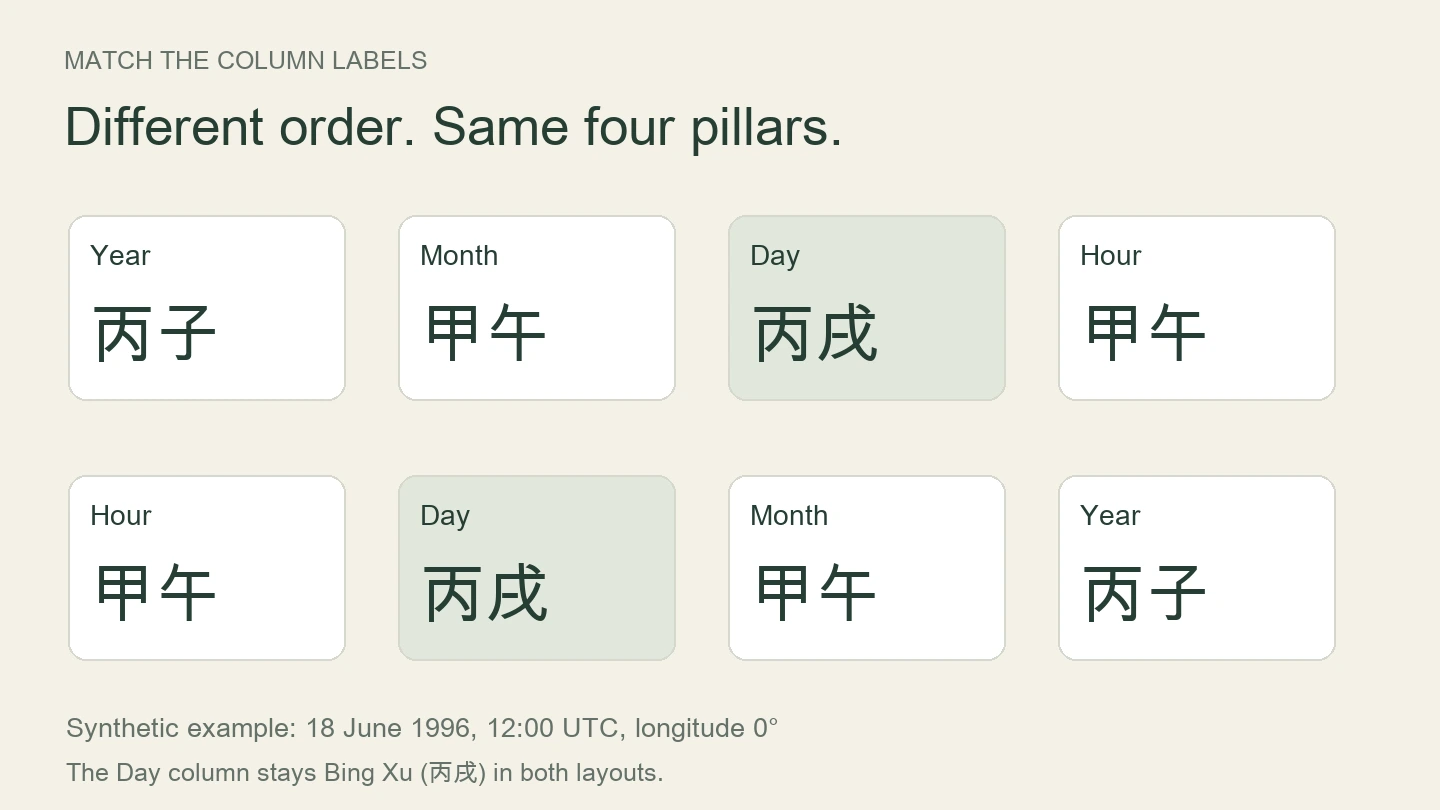
Consider an explicitly fictional teaching input: June 18, 1996, at 12:00 UTC, longitude 0°. Using Clarify's calculation rules, the four pairs in year-to-hour order are:
- Year: Bing Zi 丙子.
- Month: Jia Wu 甲午.
- Day: Bing Xu 丙戌.
- Hour: Jia Wu 甲午.
The Day Master is Bing 丙, Yang Fire. It is not Jia merely because Jia appears in two other columns. The example is away from the relevant hour, day and opening solar-term boundaries. It is a calculation example, not a customer record or a forecast.
Now imagine two displays. Display A lists Year → Month → Day → Hour: 丙子 · 甲午 · 丙戌 · 甲午. Display B lists Hour → Day → Month → Year: 甲午 · 丙戌 · 甲午 · 丙子. Reading both from the left without their headings would make them seem inconsistent. Matching Year to Year, Month to Month, Day to Day and Hour to Hour reveals that every pair agrees.
These are illustrative layouts, not a claim that every Saju app uses one direction and every BaZi app uses the other. If your screenshot has no legible headings, find its chart key before interpreting it. Do not use the first column as the Day Pillar by default.
When the characters really do differ
After matching the headings, a remaining difference is a calculation question. The label “Korean” or “Chinese” is not enough to identify the cause. Compare the actual inputs and documented settings.
Start with the date that each tool received
Check whether you entered a Gregorian date or selected a lunar-date option. A lunar birthday requires the correct year, month, day and, when applicable, leap-month designation. Do not take the same three numbers from one calendar and enter them into the other. Keep the original record alongside any conversion.
Then check the clock and location
A birth record's local clock time needs its relevant time zone. Some methods also apply longitude and an equation-of-time correction; others use a different declared convention. Do not silently add a correction yourself if a tool already applies it. The useful question is “Which time did this calculator use for the hour?” rather than “Which country made this calculator?”
Do not subtract a fixed number of minutes from every Korean birth or every overseas birth based on a general internet tip. The record, place, date and tool's method must be considered together. Our chart verification guide covers the calculation checks; this page focuses on comparing charts across labels and languages.
Ask whether a boundary was crossed
For a second controlled example, keep June 18, 1996, UTC and longitude 0°, but compare 10:30 with 11:30. Under the same Clarify calculation, the first Hour Pillar is Gui Si 癸巳; the second is Jia Wu 甲午. The year, month and day pairs remain unchanged. The one-hour difference crosses an hour interval in this example; it does not turn a Chinese chart into a Korean one.
If the original birth time is approximate, keep that uncertainty visible. A more detailed report cannot manufacture a missing minute. Clarify's uncertain-birth-time guide explains how to distinguish a known range from a completely unknown hour.
Why matching charts can still produce different readings
Calculation produces the symbols. Interpretation decides which relationships to emphasize and what meaning to draw from them. Two readers may agree on all eight characters but give different weight to seasonal support, interactions or timing. A label alone does not specify those choices, and one provider's practice cannot stand for every reader in a country.
Ask for the reasoning at the point of disagreement. “Which part of this chart supports that conclusion?” is more useful than comparing how confident the two reports sound. Separate a shared observation, such as “the Day Stem is Bing,” from an interpretation and from a practical suggestion. The guide to conflicting readings addresses that next step once the underlying chart is settled.
Neither a matching chart nor a persuasive explanation proves that a predicted event will happen. Do not use a reading to override evidence about a job, relationship, health issue or financial decision.
A comparison note you can fill in
Before seeking another reading, write one short note with these fields:
- Source input: the original date, stated calendar, recorded local time and birthplace. Mark anything unknown.
- Tool settings: calendar conversion, time-zone handling and any stated time or day-boundary rule.
- Four pairs: copy both charts into the same Year / Month / Day / Hour order.
- Difference: identify the exact pair or character that changes. If none changes, write “pillars match.”
- Next question: ask about the relevant setting if symbols differ, or the interpretive reasoning if they match.
For the noon example above, the difference field reads: “No difference after reordering; both Day Pillars are Bing Xu.” That is a complete and useful finding. It avoids buying another report simply because a different layout looked unfamiliar.
Common questions
Is Saju just the Korean zodiac?
A Four Pillars chart uses more than the birth-year animal. The year branch is one of its eight characters; the month, day and hour contribute the rest. A zodiac-animal comparison alone cannot establish whether two complete charts match.
Is Saju more accurate than BaZi?
This guide does not establish a predictive advantage for either tradition. You can check whether a calculation follows its stated inputs and rules. Whether an interpretation reliably predicts life events is a separate claim requiring evidence, not a conclusion supplied by the name of the tradition.
Can I use Clarify if I first encountered Four Pillars through Saju?
Yes, as an English BaZi reading within Clarify's stated method. You can start with the free Reading and Life Book. It is not a promise of a Korean-language consultation, a specific Korean practitioner's method, or an automatic comparison with an uploaded Saju screenshot. Read the product's actual description before entering your details.
What should I learn after matching the pillars?
Follow the step-by-step BaZi reading guide: identify the Day Master, establish seasonal context, then consider the relationships across the whole chart. Avoid treating eight characters as eight independent predictions.
Sources and scope
The Korean terminology and four-pillar description were checked against the Academy of Korean Studies entry linked above. The stem-branch cycle and hour relationships were checked against the Hong Kong Observatory reference. Both were accessed on September 23, 2026. Synthetic chart calculations were verified with Clarify's current rules; no private birth records were used. The layout comparison and five-field note are original teaching aids. See Clarify's methodology for its distinction between calendar calculation, traditional interpretation and modern reflection.