
How to Read Luck Pillars (大运): The Decade-by-Decade Logic Beyond "Good or Bad Luck"
Core Answer
Luck Pillars are ten-year stem-branch sequences in the traditional model. They change the chart comparison but do not dramatically alter a person's baseline, withhold success, or determine when an opportunity arrives.
Introduction
When studying BaZi, the "Luck Pillars" (Da Yun) often cause confusion. Many view Luck Pillars simply as an absolute indicator of the next ten years.
Luck-Pillar analysis compares the pillar with the natal chart, including internal elemental and Ten-God relations. It does not activate a specific life theme or event.
1. What are Luck Pillars (Da Yun, 大运)? How Do They Influence a Decade?
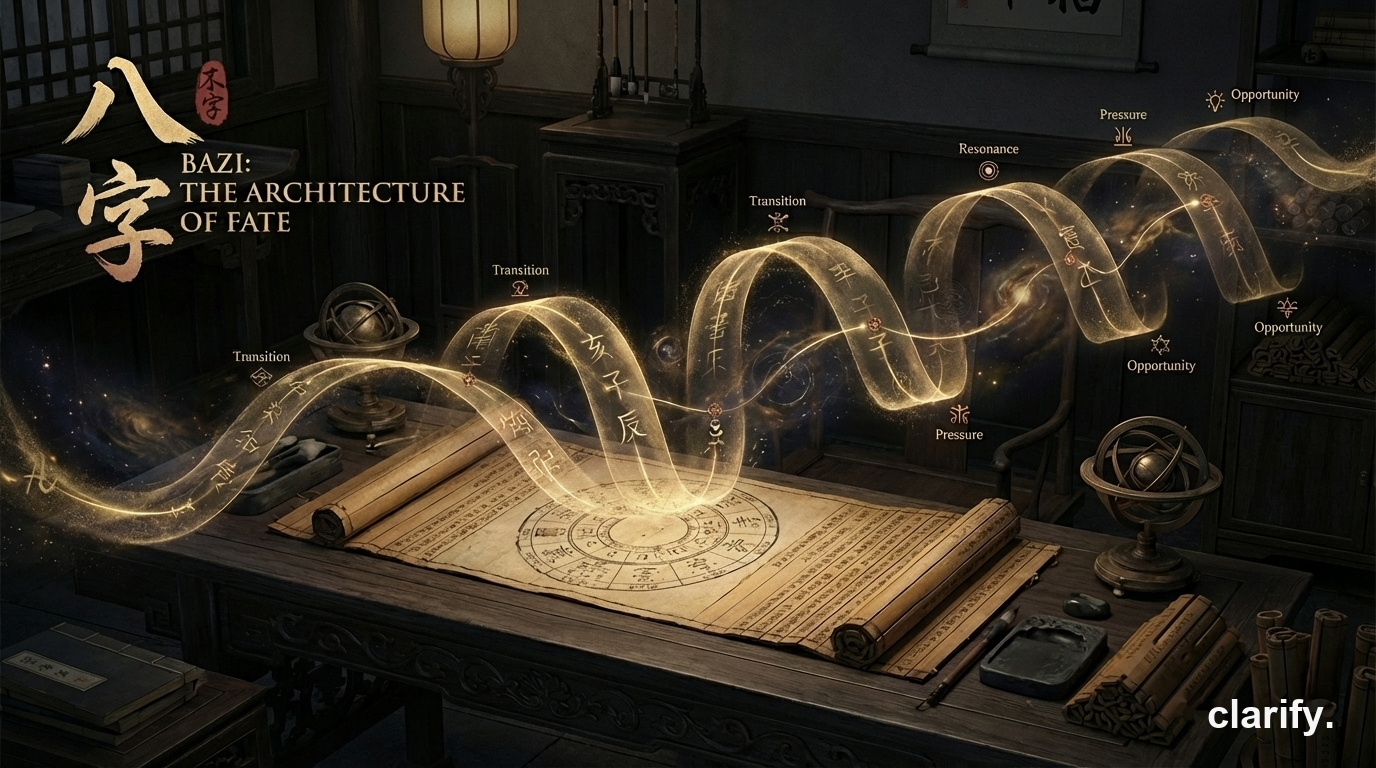
In the BaZi model, the natal chart is the fixed symbolic baseline and Luck Pillars are ten-year stem-branch layers. They change the chart comparison, not a person's underlying nature or real environment.
Natal Chart
Your starting hand of cardsLuck Pillar
The environment/era you are playing inAnnual Pillar
The annual stem-branch comparison
The decade sequence changes the traditional chart comparison. It does not explain performance in youth or middle age and does not prove that destiny or a real environment shifted.
2. The First Step is Never the Luck Pillar — It's the Natal Chart
This is the most common mistake. People default to "Wealth = Good" or "Officer = Bad." But BaZi doesn't work that way.
The same pillar can be classified differently relative to different natal charts. That classification does not establish benefit, harm, capacity, or a real-world outcome.
3. Core Strategy: Analyze "Structural Change" Not Labels
Professional analysis follows these four layers of logic.
Layer 1: The Elemental Force Introduced
Each Luck Pillar is a Heavenly-Stem and Earthly-Branch pair. Compare that pair with the natal chart and record whether a selected method treats it as supporting or conflicting with an internal relation. It does not enter a person's system, fix a problem, or amplify a real weakness.
Layer 2: Changes in Ten Gods (10S) Dynamics
The importance of Ten Gods lies in their relationship to the Day Master, not their names.
Ask how a Wealth or Officer label relates to the Day Master and wider chart. Do not translate that relation into financial capacity, promotion, authority, pressure, or anxiety.
Layer 3: The Flow of Vital Energy (Qi)
New Chains
Forming new productive cycles and opening the flow.Weak Points
Amplifying existing weak points or escalating conflict.Grounding
Grounding the Useful God and providing the missing link.
The analysis asks whether the new pillar supports or conflicts with the chart model—not whether a decade will make life smoother or more conflicted.
Layer 4: Real-World Life Themes
Traditional schools associate Luck-Pillar relations with categories such as Career, Wealth, Relationship, and Psychology. These associations do not establish real outcomes or mental states:
Career
Traditional career associations only; the pillar does not predict rank, responsibility, promotion, or an industry change.Wealth
Traditional Wealth associations only; the pillar does not predict revenue, commercial opportunity, or cash-flow stability.Relationship
Traditional relationship associations only; the pillar does not predict marriage progress or a partnership change.Psychology
A chart cannot measure or predict confidence, stress, focus, or another mental state.
Record which traditional theme the selected school associates with the decade, without treating it as a force pushing a person.
8. Luck Pillars vs. Annual Pillars
Luck Pillars span ten years and Annual Pillars span one year in the model. Neither sets a guaranteed life theme nor triggers an event.
The Luck Pillar is a ten-year layer and the Annual Pillar is a one-year layer. Compare both for internal consistency; neither is a specific real-world activation.
9. Common Misconceptions
10. A Practical Analysis Framework
11. The Method Question: Which Relations Does the Pillar Add?
Summary: a Luck Pillar is a new ten-year comparison layer in the chart model, not a life system entering a changed environment.
Want a deeper projection? Check out our 2026 Analysis Framework and Career & Wealth Applied Guide.
Deep Logic Series
FAQ
How to read Luck Pillars accurately?
What does "Ten years, one luck" mean?
Does a wealth pillar always mean money?
Ready to see your "Environmental Variables"?
Enter birth details to calculate the traditional decade-pillar sequence—not to see future events, career, wealth, or relationship outcomes.
 Analyze Now
Disclaimer: Divination and metaphysical systems are traditional cultural frameworks, not modern science or professional advice. Use this content for reference and make decisions from real-world facts and qualified guidance.