
How to Read Annual Luck in BaZi: Why Every Year Feels Different Even Inside the Same Luck Pillar
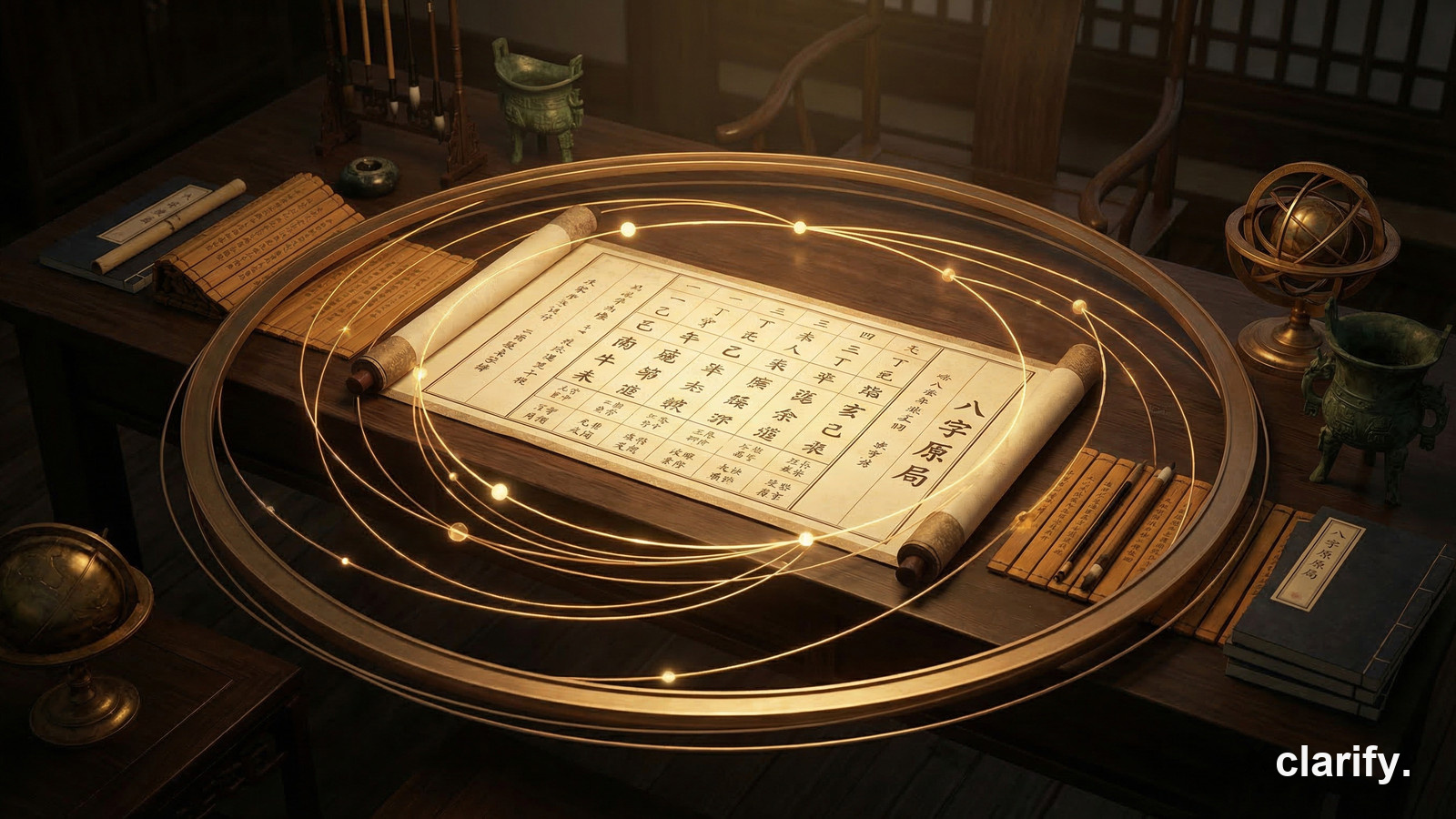
Da Yun and Annual Luck: Ten-Year and One-Year Comparison Layers
Da Yun and annual pillars use different time scales and stem-branch pairs. Their symbolic relations may differ from year to year, but the chart does not establish whether a year will feel smooth, exhausting, difficult, or successful.
In traditional reading order, Da Yun supplies a ten-year symbolic context and the annual pillar supplies a one-year comparison. These layers organize chart vocabulary; they do not decide which event, relationship, or life area will change in a given year.
Teaching metaphor only: the natal chart is the fixed symbolic baseline, Da Yun is a ten-year comparison layer, and the annual pillar is a one-year comparison layer.
Core Answer
Annual Luck is the year's stem-branch pair in the traditional model and is usually compared with the natal chart and current Luck Pillar. It does not act as an absolute trigger, determine event severity, or activate a guaranteed outcome.
What Is Annual Luck?
Annual Luck refers to the stem-branch pair assigned to a calendar year. It adds elemental, Ten-God, combination, clash, punishment, and harm relations inside the traditional model; "influence" does not mean proven real-world causation.
The natal chart, Da Yun, and annual pillar are fixed, ten-year, and one-year symbolic layers. Their chart relations differ, but they do not explain how a person will feel in a particular year.
Why Is Annual Luck So Noticeable?
Da Yun spans ten years in the model, while Annual Luck changes each year. Climate and weather are teaching metaphors only; the chart does not establish a decade theme, activate a relationship point, or turn an issue into an event.
What Is the Relationship Between Annual Luck and Da Yun?
A common reading order has three layers: natal chart, Da Yun, and annual pillar. It compares symbols at different time scales; it does not show a life road, a yearly fork, or when an event will occur.
Why Does Each Year Still Feel Different Inside the Same Luck Pillar?
The Luck Pillar and annual pillar contain different stem-branch pairs, so their internal chart interactions differ. That does not establish career growth, relationship restructuring, or which topic will dominate a year.
Within one Luck Pillar, annual stem-branch interactions can be classified differently. Labels such as starting, breakthrough, friction, or cleanup are interpretive metaphors—not event patterns or forecasts.
How to Read Annual Luck: The Safest Step-by-Step Order
Step 1: Read the Natal Chart First
Start with the natal chart so the Day Master and compared positions are explicit. Terms such as sensitive, responsive, or triggered describe chart relations only, not a person or event.Step 2: Read the Current Luck Pillar
Compare the annual pillar with the current Da Yun rather than reading it alone. Record which internal relations differ; do not infer how the year will feel or what it will amplify in real life.Step 3: Classify the Annual Pillar's Internal Relations
The key is not "what element is this year?" The real question is what role this year plays in your chart: does it bring Resource? Wealth? Officer pressure? Output? Companion competition? Structural collision?Step 4: Compare It With Key Natal Positions
The annual pillar may clash or combine with natal branches in the model. These interactions do not explain or predict a sudden, life-changing, or relationship event.Step 5: Summarize the Year's Real Theme
Only then summarize the traditional chart themes, keeping them separate from progress, pressure, recovery, career, relationship, or turning-point claims about real life.
What Kinds of Annual Years Usually Feel Easier?
Some schools use the following labels for comparatively supportive annual chart relations. They do not identify years that will feel smoother:
They bring what both chart and Luck Pillar need
This means only that the selected school finds fewer internal chart conflicts; it does not predict that life will line up naturally.They do not damage key positions
They do not clash roots, break the main structure, or hit the Month Branch.They help things land
The model may describe an Output sequence. It does not turn ideas into action or opportunities into results.They bring out good latent potential
Hidden stems and combinations are chart terms; they do not make resources, connections, or momentum usable in a particular year.
What Kinds of Annual Years Feel More Eventful or Life-Changing?
Some schools classify the following annual relations as more active inside the chart. They do not establish an eventful or life-changing year:
They hit a key position
For example the Month Branch, Day Branch, a root, or a key structural route.They form a relation with a hidden natal-chart symbol
A natal clash may be revisited when a related annual branch appears. This does not mean conflict will emerge in real life.They resonate with the current Luck Pillar
When the annual pillar and Da Yun contain reinforcing chart relations, the model records that symbolic reinforcement. It does not establish a stronger real-world effect.They alter the structural expression directly
These chart interactions do not increase or establish the likelihood of job change, relocation, marriage, breakup, or an identity shift.
4 Examples Users Can Easily Follow
Example 1: Different annual relation inside one Luck Pillar A yearly stem-branch pair may pressure the Day Master or oppose a root inside the chart model. This does not explain exhaustion, surface a relationship issue, or identify an easy or difficult year.
Example 2: A supportive annual relation inside an ordinary Luck Pillar A school may classify one annual element as favorable or as opening an internal chart route. This does not connect potential to reality or identify an unusually good year.
Example 3: Comparing the annual pillar with relationship-associated positions Readers may compare the annual branch with the Day Branch or Spouse Palace. This does not identify a relationship year, career year, partner event, or life-area outcome.
Example 4: Why can a difficult year turn out to be one of the most important later? Some readers use "restructuring" as a chart-theme label. It cannot identify a turning year or predict job change, breakup, forced transition, chaos, or when everything will change.
5 Questions Users Should Remember
What Ten Gods relationship does this year represent for me?
Do not start with good or bad.Does it touch a key point?
For example the Month Branch, Day Branch, roots, or structural line.Is it cooperating with the current Luck Pillar or fighting it?
This changes only the classification of the internal chart relation; it does not measure event intensity.Is it supporting the structure, pressuring it, or opening it?
This identifies a chart-relation category, not what kind of real year a person will have.Which traditional chart relation is being compared this year?
Keep any career, relationship, money, family, movement, health, or identity association non-predictive and secondary to real-world evidence.
Annual Luck vs. Monthly and Daily Timing: Which Matters Most?
Da Yun
Represents the model's ten-year comparison layer.Annual year
Represents the model's one-year comparison layer, not a real-world trigger.Monthly timing
Shows which month becomes especially visible.Daily timing
Shows finer, date-level rhythm.
The 7 Most Common Beginner Mistakes
Reading annual luck without Da Yun
That removes all background context.Treating annual years as stand-alone good/bad labels
The same year acts completely differently in different charts and Luck Pillars.Reading only the year's element, ignoring Ten Gods
That keeps the reading too shallow.Reading only the visible stem, ignoring branch triggers
Branch-level interactions may be prominent inside the chart model; they do not drive eventful years.Assuming major change always means something bad
Do not label a year as eventful, a turning point, or a failure from chart interactions.Assuming a good year must feel easy
A favorable annual chart label does not establish opportunity, cost, success, or difficulty.Matching annual luck to events too mechanically
BaZi is better understood as timing tendency and structural activation, not a fixed script.
Final Thought: Annual Luck Is Not "Good or Bad This Year" — It Is "What Gets Triggered This Year"
The natal chart, Da Yun, and annual pillar are compared as layers of traditional symbolism. They do not show what will be pressed, activated, or caused in a real year and are not an event map.
Further Reading
FAQ
What is the safest way to read annual luck?
Why can years feel very different inside the same Luck Pillar?
Should I read annual luck or Da Yun first?
Does a high-change year always mean a bad year?
Can annual luck directly determine exact events?
Want to Compare This Year's Symbols Without Treating Them as an Event Forecast?
Start with an accurate chart, then compare the annual pillar with the natal chart and Luck Pillar as traditional symbolism—not as a yearly trigger or decision tool.
 Calculate My BaZi Chart
Disclaimer: Divination and metaphysical systems are traditional cultural frameworks, not modern science or professional advice. Use this content for reference and make decisions from real-world facts and qualified guidance.