
Health Correspondences in BaZi: A Historical Framework, Not Medical Evidence
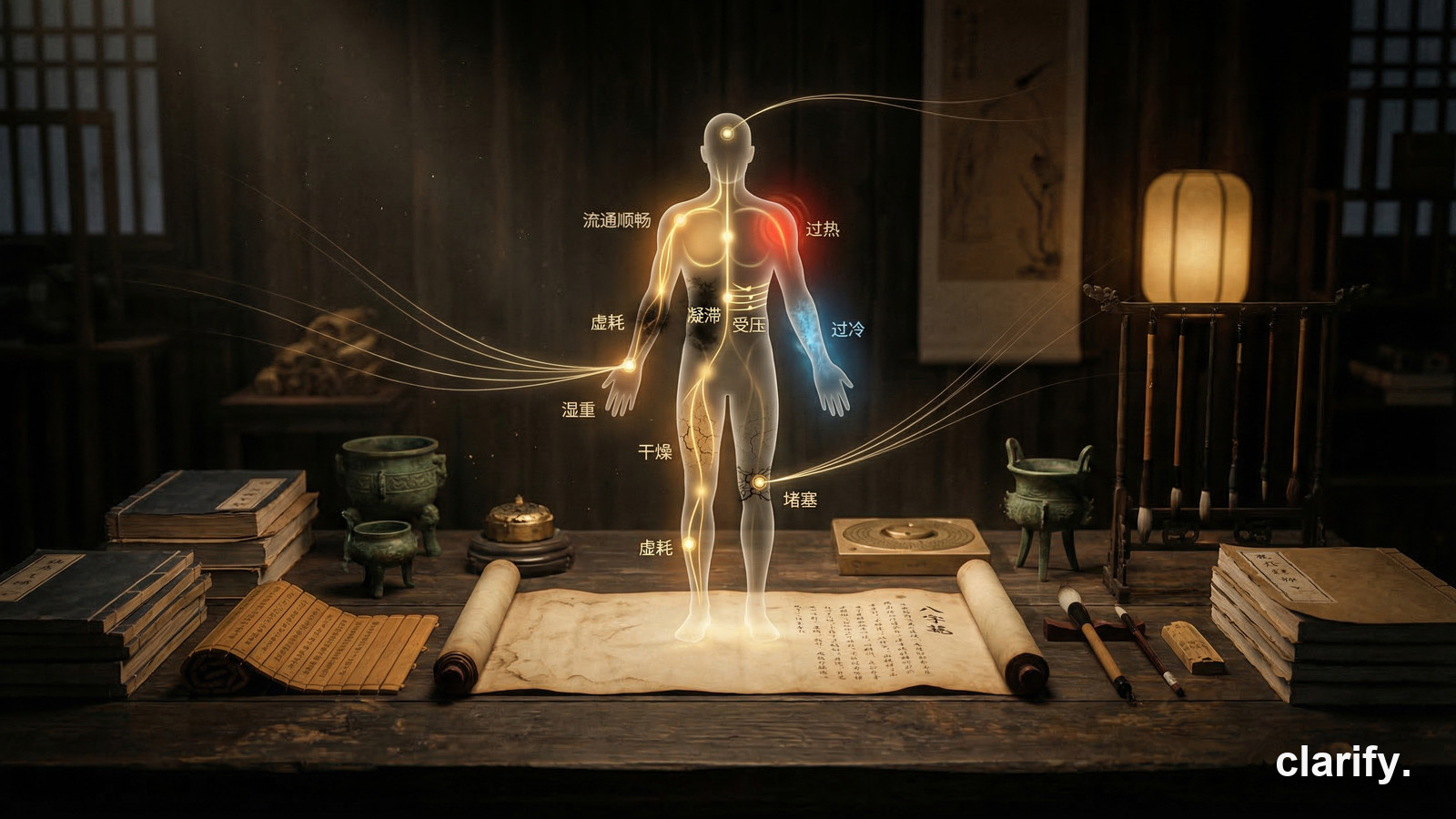
Health Correspondences Are Symbolic—Not a Prescription or Risk Test
People may ask whether a BaZi chart can show bodily strength or future illness. It cannot. A chart is not clinical evidence and should not be used to assess symptoms, disease probability, treatment, or prognosis.
A more accurate description is: traditional BaZi literature assigns symbolic body and climate correspondences to the Five Elements. Those correspondences document a historical model; they do not identify which body system will become unwell, what will trigger symptoms, or when recovery is needed.
BaZi does not measure structural sensitivity or stress direction. Use ordinary health guidance—symptom history, examination, validated testing, and qualified care—for health decisions.
Core Answer
In traditional texts, readers compare elemental balance, climate language, and branch interactions, then consult historical body correspondences. Clarify presents that vocabulary for cultural study only: it cannot identify sensitive organs, recovery capacity, preventive-care needs, or higher-risk years.
What Does Health Reading in BaZi Actually Mean?
A traditional reading describes symbolic relationships among elements and climates. It does not show which body systems are sensitive, how an environment affects you, how quickly you recover, or whether you have a physical, emotional, or metabolic condition.
It gives historical terminology, not medical direction or a substitute for laboratory and clinical evidence.
Why BaZi Is Not a Medical Report
Do not map weak Wood to liver disease—or any element to a diagnosis. A BaZi chart cannot establish health tendencies, sensitivities, or stress triggers. Medical testing and professional evaluation answer different questions and must not be deferred because of a chart reading.
Five Elements and Health: Historical Correspondences
Wood
Traditional correspondence: growth, movement, and seasonal spring imagery. It does not explain tension, emotional repression, pain, or bodily symptoms.Fire
Traditional correspondence: heat, visibility, and summer imagery. It does not measure circulation, the nervous system, agitation, body temperature, or sleep quality.Earth
Traditional correspondence: center, nourishment, and seasonal transition imagery. It does not assess digestion, fatigue, weight, or physical heaviness.Metal
Traditional correspondence: autumn, contraction, and boundary imagery. It does not assess breathing, skin, the lungs, stiffness, or respiratory sensitivity.Water
Traditional correspondence: winter, storage, and downward movement imagery. It does not measure endurance, recovery, kidney function, hydration, or swelling.
How Traditional Climate Terms Are Used
Cold, heat, dryness, and dampness are climate terms used in historical Chinese systems. A chart's "internal climate" is metaphorical and does not establish the cause of symptoms, physical comfort, hydration, infection, or body regulation.
How Traditional Readers Describe a "Pressure-Type" Theme
Some readers use "pressure-type" as an interpretive theme. The following chart terms do not identify anxiety, chronic stress, or a physiological stress response:
Heavy Officer Pressure
Traditional reading theme: duty, rules, or constraint. It does not show an overactive mind, inability to relax, cortisol response, or chronic stress state.Tight Structure
Traditional reading theme: concentrated or constrained structure. It does not show breathing difficulty, sleep disturbance, or immune function.
How Traditional Readers Describe a "Depletion" Theme
Weak Water/Resource
Traditional reading theme: limited symbolic support or storage. It does not measure the body's restoration system or predict slower recovery.Excessive Output Leak
Traditional reading theme: expression or output. It does not show productivity, burnout, nutrient depletion, or damage to a physical foundation.
How Traditional Readers Describe a "Stagnation" Theme
Damp Earth/Heavy Water
Traditional reading theme: concentration of Earth or Water imagery. It does not diagnose fatigue, edema, metabolic slowing, or physical heaviness.Wood Not Moving
Traditional reading theme: limited movement in the elemental model. It does not explain feeling trapped, musculoskeletal stiffness, pain, or stress symptoms.
Chart Interactions and Historical Health Vocabulary
Clash, punishment, and harm are technical relationship labels inside the chart model. They do not establish acute fluctuation, chronic wear, injury, disease, or a bodily response.
Why BaZi Cannot Identify Higher-Risk Health Years
Cumulative Loading
Within the symbolic model, a later stem or branch may repeat an existing element. Repetition does not demonstrate added physiological pressure.Hitting the Foundation
A clash may involve a root or Month Branch in the chart grammar. It does not show that sleep, mood, immunity, heart rate, or any body rhythm will fluctuate.Extreme Climate Phases
Annual symbols may change the model's balance of cold, heat, dryness, or dampness. They do not predict weather exposure, symptoms, or clinical risk.
4 Simple Examples
Example 1: Workload and symptoms. If sleep or physical symptoms change during busy periods, use workload history and medical evidence to investigate; the chart cannot identify the cause or an immune effect.
Example 2: Persistent fatigue. Normal test results do not mean a chart can reveal a hidden imbalance. Persistent fatigue deserves follow-up with a qualified clinician, who can review symptoms, sleep, medication, mental health, and other evidence.
Example 3: Routine changes. Sleep and meal schedules can affect wellbeing, but individual effects must be observed in real life; a chart cannot rank who will be affected faster or more severely.
Example 4: Symptoms appearing over time. New symptoms can have many causes. A Luck Pillar or annual symbol cannot establish that a latent weakness has been activated.
The 8 Most Common Beginner Mistakes
Element = Fixed Organ
Do not substitute a broader "system tendency" for an organ claim; neither is medically established by the chart.Clash = Guaranteed Disaster
A clash is not medical evidence. Do not use balance or timing language to estimate danger.Ignoring Climate
Actual temperature and environmental exposure can matter to health; the chart's climate metaphor does not measure them or prescribe an adjustment.Ignoring Life Stage
Health does not depend on a Luck Pillar. Use age, history, symptoms, exposures, and clinical guidance instead.
Summary: Study the Correspondences Without Using Them as Health Evidence
The safest answer to "how should health appear in BaZi education?" is as a history of symbolic correspondences. The chart cannot locate weakness, identify a sensitivity, assess exhaustion, or offer a prescription. Use qualified care and real-world evidence for health management.
Further Reading
FAQ
What should I read first for health in BaZi?
Can BaZi predict exact diseases?
Why do I feel tired if my medical tests are fine?
Can a BaZi chart identify higher-risk health years?
Explore Traditional Health Correspondences—with the Boundary Visible
Calculate a BaZi chart to study its traditional element and climate vocabulary—not to assess your body, mental health, or future medical risk.
 Explore the Traditional Framework
Disclaimer: Divination and metaphysical systems are traditional cultural frameworks, not modern science or professional advice. Use this content for reference and make decisions from real-world facts and qualified guidance.