
How to Read He Chong Xing Hai: Why Many Live in Structures That Pull and Tangle
Core Answer
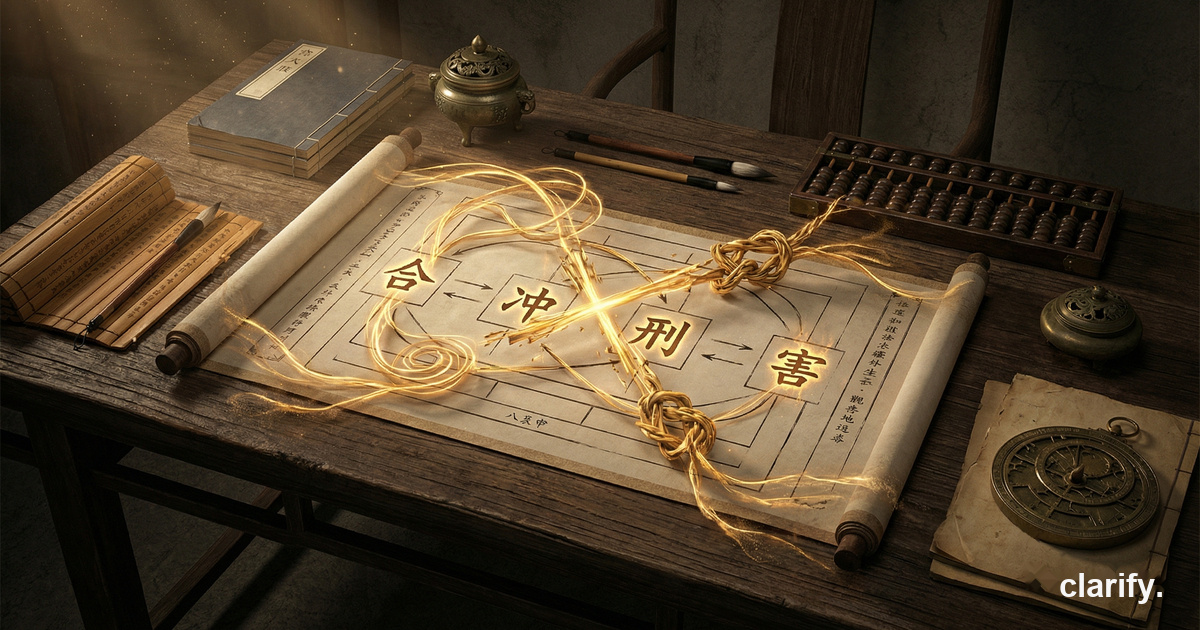
Combinations, Clashes, Punishments, and Harms are traditional chart interactions. They do not expose exact relationship tension, career friction, internal drain, major shifts, misfortune, or rescue; the quoted auspicious and inauspicious language is historical doctrine.
Introduction
These questions are normal. But reducing these concepts to simple labels distorts the reading. In real BaZi, they do not judge morality or assign lucky/unlucky tags. They tell you how the forces inside your chart interact.
A safer question is how a selected school defines these interactions inside the chart. They do not make relationships, marriage, career, or life more unstable, strained, or draining.
What Does He Chong Xing Hai Mean in BaZi?
The simplest explanation is: He, Chong, Xing, and Hai are interaction patterns between stems and branches in the chart.
They are not just symbolic labels. They show whether forces attract each other, collide, constrain each other, or create hidden wear.
They are the interaction language of structure, explaining why the chart behaves the way it does.
Why Shouldn’t They Be Reduced to Good or Bad?
Because they describe modes of interaction, not moral verdicts. Combination is not always good (it can be sticky entanglement). Clash is not always bad (it can mean movement or breakthrough). Punishment is not always disaster (it often means long-term inner friction).
If all someone knows is "combination good, clash bad", the reading stays very shallow.
He Chong Xing Hai describes interaction mechanics rather than simple dualistic judgments.
What Does “He” (Combination) Feel Like?
The simplest explanation: He feels like being pulled together. It suggests binding, attraction, entanglement, sticking, and difficulty separating.
The key point of He is not "good", but: hard to loosen.
It is not always sweetness. It may appear as relationships becoming too sticky, blurred boundaries, unresolved emotions, or cooperative dragging.
What Does “Chong” (Clash) Feel Like?
Chong feels like collision and activation. It suggests change, movement, instability, triggering, and one force hitting another into motion.
The key point of Chong is not "ruin", but: hard to keep still.
Within the model, Clash denotes opposition or movement between symbols. It does not predict a move, job change, instability, or breakthrough.
What Does “Xing” (Punishment) Feel Like?
Xing feels like grinding, tightening, and being internally twisted. It is long-term awkwardness, slow pressure, and persistent unsmoothness.
The key point of Xing is not "disaster", but: long-term unsmoothness.
Punishment is an internal chart label. It does not establish twisted relationships, invisible workplace resistance, or accumulated strain.
What Does “Hai” (Harm) Feel Like?
Hai is an indirect branch relation in the chart model. It does not establish hidden damage, misunderstanding, distance, emotional wear, or ongoing imbalance in real life.
The key point of Hai is not "conspiracy", but: hidden attrition.
Harm is an indirect branch relation in the model. It does not establish hidden conflict, emotional unease, fatigue, or gradual damage.
Why Do Many People Not Have “Bad Relationships,” but Structures That Pull More Easily?
Many relationships are not loveless. They are simply not clean-flowing—they are full of repeated tension or constantly slightly tangled.
Relationships carrying strong combinations, clashes, punishments, or harms easily stick, collide, grind, or wear quietly. This isn't about a lack of feeling; it's about structures that cost energy to hold.
It is not always "no love". Often, it is a relationship that naturally costs more energy to maintain.
How Are He Chong Xing Hai Compared With Marriage-Associated Positions?
Marriage is vulnerable to overbinding, overmovement, long-term friction, and hidden drain—exactly what He, Chong, Xing, and Hai describe.
He, Chong, Xing, and Hai describe different chart relations around a spouse-palace symbol. They do not measure boundaries, make a marriage unstable or heavy, create misunderstanding, or establish lack of love.
How Are These Relations Compared With Career-Associated Symbols?
Readers may apply these labels to a career-related chart position, but they cannot explain workplace struggle, collaboration, role changes, blocked processes, or hidden friction.
The felt experience becomes not a lack of ability, but an incredibly high process cost to get things done.
Why Do Luck Pillars Change the Felt Experience?
Readers may compare natal interactions with Luck Pillars or annual symbols. Timing symbols do not activate or amplify a guaranteed lived experience.
The natal chart gives the structure, and timing gives the felt experience.
4 Examples Users Can Understand Easily
The 5 Questions Users Should Remember
The 8 Most Common Beginner Mistakes
Most Practical Takeaways
Explore Related Concepts
FAQ
What is the safest way to read He Chong Xing Hai?
Is Combination (He) always good?
Is Clash (Chong) always bad?
What is the difference between Punishment and Harm?
Can these interactions establish marriage or career outcomes?
Want to Know What Is Pulling You in Your Chart?
Start with an accurate BaZi chart and identify where these interactions appear in the model—not where conflict or change will occur in a life path.
 Check Your Structural Tension
Disclaimer: Divination and metaphysical systems are traditional cultural frameworks, not modern science or professional advice. Use this content for reference and make decisions from real-world facts and qualified guidance.