
How to Read the Spouse Palace in BaZi: Why Some People Don’t Lack Marriage Luck but Have a Long-Term Relationship Seat That Gets Triggered More Easily
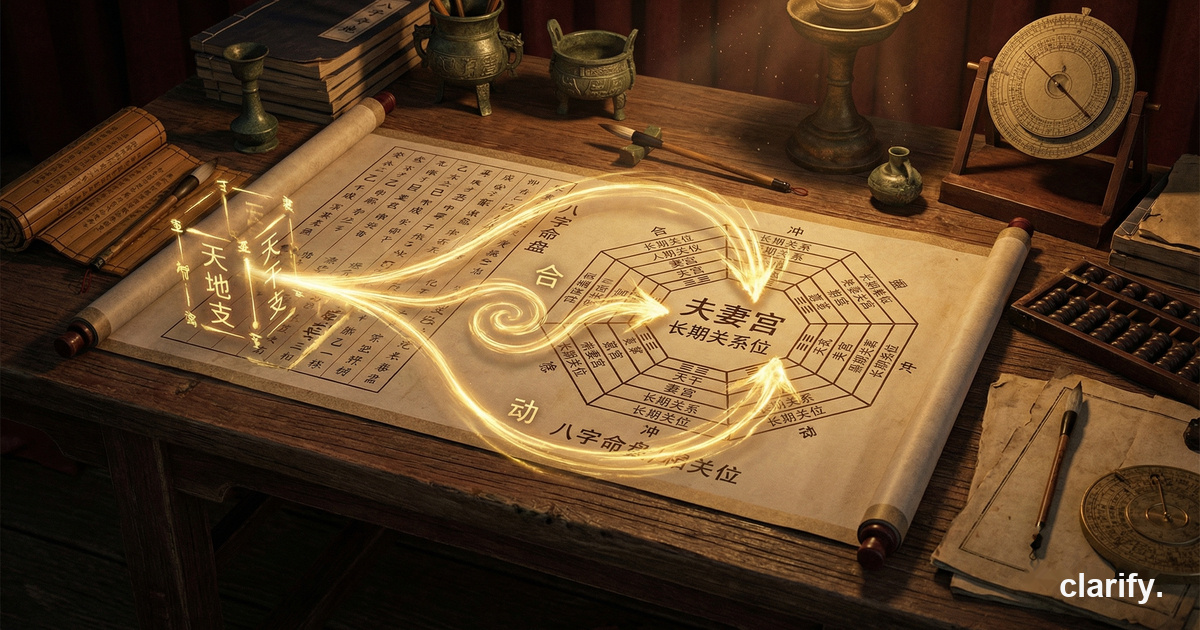
The Spouse Palace: More Than Just "Will I Marry?"
Common questions ask whether the Spouse Palace is favorable, whether a clash predicts divorce, or why a real relationship feels difficult. The chart cannot answer those outcome questions; this page explains only the traditional position and relation vocabulary.
The Day Branch can be classified with traditional interaction terms, but a chart cannot measure whether a real relationship is stable, tight, cold, sticky, pressured, or likely to shift at a particular time.
This guide explains the traditional Spouse-Palace convention and its interaction vocabulary. It does not establish marriage luck or an easily triggered relationship seat.
Core Answer
In common BaZi practice, the Spouse Palace refers to the Day Branch and is compared with the Day Master, spouse stars, interactions, and Luck Pillars. These symbols do not measure marriage luck, relationship stability, or ease of activation.
What Does the Spouse Palace Mean in BaZi?
The simplest explanation is: The Spouse Palace usually refers to the Day Branch. It matters because in many BaZi systems, it is treated as the intimate relationship seat, the marriage landing point, and the close relational environment.
The Spouse Palace is a symbolic position associated with long-term partnership. It does not tell whether commitment will settle or become disturbed.
Why Is the Spouse Palace So Important?
Because short-term attraction and long-term relationship are not the same thing. A person can have attraction and romance without having a steady structure for cohabitation and shared adult rhythms.
The Spouse Palace is used as a prompt for long-term partnership themes. It does not show what happens in everyday intimacy or how a relationship settles.
Relationship Between the Spouse Palace and the Day Branch
In BaZi, the Spouse Palace most commonly refers to the Day Branch. The Day Pillar has two parts: the Day Stem (which relates more to the self) and the Day Branch (which relates more to the long-term relationship seat next to the self).
It is related to marriage and partner patterns, but it is not simply "the spouse person", and is not enough on its own to judge the full marriage outcome. It is the landing point of long-term relationship.
What Can the Spouse Palace Show?
The tone of long-term relationship
These are historical chart descriptors, not measured relationship feelings, stability, or activation risk.The landing quality of marriage
The symbol does not establish whether a relationship will occur or what happens in shared life.Comfort and tension points in intimacy
A chart cannot measure need for space, sensitivity to disruption, or relationship steadiness.Whether the position gets moved easily
The Spouse Palace does not predict breakups, premarital tension, or life changes affecting a relationship.
What Can't the Spouse Palace Be Used Alone to Judge?
It cannot alone judge marriage success or failure
Traditional readers may also compare spouse stars, interactions, and timing, but the combined chart still does not establish a marriage outcome.A clash does not automatically mean divorce
This is one of the most common fear-based distortions.It does not equal a fixed marriage fate
The same Palace acts differently across structural environments and Luck Pillars.It is not the only marriage answer
It is central, but not total. Use it as part of a holistic reading.
Why Do People Panic When They Hear “The Spouse Palace Is Clashed”?
The word "clash" can sound dramatic. In the model it denotes branch opposition; it does not mean divorce or increase the likelihood that a relationship will move, change, or be affected by outside forces.
A Spouse-Palace clash does not predict relationship movement, relocation, external disruption, or lack of stability.
What Does It Really Mean When It Is Clashed?
The simplest way to understand it is: the long-term relationship seat is easier to move. This movement can stem from rhythm shifts, stress, or life changes rippling directly into the relationship.
Greater stage change in relationship
It is not necessarily bad, but it is not especially quiet or still.Greater impact of external factors
A chart cannot show that work, relocation, or family change will disrupt a partnership.A relationship seat that is less quiet
A chart cannot prescribe a highly compatible match or predict that a relationship will change with life events.A more dynamic marriage line
A dynamic-line label does not establish marriage luck or a nonlinear relationship path.
Why Do Some People Have a Seat That Gets Triggered Easily?
Many wonder: I’m not incapable of entering a relationship, but why do things always tighten at key stages? Often the answer is: not a lack of marriage luck, but a relationship seat that is easier to activate.
"Sensitive seat" is a chart metaphor. It does not predict easier dating, turbulent commitment, or a winding path to marriage.
Why Do Combinations, Clashes, Punishments, and Harms Matter?
Combination
Not always good. Sometimes means binding, dragging, or entangling.Clash
More like movement, change, outside impact, or unstable rhythm.Punishment
More like long-term awkwardness, internal friction, and pressure.Harm
More like hidden drain, misunderstanding, or subtle disharmony.
These interactions classify internal chart relations. They do not show a real relational field, support, repeated pulling, or emotional wear.
Why Is Dating Easy, but Long-Term Relationship Unstable?
The Spouse Palace does not govern relationship behavior, show ease of starting romance, or predict problems after commitment.
A Spouse-Palace label does not show emotional flow, ease of starting a relationship, or difficulty sustaining one.
Why Are Some Marriages Very Sensitive to Life Rhythm Changes?
A Spouse-Palace label does not measure sensitivity to job change, relocation, children, financial stress, or timing symbols.
Compatibility and life circumstances must be evaluated from real-world evidence. The Spouse Palace does not show that a marriage will do well or convert stress into relationship tension.
4 Examples Users Can Understand Easily
Example 1: Why dates easily but struggles deciding to marry?
A dynamic-Palace label cannot explain attraction, hesitation about marriage, resistance, or sensitivity to pressure.
Example 2: Why do some have turbulent marriages without a "divorce chart"?
A dynamic-Palace label does not establish an uneven relationship timeline, repeated separation, or marriage turbulence.
Example 3: Why do outside issues affect their deep bond?
A Spouse-Palace label does not measure boundaries between outside stress and intimacy or a person's disturbance tolerance.
Example 4: Why do big relationship steps cluster in certain phases?
Readers may compare Luck Pillars with the Spouse Palace, but this does not trigger or time a major relationship shift.
5 Questions Users Should Remember
Is my Spouse Palace stable, tight, cold, sticky, or easily moved?
Understanding this answers the baseline tone.Do I lack marriage luck, or is my relationship seat easily triggered?
Treat the relation as traditional chart vocabulary rather than evidence that personal boundaries are easily pulled.Is it aligned with my self-core?
This compares symbolic positions; it does not determine comfort or tension in commitment.What does my Spouse Palace react to most strongly?
External timing, clashes, internal friction, draining pressure?Which Luck Pillars contain related chart symbols?
Marriage timing cannot be established from stage-sensitive chart interactions.
Why Do Luck Pillars Change the Felt Experience?
The chart does not show youth instability, later steadiness, commitment readiness, or suffocation in a relationship phase.
Luck Pillars change the symbolic relations around the Spouse Palace. They do not show outside pressure on a marriage or determine whether a relationship feels still, supported, or movable.
The 8 Most Common Beginner Mistakes
Mistake 1: Clashed = Divorce
False. A clash marks branch opposition in the model; it does not establish movement or relationship reaction.Mistake 2: "Good" = Guaranteed Happy Marriage
Incomplete. The whole chart matters.Mistake 3: Ignoring Day Master
Creates dangerous blindspots.Mistake 4: Spouse Palace = The Spouse
It represents the *landing point*, not just the human partner.Mistake 5: All Combinations are Good
False. Combinations can bind or entangle.Mistake 6: Ignoring Timing
It must be read in the context of active life stages.Mistake 7: Easily moved = No Marriage Luck
False. They just have a more dynamic path.Mistake 8: Scaring oneself with labels
It's a diagnostic tool, not a means for spreading fear.
Most Practical Takeaways
Start With an Accurate Chart
If you want to know whether you truly lack marriage luck or just have a more sensitive Palace, the first step is to get an accurate BaZi chart.
An incorrect birth time can change the Hour Pillar. In Clarify, True Solar Time changes that pillar only when the corrected time crosses an hour boundary; it does not replace the civil-date Day Pillar or automatically change the Spouse Palace.
Final Thoughts: How Long-Term Relationship Lands
The exact BaZi answer is that the Spouse Palace represents the landing point of long-term partnership, not a simple pass/fail marriage test.
Identify the Spouse-Palace relations inside the model without treating them as evidence of stability, tension, mobility, pressure, or activation timing.
Sources & Methodology Notes
This article uses the common BaZi convention that the Spouse Palace refers to the Day Branch, then reads that position inside the full chart rather than as a standalone marriage verdict.
Core convention
The Spouse Palace is treated as the Day Branch: the Earthly Branch beneath the Day Master and the closest chart position for long-term partnership.Interpretation scope
The Spouse Palace describes how long-term relationship settles into daily life. It should not be used alone as a pass/fail indicator for marriage success.Required context
A complete reading also checks spouse stars, Day Master condition, combinations, clashes, punishments, harms, Luck Pillars, and annual timing.Editorial basis
Clarify applies this article-level convention through its editorial methodology and the related guide to combinations, clashes, punishments, and harms.
Further Reading
FAQ
What is the safest way to read the Spouse Palace?
Is the Spouse Palace the same as the Day Branch?
Does a clash to the Spouse Palace mean divorce?
Can the Spouse Palace alone judge marriage?
Why is dating easy for me but long-term relationship unstable?
Disclaimer: Divination and metaphysical systems are traditional cultural frameworks, not modern science or professional advice. Use this content for reference and make decisions from real-world facts and qualified guidance.