2027 Chinese Zodiac: Fire Goat Year and BaZi Forecast
2027 is the Year of the Fire Goat, called Ding Wei (丁未) in the stem-and-branch calendar. For the popular lunar-year zodiac, it begins on February 6, 2027 and ends on January 25, 2028. BaZi uses a different boundary: the solar term Li Chun, which falls on February 4 in Hong Kong's 2027 calendar.
If your question is “Will 2027 be a good year for me?”, the animal alone cannot answer it. The useful next step is to compare Ding Wei with your Day Master and the rest of your chart. Below are the dates, a guide to all ten Day Masters, the main zodiac relationships and two calculated teaching examples. The calendar facts are checkable; the forecast themes are traditional interpretations for reflection, not verified predictions.
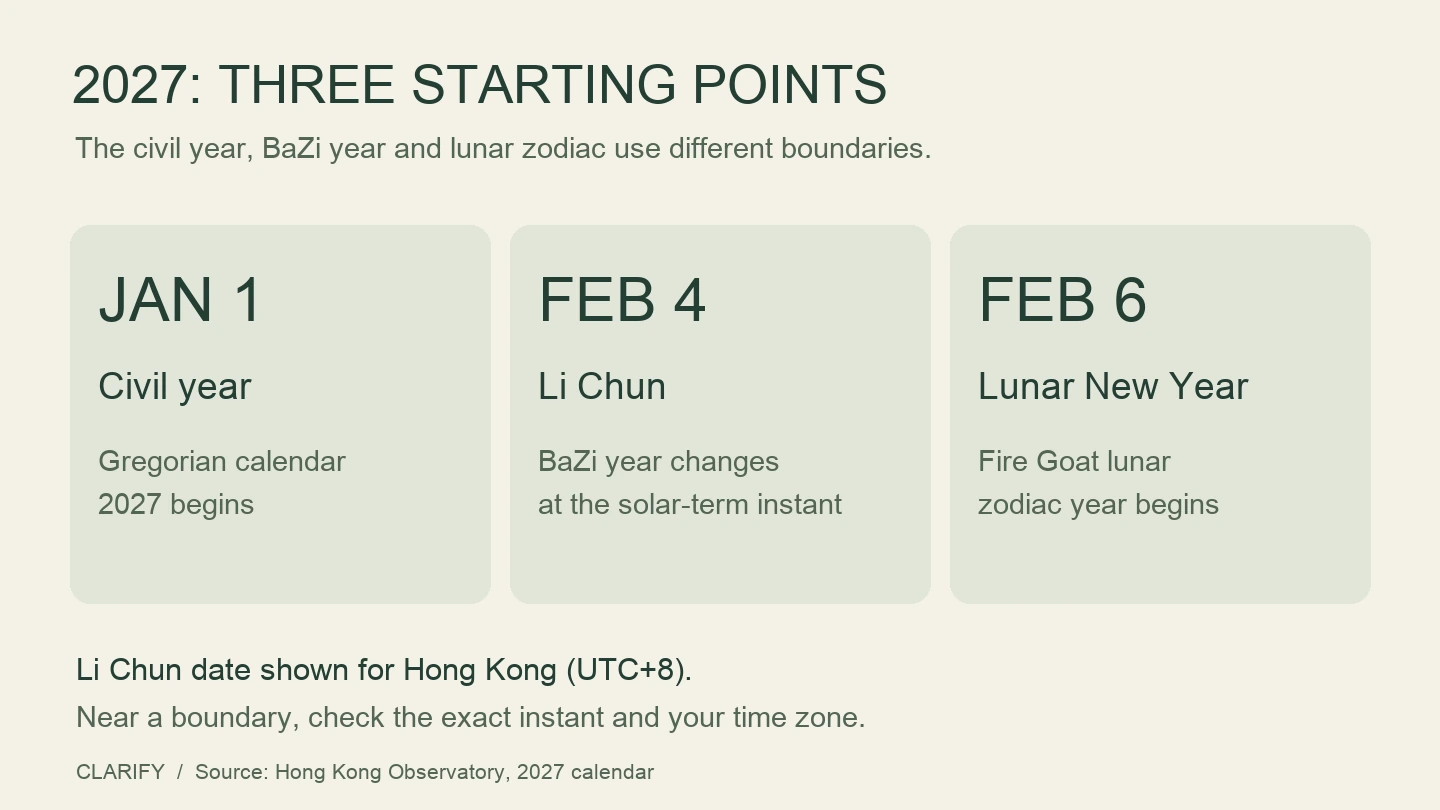
When does the 2027 Fire Goat year begin?
- January 1, 2027: the civil year changes. This does not itself change the Chinese zodiac or BaZi annual pillar.
- February 4, 2027: Li Chun, or Spring Commences, in the Hong Kong Observatory's calendar. Under Clarify's BaZi convention, the annual pillar changes at the solar-term instant, not automatically at local midnight.
- February 6, 2027: Lunar New Year and the start of the popular lunar-year Fire Goat zodiac.
- January 26, 2028: the following Lunar New Year begins. January 25 is therefore the last day of the 2027 lunar zodiac year.
These dates come from the Hong Kong Observatory's 2027 calendar and 2028 calendar. They use the Hong Kong calendar context, UTC+8. They are not universal midnight cutoffs for every location.
For example, February 5 in Hong Kong is already after the 2027 Li Chun boundary but still before Lunar New Year. A lunar-zodiac answer and a BaZi Year Pillar can therefore differ without either calculator changing the same rule. For a birth close to the boundary, use the Li Chun year-boundary guide rather than assigning a year from the Gregorian date alone.
Why Fire Goat, and is Sheep a different sign?
Ding is the Yin Fire Heavenly Stem. Wei is the Earthly Branch associated with the Goat and conventionally classified as Earth. “Fire Goat” names the year's stem-and-branch pairing; it does not mean that every part of the branch, or everybody born that year, is Fire.
Goat, Sheep and Ram are English labels used around the same zodiac animal, yang (羊). The Smithsonian's zodiac-heads explanation discusses the ram or goat under this Chinese name. Here we use Goat, as the Observatory does. The translation does not create a second 2027 zodiac year.
In traditional imagery, Yin Fire is often compared with a lamp: directed attention, expression and sustained care. Wei contains the hidden stems Ji Earth, Ding Fire and Yi Wood in the convention used here. That gives a richer reading than “a gentle Goat year”: expression, what sustains it and what it produces may be examined together. These are interpretive associations, not evidence that the year will make people behave a certain way.
The preceding 2026 Fire Horse year is Bing Wu, not Ding Wei. Both names include Fire, but their stems, branches and relationships to a personal chart differ. Do not reuse a 2026 forecast by changing its year number.
2027 forecast themes for each Day Master
Your Day Master is the stem of your birth-day pillar. It is not your birth-year animal. The list below maps the annual stem Ding to each Day Master using Five Element generation/control and Yin-Yang polarity. It is one layer of a reading: it does not assess whether Fire is favorable, how strong your chart is, or what your current ten-year cycle contributes.
The traditional Ten Gods names are relationship labels. “Wealth” is not a promised payment, “Rob Wealth” is not a prediction of theft, and “Seven Killings” is not a prediction of harm.
Wood: Jia and Yi
- Jia, Yang Wood — Hurting Officer. Wood produces Fire, with opposite polarity here. A traditional theme is expression that questions an established way of doing things. A useful 2027 reflection is where your criticism could become a finished proposal or creative piece that others can examine.
- Yi, Yin Wood — Eating God. Wood again produces Fire, now with matching polarity. The symbolic emphasis is on cultivated output and enjoyment of a practice. Consider which small, repeatable project you would like to finish; neither the label nor the year guarantees an audience.
Fire: Bing and Ding
- Bing, Yang Fire — Rob Wealth. Ding is the same element with opposite polarity. Peer involvement, sharing and competition are traditional themes. Review how a group project divides effort, credit and responsibilities instead of assuming that another person will take something from you.
- Ding, Yin Fire — Friend. The annual stem matches your Day Master. A reading may foreground peers, autonomy or a familiar way of acting. Ask which commitments you genuinely want to own and which assumptions need another person's perspective. Matching stems do not automatically make a lucky year.
Earth: Wu and Ji
- Wu, Yang Earth — Direct Resource. Fire generates Earth, with opposite polarity. Learning, guidance and support are traditional associations. Identify one skill you want to practice and the actual time or teaching support needed to develop it.
- Ji, Yin Earth — Indirect Resource. Fire generates Earth with matching polarity. Exploration and less conventional learning can be useful reflection themes. Turn an interesting idea into a small test rather than collecting explanations without applying them.
Metal: Geng and Xin
- Geng, Yang Metal — Direct Officer. Fire controls Metal, with opposite polarity. Structure, commitments and standards may be the focus of a traditional reading. Ask whether a role's expectations are clearly stated and realistically supported; this does not predict promotion.
- Xin, Yin Metal — Seven Killings. Fire controls Metal with matching polarity. This label often brings up pressure, challenge and response. Translate it into an ordinary question about workload, preparation or boundaries, not an expectation of danger.
Water: Ren and Gui
- Ren, Yang Water — Direct Wealth. Water controls Fire, with opposite polarity. Resource management and concrete responsibilities are traditional themes. Review what maintaining a project actually requires. A Wealth label does not establish future income or justify an investment.
- Gui, Yin Water — Indirect Wealth. Water controls Fire with matching polarity. Opportunities and the handling of variable resources are common symbolic themes. Ask which offers fit your existing commitments and what evidence you need before accepting one.
These prompts are editorial applications of the labels, not instructions issued by the calendar. The relationship can be calculated; whether an interpretation describes your life must be checked against experience. For the wider timing method, see annual pillars in BaZi.
What does 2027 mean for the twelve zodiac signs?
The Goat branch can be compared with any branch in a chart, not just the birth year. The following reference uses common branch relationships; it is not a ranking of lucky and unlucky animals.
- Rat: Zi–Wei is conventionally called a harm relationship. This is a technical pairing, not evidence that somebody intends harm.
- Ox: Chou–Wei is a clash. It marks a relationship to examine in context, not an inevitable loss or disruption.
- Tiger: Yin has no direct six-combination or six-clash with Wei. That does not make every Tiger chart unaffected.
- Rabbit: Mao and Wei are part of the Hai–Mao–Wei Wood trine. Two branches alone do not prove a completed transformation.
- Dragon: Chen and Wei have no direct six-combination or six-clash. Sharing an Earth classification does not make them interchangeable.
- Snake: Si and Wei belong to the Si–Wu–Wei seasonal Fire grouping. Check the other branches and conditions before claiming a completed group.
- Horse: Wu–Wei is a six-combination. A combination is not a blanket promise of harmony, marriage or success.
- Goat: Wei repeats your year branch. Repetition draws attention to a symbol; it does not by itself mean a bad year or a full repeated pillar.
- Monkey: Shen and Wei have no direct six-combination or six-clash. The annual stem and other chart contacts still matter.
- Rooster: You and Wei have no direct six-combination or six-clash. There is no automatic “safe” verdict from this absence.
- Dog: Xu–Wei is a break pairing in the convention used here; both also belong to the Chou–Xu–Wei punishment group. Schools differ in how incomplete groups are handled. Neither label predicts an event.
- Pig: Hai and Wei belong to the Wood trine with Mao. Read it as a possible relationship to investigate, not an automatic good-luck award.
To understand why the same animal can produce different readings, start with BaZi versus the Chinese zodiac. Branch combinations and clashes need the whole configuration, including where a branch appears and whether the proposed relationship is actually usable.
Two calculated examples: both Horse years, different 2027 questions
These are synthetic teaching inputs, not customers or real case histories. Both use 12:00 civil time, UTC, longitude 0 degrees, with the time known. The pillars below were calculated using Clarify's current calculation module. They demonstrate label differences, not personal predictions or independent proof that BaZi forecasts work.
Example A: June 15, 1990
Year Geng Wu; month Ren Wu; day Xin Hai; hour Jia Wu. The Day Master is Xin, Yin Metal. Against the 2027 Ding stem, Fire controls Metal and the polarity matches: the relationship is Seven Killings.
The year branches still form the Horse–Goat combination. Yet “Horse has a combination in 2027” misses the distinct annual-stem relationship. An appropriate reflection question might be: “Which responsibilities need clearer preparation or limits?” It would be inappropriate to claim that pressure, conflict or a particular event must occur.
Example B: June 16, 1990
Year Geng Wu; month Ren Wu; day Ren Zi; hour Bing Wu. The Day Master is Ren, Yang Water. Water controls Fire and the polarity differs from Ding: the annual-stem relationship is Direct Wealth.
This example has the same birth-year animal and the same year-branch combination, but a different Day Master, day branch and hour pillar. A reflection question might be: “What resources would I need to keep this commitment?” It is not evidence that this person will earn more than Example A. Neither example evaluates favorable elements or ten-year cycles, so neither is a complete annual reading.
Which months should you look at in 2027?
There is no universally best month for all charts. The solar-month sequence below is a reference for checking a forecast, not an auspicious-date list. Listed dates are the Hong Kong calendar dates containing each opening solar term; the pillar changes at the term's instant.
| Opening date | Solar term | Month pillar |
|---|---|---|
| Feb 4, 2027 | Li Chun | Ren Yin |
| Mar 6 | Jing Zhe | Gui Mao |
| Apr 5 | Qing Ming | Jia Chen |
| May 6 | Li Xia | Yi Si |
| Jun 6 | Mang Zhong | Bing Wu |
| Jul 7 | Xiao Shu | Ding Wei |
| Aug 8 | Li Qiu | Wu Shen |
| Sep 8 | Bai Lu | Ji You |
| Oct 8 | Han Lu | Geng Xu |
| Nov 7 | Li Dong | Xin Hai |
| Dec 7 | Da Xue | Ren Zi |
| Jan 6, 2028 | Xiao Han | Gui Chou |
The dates are from the Observatory calendars linked above. The pillar sequence is derived from the traditional year-to-month stem rule: a Ding year begins its Tiger month with Ren Yin, then advances one stem and branch at each opening term. January 2027 is still in the preceding BaZi annual cycle; the final Ox month of this Ding Wei cycle is in January 2028. Our monthly-pillar guide explains why a Gregorian month can contain two solar-month pillars.
Use the forecast to make a small, reviewable plan
Choose one theme that relates to a real question, then separate the chart label from your next action. For work, identify a responsibility you want to clarify. For relationships, choose a conversation or shared commitment to discuss; a favorable animal pairing cannot establish another person's intentions. For money, record practical constraints without using a Wealth label to predict returns.
A simple fictional note could say: “The reading prompted me to think about learning. I will practice a skill twice a week for one month, then review what I can actually do.” The review has observable evidence. Whether the plan succeeds is not decided by the annual pillar.
Find your personal starting point
If you do not know your Day Master, begin with the Free Life Book. Your first complete eight-chapter report is free to read online without an account, email or card. Follow the actual form for the required birth details; add birth time and place only if known. A missing Hour Pillar should remain missing, not be filled with an invented time.
The optional Year Ahead Blueprint adds a personal planning layer with twelve timing windows and a 90-day plan. It is a separate product, not a promise that a purchase today covers January through December 2027. Check the actual report period before using it for a particular year. This public article stands on its own; no purchase is needed to read the dates, comparisons or examples.
Common 2027 questions
Is 2027 the Year of the Horse or the Goat?
The new 2027 lunar zodiac year is Fire Goat from February 6. Dates before that boundary are still in the preceding lunar Horse year. BaZi's Li Chun boundary is different, so state which calendar convention you mean.
Does being a Goat mean 2027 will be unlucky?
No such conclusion follows from the animal alone. Repeating a year branch does not establish a personal outcome. Other pillars, timing layers, interpretive conventions and ordinary life circumstances matter.
Can I use this guide without my exact birth time?
You can read the calendar and compare a known Day Master. Missing birth time limits the chart; it does not justify inventing an Hour Pillar. Near a day or solar-term boundary, uncertainty needs particular care.
Are the forecast and the calendar equally certain?
No. Calendar dates and stem relationships can be checked within a stated method. Their interpretation as a personal forecast is a traditional practice, not a scientifically validated account of what will happen. Clarify uses it for reflection and planning; see our methodology and limits.