READ THE CLAIM BEHIND THE LABEL
What Does a “Bad BaZi Chart” Mean?
Before accepting a verdict about your whole life, ask what the reader actually assessed. A weak Day Master, an absent element, a broken pattern, and an unfavorable period are different claims.
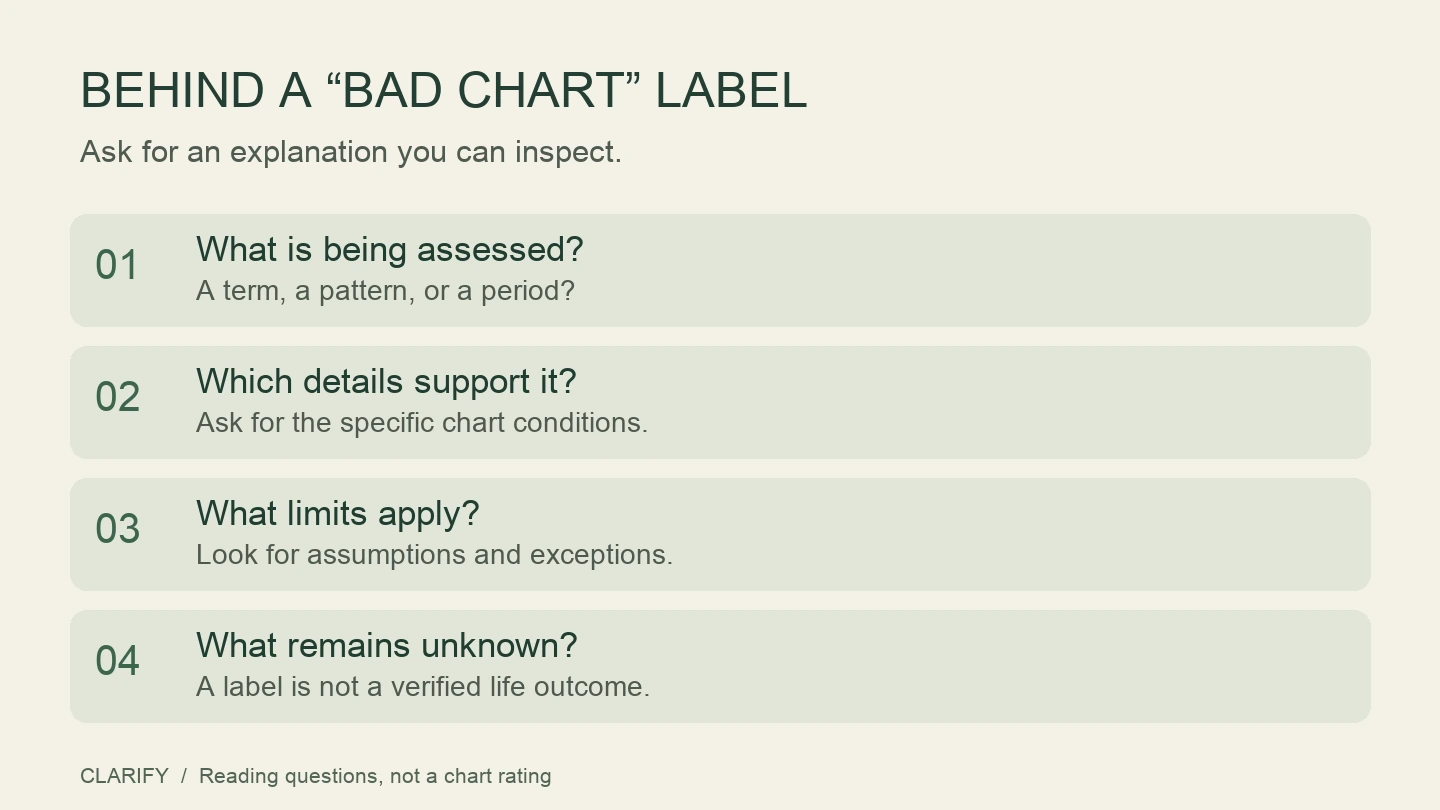
First ask what “bad” refers to
When you encounter this phrase, look for the sentence immediately before and after it. Is the reader describing support for the Day Master, a particular relationship between symbols, or a period in a timing analysis? Or have they moved directly from a chart label to a judgment about you?
Public explanations differ. Sean Chan's discussion of bad charts explicitly uses chart categories and distinguishes the natal chart from timing phases. Sifu Xion's discussion emphasizes structural conditions and changing timing. These are examples of practitioners' approaches, not a shared measurement scale or evidence that their life-outcome claims are established. Clarify does not adopt personal judgments from either page.
You do not need to settle a debate between schools to ask for a precise explanation of a sentence addressed to you. “Which part of the chart are you describing?” is a more answerable starting question than “Is my entire destiny good or bad?”
Four labels that should not be collapsed into one verdict
Use this map to find the relevant explanation. These are different questions inside the traditional framework, not four grades of a person's life.
| Label | What to clarify | First question |
|---|---|---|
| Weak Day Master | Support in the chart | Which factors were weighed? |
| Missing element | What was counted | Were hidden stems included? |
| Broken pattern | A required relation | What condition is obstructed? |
| Unfavorable period | A timing assessment | Which dates and function? |
“Weak” does not mean a weak person
Day Master strength compares traditional support, seasonal context, roots, drain, and control around the birth-day stem. A strength label needs that context; it is not a character assessment. For the actual factors, read Day Master strength and balance. Ask which factor changes the conclusion rather than requesting a more flattering adjective.
“Missing” needs a counting scope
An element absent from a surface display may appear in hidden stems, the additional symbols traditionally assigned within the Earthly Branches. Unknown birth time can also limit what has been counted. Our missing-elements guide explains these checks. “Not shown here” and “needed to fix your life” are separate claims; the first does not establish the second.
“Broken” needs a named pattern and a reason
If a reader says a pattern is broken, ask which pattern they selected, what relation it requires, and what interferes with that relation. The guide to pattern formation and breakage covers the technical distinction. A claim that a pattern's conditions are unfulfilled does not show that a person is broken or that every undertaking will fail.
“Unfavorable” needs a function and a period
A timing assessment asks how a particular period interacts with the natal chart under a stated method. It is not interchangeable with a judgment about the entire birth chart. Ask for the covered dates, the function being discussed, and any competing effects. Read favorable and unfavorable Luck Pillars for that narrower question. One label does not establish failure in every area throughout a decade.
A worked example: make an alarming sentence answerable
The following sentence and exchange are invented for this exercise. They are not a customer's reading, an actual Clarify output, or a calculated chart:
“Your chart is bad because your Day Master is weak. You should not start anything this year.”
There are three separate steps in that sentence. First comes a strength classification. Then the classification becomes a whole-chart verdict. Finally, the verdict becomes an instruction covering an entire year. Even if the first step is correctly explained within a traditional method, the next two steps still require their own reasoning. The word “because” does not supply it.
| Part of the sentence | Question to send back |
|---|---|
| “Day Master is weak” | Which seasonal, root, and support factors led to that label? |
| “Your chart is bad” | Which particular function or pattern are you evaluating? |
| “Do not start anything” | Why would that apply to every activity, rather than one defined concern? |
| “This year” | What exact period was assessed, and where does its reasoning appear? |
Here is a complete response the fictional reader could write:
“Please separate the strength label from the recommendation. Which chart conditions led to the strength assessment, and what specific concern are you connecting to the year? I am considering a weekend drawing class. What, if anything, in your explanation addresses that activity? Please distinguish the traditional interpretation from a claim about what will actually happen.”
This question does not assume the chart can decide whether the class is worthwhile. The reader can separately check the timetable, cost, travel, and whether they want to learn the skill. If the reading provides no relevant explanation, the conclusion remains “not established,” rather than “the class must go badly” or “the chart must be secretly excellent.”
A satisfactory clarification may explain only the technical label. That is still useful: you now know its narrower scope. You do not need a replacement prediction to stop treating an unsupported generalization as a decision rule.
What would count as a useful answer?
Look for an answer that names the chart details, states the method, and connects them to the particular interpretation. It should identify uncertainty and conditions that could change the assessment. A glossary definition alone explains a term; it does not show that the term was applied correctly to your chart.
If the answer is a percentage or rank, ask what the scale measures. A tool's internal score does not automatically become a probability that your life will go well or badly. The explanation must provide the missing basis for that further claim. Our guide to calculation, interpretation, and personal claims explains the distinction in more detail.
If the response repeats the label, substitutes another intimidating term, or treats your request for an explanation as proof that the chart is bad, it has not answered the question. Record what remains unresolved. This is a way to assess the explanation's usefulness, not a way to diagnose the reader or infer their motives.
Does a negative label mean you need to buy a remedy?
The label does not establish that a purchase is necessary or that an item, renamed product, or further reading can guarantee a different outcome. Before paying for anything, identify the actual deliverable and the basis of the claim. You can decline an offer that does not answer your question.
Clarify offers a Free Life Book with eight complete chapters to read online. It is a way to explore a personal reading's scope, not a service that certifies a chart as good or removes bad luck. The optional Year Ahead Blueprint adds a defined twelve-month planning layer; buying it is not a remedy for a negative chart label.
BaZi is a traditional interpretive framework. You can use an explanation as a prompt to examine a question while keeping actual circumstances, available evidence, and your choices separate from the chart's terminology. You do not have to accept an assessment of your worth to learn what a technical word means.
Common questions
Can I tell whether my whole chart is bad from one symbol?
One symbol does not provide the context for a whole-chart assessment. Ask which relationship and method the reader is using. Even a detailed traditional interpretation does not, by itself, establish a real-life outcome.
Is a broken pattern the same as a bad life?
No. Pattern breakage is a claim about conditions required by a particular traditional structure. It should be explained at that level. It is not evidence that a person has failed or has no future.
Should I get another report until I receive a better label?
A more reassuring label does not resolve an unexplained one. Start with a specific clarification request. The guide to when to revisit a BaZi reading separates rereading, corrections, and new coverage so you can identify what another report would actually add.
Sources and reading boundaries
- Sean Chan: Bad BaZi Charts, Revisiting the Taboo Topic — an example of one practitioner's categorization approach, not evidence for judgments about character or destiny.
- Sifu Xion: discussion of a bad BaZi chart — a contrasting structural framing; its historical, efficacy, and life-outcome assertions are not adopted here.
- Clarify methodology — how calculation, written interpretation, and automated checks are separated. The examples and clarification questions in this article are original teaching exercises.
UNDERSTAND THE SCOPE FIRST
Explore a reading without buying a verdict.
See what Clarify's free online Life Book includes, then use the relevant concept guides to ask a more specific question.