WHEN TO RETURN TO A READING
How Often Should You Get a BaZi Reading?
A new month, a confusing paragraph, and a corrected birth time are three different reasons to revisit a report. They do not all call for buying another one.
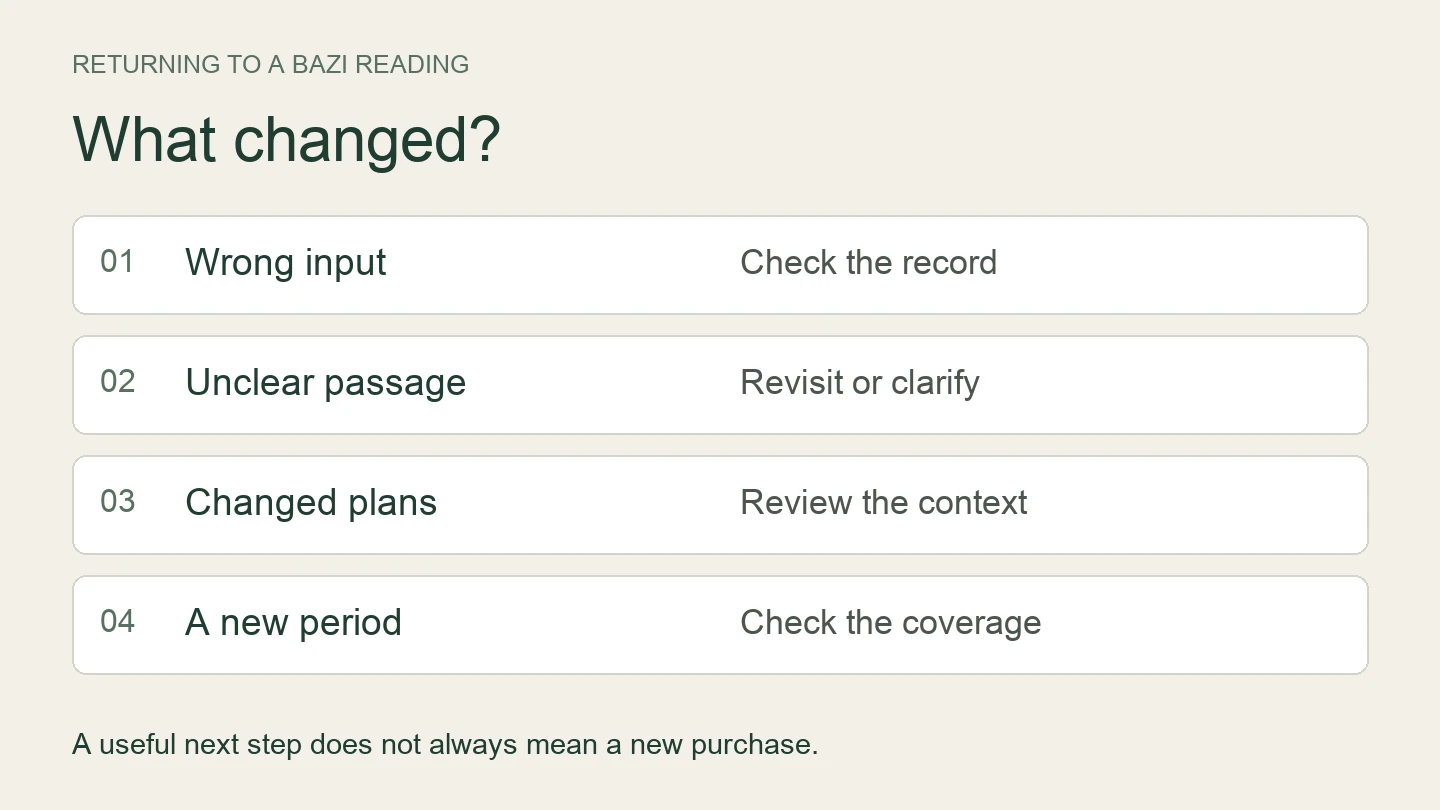
First separate rereading, recalculating, and buying
Rereading means returning to a document you already have. Recalculating means checking the chart using specified birth inputs and calculation conventions. Getting another interpretation means obtaining a different explanation, a follow-up conversation, or a report covering another period. Only the last of these might involve a new purchase, depending on the service.
Providers make different suggestions. XuanSeal's reading checklist proposes monthly review and a quarterly reset. My Eastern Astrology's follow-up service instead offers a defined question-and-reply format for existing clients. These are examples of service approaches, not evidence for a universally effective BaZi timetable. Clarify does not provide that external provider's consultation service.
A useful question is: “What would another reading add that I cannot get by checking or rereading this one?” If you cannot name the missing information, you may not need another report yet.
What changed since your last reading?
| Reason | Try first | Missing value |
|---|---|---|
| Wrong birth detail | Check inputs | A corrected chart, if needed |
| Unclear passage | Read its context | A clear answer to your question |
| New plans | Check real limits | Relevant context missing from your report |
| Later period | Check covered dates | Dates not in your current report |
The table is a decision aid, not a ranking of readings. More pages, a newer generation date, or a higher price do not by themselves establish that the missing information has been supplied.
Correct an input when you discover an error
A corrected birth time is a reason to inspect the calculation rather than wait for an annual review. Keep the old input record and identify the actual correction: a mistyped date, a newly confirmed time, or an incorrectly selected place. A correction can affect the chart; it does not mean every sentence in the old interpretation has necessarily changed.
Start with the BaZi chart verification guide. If the time remains uncertain, use the birth-time guide instead of picking a time to obtain a preferred result. Merely generating several different descriptions cannot verify which birth record is correct.
In the natal chart, the Four Pillars describe a specified birth moment under a stated calculation method. A birthday or a change of job does not turn that birth moment into a new one. Different inputs or methods can produce different calculated fields, so keep those separate from changes in your life.
Reread a specific section when your question changes
You may notice different things in the same paragraph after taking on a new responsibility. That is a change in the context you bring to the report; it is not proof that the report predicted the responsibility.
Open the section relevant to the question, including the qualifications around the sentence that caught your attention. Write down which part you do not understand. Is it a term, a claim about your habits, a date range, or an action suggestion? Our guide to calculation, interpretation, and personal claims helps separate these layers.
If clarification would require a conversation, check whether the service actually includes one and what it covers. Do not assume a downloadable report also includes personal follow-up. If the problem is two conflicting interpretations, compare the disputed passages before purchasing a third opinion.
A practical example: a changed schedule, not a changed chart
This example is fictional. It is not a customer story, a calculated chart, or an excerpt from a Clarify report.
On September 13, a reader returns to a paragraph about protecting time for a creative project. The birth inputs are unchanged. What changed is the available time: a new weekly commitment leaves less room for drawing practice. The reader's question is now, “Which part of my original plan still fits?”
The next step is to review the actual schedule and the passage's scope. A new natal calculation would not tell the reader how many free evenings remain. They choose September 27 to look back at what they managed to do: fourteen elapsed days later. Two weeks is their convenient planning interval, not a BaZi rule or a promise that a pattern will become clear in that time.
| Return note | Fictional filled example |
|---|---|
| What changed? | My weekly availability, not my birth details |
| What am I checking? | Whether my drawing plan still fits the time I have |
| What can I use now? | The relevant existing passage and my actual schedule |
| When will I look again? | September 27, unless the schedule changes sooner |
| Do I need a new report? | No new information requirement has been identified |
At the next review, the reader records what happened, including anything that did not fit the interpretation. Completing more drawings would not validate a BaZi prediction: the changed plan, available time, and many other factors could explain it.
Does a new year mean you need a new reading?
A natal reading and an annual report have different scopes. The Annual Pillar is a changing timing layer in the traditional framework; it does not replace the natal Four Pillars. A report's coverage dates also need to be distinguished from the calendar boundaries used in its calculations.
Before buying a later report, inspect the dates in the one you already have. If it already covers the period you want to review, a new purchase may add little. If it does not, check what the new product actually covers. A label such as “year ahead” is not, by itself, a promise of automatic renewal, continuously refreshed content, or twelve separate reports.
Clarify's Year Ahead Blueprint is an optional, one-time USD 24 report with twelve timing windows, five seasons, four areas of life, and a 90-day field plan. It follows the same personal Reading. Its twelve rolling solar-month windows are prepared at generation time; they are not a subscription to a new reading every month. Read the product page and inspect the report's own dates when deciding whether its coverage answers your question.
If you already have a paid report and are considering another generation, check the current access and replacement behavior first. A new payment should not be treated as a harmless refresh button or a guarantee that both versions will remain available together.
Set a review reminder only if it helps
You can choose a convenient reminder after you have had a chance to try an ordinary, reversible action. You can also return earlier when a relevant fact changes, or skip the reminder when there is nothing useful to review. Neither choice requires a new purchase.
Use the short return note above: what changed, what you are checking, what you can use already, when you will look again, and whether anything is actually missing. Keep “not observed” and “unclear” as valid answers. Do not keep generating reports until one gives the answer you want.
BaZi is a traditional interpretive framework for reflection, not a verified schedule for future events. If a reading pressures you to keep buying updates to prevent an adverse outcome, pause the purchase and ask what specific deliverable is being offered. Frequency alone does not make a claim more reliable.
Common questions
Should I get a BaZi reading every month?
There is no general requirement to buy monthly readings. Reviewing a monthly section you already have is different from buying a new interpretation. Decide from the question and missing coverage, not just the month changing.
Does my natal BaZi chart change on my birthday?
The natal chart refers to your birth inputs under a stated method. A birthday does not change those inputs. Age labels and timing layers are separate matters; a correction to the recorded inputs can require a calculation check.
Can I begin without paying for an annual report?
Yes. Clarify's Free Life Book provides eight complete chapters to read online. The annual Blueprint is optional. You can inspect the free product's scope before deciding whether another layer is useful.
Sources and product checks
- XuanSeal: BaZi Report Reading Checklist — an example of a provider's suggested review rhythm, not evidence of an optimal schedule.
- My Eastern Astrology: Follow-Up Questions — an example of a separate follow-up service with a defined format, not a Clarify feature or an endorsement.
- Clarify methodology — the distinction between calculation, written interpretation, and automated checks.
START WITH THE SCOPE
See what your first Reading includes.
The Free Life Book explains the core pattern. Explore it first, then return to the parts that help answer a concrete question.