BaZi vs MBTI: Can Your Birth Chart Reveal Your Type?
A BaZi Day Master does not give you an MBTI type. Jia Wood is not another name for ENFJ, and Yin Water does not establish an Introversion preference. BaZi derives symbols from birth information; MBTI uses questionnaire responses and a process of checking which preferences fit. Similar descriptions do not create a conversion between them.
If you have seen BaZi called “Chinese MBTI,” the phrase may be a convenient introduction to personality-themed reading. It is not a technical equivalence. This guide shows what the labels actually contain, how to spot an unsupported correspondence, and how to compare two descriptions without deciding that one reveals your hidden “true self.”
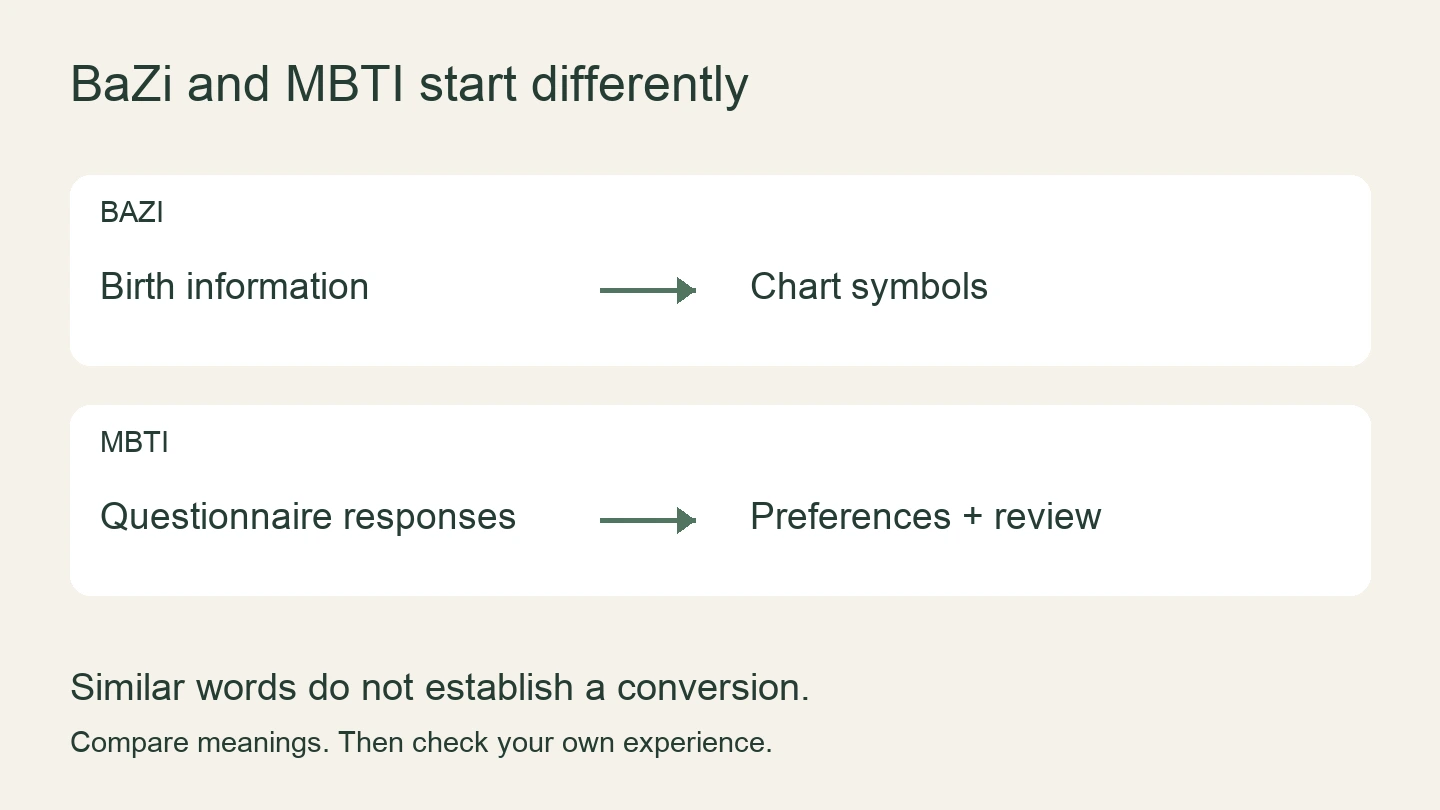
Two systems, two routes to a result
BaZi: birth information to a chart
BaZi, or Four Pillars, assigns a Heavenly Stem and an Earthly Branch to the birth year, month, day and, when known, hour. Four pairs make eight characters. The upper symbol in the day column is the Day Master, the reference used to describe relationships among the chart's elements.
The ten possible Day Masters combine five elements with yin or yang. They are calendrical symbols, not ten questionnaire scores. Traditional interpretation considers the rest of the chart as well. Calling Jia a tree may help someone remember its symbolism; it does not measure how that person behaves in a meeting.
MBTI: responses to preferences and best-fit review
The Myers-Briggs Type Indicator, usually abbreviated MBTI, reports preferences using four letter pairs: E–I, S–N, T–F and J–P. The Myers & Briggs Foundation's type overview describes the resulting sixteen combinations. They are not derived from a birth calendar.
The Foundation's best-fit guidance also distinguishes receiving a result from deciding which type best describes you after learning about the framework and reviewing your results. Reading a four-letter label on a chart site is not the same process.
The difference is about what each method does. It does not establish that a birth-based reading is more accurate because its input is fixed, or that any four-letter quiz is the official MBTI assessment.
What the letters mean—and what the chart symbols mean
In the Foundation's description of the preference pairs, E–I concerns the orientation of attention; S–N concerns taking in information; T–F concerns making decisions; and J–P concerns how a person approaches the outside world. These terms have meanings within that framework. “Thinking” does not simply mean being intelligent, and “Introversion” is not a synonym for shyness.
BaZi uses a different set of relationships. For example, Jia and Yi both belong to Wood, with yang and yin polarity respectively. In Ten Gods terminology, the same Bing Fire is Eating God relative to Jia and Hurting Officer relative to Yi. That change follows the reference stem and polarity rule. It does not mean a person's answers to a personality questionnaire have changed.
For the full explanation of these chart layers, use BaZi personality: Day Master, Five Elements and Ten Gods. Here, the key distinction is that a chart relationship and a reported preference are different kinds of label.
Three tempting conversions that do not follow
“Yin means I; yang means E”
This turns a symbolic polarity into a questionnaire result. Imagine two fictional people who both have a Jia Day Master. One likes discussing a new idea aloud; the other prefers drafting notes before a discussion. The shared yang label does not tell us how either would answer the full assessment or which type each would verify.
This is a teaching example, not an observed study of Jia people. Its purpose is to expose the missing step: the proposed translation has supplied no evidence connecting a stem to a person's preferences.
“Strong Output means an extraverted type”
Output is a BaZi relationship to the Day Master. A reading might use it to discuss making, explaining or expressing. Those activities include writing alone, revising a design and speaking to an audience. Moving directly from “expression” to E skips both the meaning of the preference and the person's own experience.
Similarly, an Officer-related theme of standards does not assign J, and a Resource-related theme of learning does not assign N. A resemblance between words is a possible discussion prompt. It is not a validated scoring rule.
“More chart combinations mean a more accurate personality result”
A system can produce many distinct outputs without those outputs describing people well. The number of possible labels tells you about the classification scheme, not how accurately it measures a particular characteristic.
For example, the MBTI letter combinations can be counted as 2 × 2 × 2 × 2 = 16. The ten Day Masters can be counted as 5 × 2 = 10. Neither calculation compares accuracy, and the ten Day Masters are not a count of complete BaZi charts. A larger number on either side would still leave the validation question unanswered.
A worked example: “My chart says expressive, but I identify as an introvert”
Suppose a fictional reader has a BaZi report that discusses Output through communication. They also identify with an MBTI type beginning with I. They worry that one result must be wrong.
First, separate the claims. The BaZi passage is interpreting a chart relationship. The MBTI letter names a preference within another framework. Neither sentence, by itself, says “you must enjoy every social gathering.”
Next, write down what actually happens. The reader may enjoy preparing a detailed presentation, deliver it competently, and then prefer a quiet evening. Those observations describe different activities and circumstances. They do not require a new chart, an invented “hidden extravert,” or a forced conversion to E.
Finally, choose the question worth exploring: “Do I communicate more clearly after preparing in writing?” That can be tested in an ordinary, low-stakes discussion. Preparing a short note and noticing whether it helps is useful regardless of whether either personality description feels right.
This example does not diagnose a type or prove a BaZi interpretation. It shows how to resolve an apparent contradiction by making the claims more precise.
How to evaluate a BaZi-to-MBTI chart you find online
- Identify what it maps. Is the table using only the Day Master, the full chart, an element percentage, or a writer's invented archetype? These are not interchangeable inputs.
- Look for a stated rule. “Metal feels like a Thinking type” is an analogy. A reproducible rule must explain exactly how the output is assigned.
- Ask what evidence tested that rule. Examples selected because they look convincing do not tell you how often the mapping fails on new people.
- Keep missing evidence visible. If the page gives no validation for the correspondence, treat it as the author's proposed analogy, not a way to obtain your MBTI result.
The sources reviewed for this guide do not establish a validated Day Master-to-MBTI conversion. That is the boundary of this comparison; it is not a claim that an exhaustive review of all personality research has been performed.
A comparison note that is more useful than collecting labels
Try this five-line note with one passage from each reading:
- Source and exact label: Which report or assessment am I using?
- Meaning in that system: Is this a chart relationship, a preference, or an added interpretation?
- One concrete match: What recent situation seems to fit?
- One exception: When did I behave differently, and what changed?
- One practical question: What can I observe or try without needing the label to be true?
For example: “I describe myself as organized, but I leave creative projects open-ended. Is the difference a preference, a deadline requirement, or familiarity with the task?” That question is more informative than changing a type to make every behavior fit.
The Foundation's MBTI overview describes preferences as distinct from ability, skill and character. On the BaZi side, Clarify likewise treats a reading as traditional interpretation for reflection. Neither label should replace direct evidence about what you can do or how another person treats you.
Explore the BaZi side in Clarify
If you want to see the chart vocabulary in context, Clarify's free Reading and Life Book provides a BaZi-based starting point. It does not administer the MBTI assessment or convert your Day Master into a four-letter type. Use the actual form's required fields and add birth time and place if you know them; unknown time should remain unknown.
When reading the result, begin with one paragraph you can compare with experience. If a description does not fit, you can leave it aside. You do not need a second personality system to justify or overturn it.
Common questions
Is BaZi the Chinese version of MBTI?
“Chinese MBTI” is an informal comparison, not a shared method. BaZi uses a traditional calendrical chart; MBTI uses a preference framework and assessment process. The nickname should not be taken to imply affiliation or equivalence.
Can I be a Yin Day Master and have an E type?
A yin label does not determine the E–I preference. There is no supported conversion in the sources reviewed here that would make those labels incompatible. Read each within its own framework.
Does a fixed birth chart reveal a more authentic self?
Fixed inputs can make a calculation repeatable under the same rules. Repeatability alone does not show that an interpretation is a more accurate account of you. An interpretation that disagrees with your experience is not automatically exposing something you have failed to recognize.
Which one should I use?
Choose according to the experience you want. To understand an MBTI result, learn its preferences and best-fit process. To explore BaZi, learn the chart and its traditional interpretation. You can find either, both or neither useful; this guide does not rank their predictive accuracy.
Sources and scope
The linked Myers & Briggs Foundation pages define its own framework and best-fit process; they are not independent evidence validating a BaZi comparison. Clarify's linked guides explain the BaZi terms used here. The two-person example, communication example, arithmetic and comparison note are original teaching aids. No customer cases, conversion study, expert review or psychological diagnosis is claimed.