
How to Read the Day Pillar in BaZi: Why Reading Only the Day Pillar Often Leads to Distortion
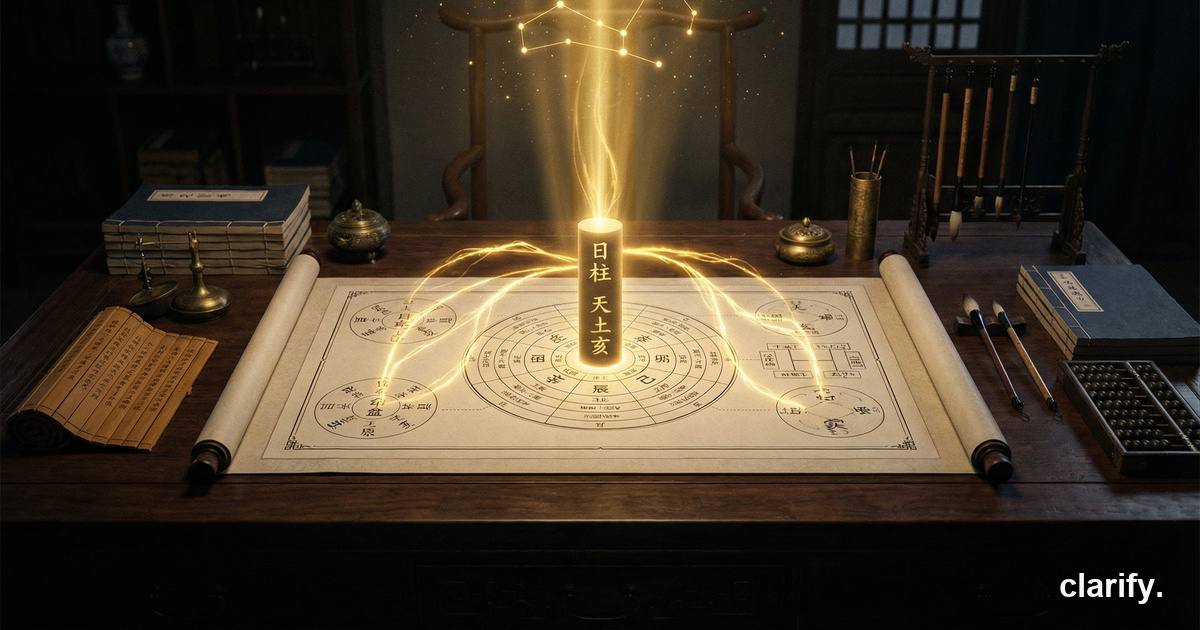
The Day Pillar Is Important — But It Is Not the Whole Chart
When people first come across BaZi, one of the first things they hear about is the Day Pillar. This Day Pillar has difficult marriage, this one has a strong personality, this one marries late. These statements spread easily because they feel direct and personal.
But the problem is exactly that: the Day Pillar is important, but if you read only the Day Pillar and jump to major conclusions, the interpretation often becomes distorted. The better approach is to understand why the Day Pillar matters, then place it back inside the whole chart.
The Day Pillar is the core personal position of the chart — it touches both the self-core and the relationship landing point. But it is an entry point, not a complete answer.
Core Answer
The Day Pillar combines the Day Stem and Day Branch. In Zi Ping traditions, the Stem is commonly used as a reference associated with the self and the Branch as the spouse palace. These are interpretive conventions, not empirical measures of personality or relationship outcomes. A consistent reading places the pillar within Yue Ling, the whole chart, and the selected school.
What Does the Day Pillar Actually Mean in BaZi?
The simplest explanation: the Day Pillar is the combination of the Day Stem and Day Branch. In traditional interpretation, the Day Stem is associated with the self and the Day Branch with the closest relational placement, especially the spouse palace. These associations are symbolic rather than measured traits.
That is why many people are drawn to Day Pillar content first — it feels personal very quickly. People often feel: this sounds like me, this sounds like my relationship pattern. That feeling is not completely wrong, but the problem is: the Day Pillar is a core entry point, not the complete answer.
Why Is the Day Pillar Important in Traditional Reading?
The Day Stem represents the core self
The Day Master is the reference point used to classify the rest of the chart within this system.The Day Branch represents the close relational seat
Traditional readers start spouse-palace questions here, while keeping relationship outcomes outside what one symbol can establish.The Day Pillar shows how self and relationship sit together
The tradition uses the pillar to frame symbolic themes of self and long-term bonds; it does not directly measure a relationship pattern.The position that feels most personally resonant
The Day Pillar naturally creates strong reader identification — but that resonance comes from the core entry point, not a complete portrait.
How Is the Day Pillar Used Traditionally?
A core entry into temperament
Traditional readers use contrasts such as softer or harder and steadier or more urgent as prompts for reflection, not as measured personality traits.Long-term relationship landing point
The Day Branch is traditionally associated with marriage and the spouse palace, but it does not establish comfort, friction, or an outcome in a real partnership.How self and relationship are tied together
The symbolic relationship between Stem and Branch can organize reflection on closeness and boundaries without diagnosing a person or partnership.A base life texture
Some traditions describe a symbolic background tone for the pillar; this remains an interpretive metaphor, not a factual portrait.
What Can't the Day Pillar Be Used Alone to Judge?
It cannot alone judge the entire life fate
A single position does not establish fate, and adding Yue Ling, chart strength, Ten Gods, or Luck Pillars does not turn the model into a factual life forecast.It cannot alone judge marriage outcome
Traditional marriage readings may also compare the spouse star, chart interactions, and timing symbols. None of those layers establishes a marriage outcome or activation date.It cannot alone judge wealth or career level
Wealth stars, Officer stars, Output–Wealth flow, and Luck Pillars are chart vocabulary; even a full-chart reading does not measure wealth or career level.It cannot freeze one Day Pillar into one fixed personality
The same Day Pillar can express very differently depending on Yue Ling, root strength, chart structure, and major life phases.
Why Does Reading Only the Day Pillar Often Go Wrong?
Because the Day Pillar feels so obviously central. It touches the self and it touches relationship — making it very easy to package as short-form labels: this Day Pillar marries late, this one is controlling, this one has bad luck in love. These spread well, but they often flatten real chart logic into oversimplification.
Treating the Day Pillar as the whole chart
This is the biggest problem. The Day Pillar is a core position, but the chart includes Yue Ling, the other three pillars, Ten Gods, and timing. Missing any layer leads to distortion.Ignoring Yue Ling
The same Day Pillar behaves very differently in different seasonal backgrounds. Without the Month Command, Day Pillar reading loses its most critical context.Ignoring strength and whole-chart structure
The Day Pillar's expression depends on whether the overall chart supports it or pulls against it — rooting, energy flow, and Ten-God interplay all matter.Ignoring Luck Pillars and timing
A tense Day-Pillar label does not establish a hard relationship phase, and timing symbols do not establish an excellent later phase. Context can refine model interpretation, not predict a relationship outcome.
Day Stem vs. Day Branch: What Each One Actually Shows
The Day Stem is treated as the "I" reference in the traditional model. Readers may use it to discuss symbolic themes of action and pressure, but it does not measure behavior or resilience. Its chart classification also changes with Yue Ling, roots, and Ten-God structure.
The Day Branch is traditionally tied to the closest relationship seat. It can provide a symbolic prompt for questions about intimacy and commitment, but it cannot explain lived relationship dynamics. Important within the model does not make it evidence of a marriage outcome.
4 Examples Users Can Understand Easily
Example 1: Why can the same Day Pillar produce very different marriages?
The Day Pillar does not exist in isolation, so schools compare Yue Ling, chart strength, spouse-star condition, and Luck Pillars. These variables describe model context; they do not lead to or predict marriage outcomes.
Example 2: Why does a Day Pillar feel accurate but also not fully accurate?
Reader resonance does not show that a Day Pillar accurately captures the core self. Yue Ling, other pillars, Ten Gods, and Luck Pillars add model context but do not measure a whole person.
Example 3: Why do people use only the Day Pillar to talk about marriage?
Because it is easy to package. It feels personal, touches relationship, and creates strong resonance quickly — ideal for short-form content, but not ideal for complete judgment. That is why Day Pillar content is both popular and often distorted.
Example 4: Why do some Day Pillar labels sound scary, but real life is not that extreme?
Many labels ignore the wider chart. Even so, chart support and timing cannot establish whether real relationship friction or an outcome will be mild, severe, or workable.
5 Questions Users Should Remember
What is my Day Stem?
This is the first entry into the self-core. Read the elemental nature and basic temperament from this position.What is happening in my Day Branch?
Traditional readers inspect clashes and combinations around the spouse-palace symbol; those patterns do not determine real relationship stability.Is my Day Pillar supported or strained by the rest of the chart?
It cannot be judged alone. Check whether Yue Ling supports the Day Master and whether the Ten-God structure flows or conflicts.Is the issue the Day Pillar itself, or the whole environment around it?
Compare the surrounding chart structure and timing symbols without treating them as the cause of a real difficulty.How do Luck Pillars repeat or modify this Day Pillar's internal relations?
Day Pillar expression is highly stage-sensitive. The same core can feel very different across different decades of life.
Why Do Luck Pillars Change the Felt Experience of the Day Pillar?
Some schools describe Day-Pillar themes differently across Luck Pillars. Those labels do not establish youth tension, later ease, difficult relationship periods, or future compatibility.
Traditional readers use Luck Pillars to discuss how symbolic themes may change across periods. They do not determine how a person or relationship will unfold over time.
The 8 Most Common Beginner Mistakes
Mistake 1: Using only the Day Pillar to judge the whole chart
This is the biggest mistake. The Day Pillar is core but not the whole picture.Mistake 2: Turning the Day Pillar directly into a marriage conclusion
Marriage also depends on the spouse star, overall structure, and timing. The Day Pillar is one input, not the answer.Mistake 3: Freezing the Day Pillar into a fixed personality type
The Day Pillar shows tone, not total personality. Luck Pillars and environment shape how it expresses.Mistake 4: Ignoring Yue Ling when talking about Day Pillar strength
The same Day Pillar behaves differently in different seasons. Month Command is the essential first context.Mistake 5: Judging relationships without reading the spouse star
That makes marriage reading too narrow and easily distorted by a single surface indicator.Mistake 6: Over-identifying with a scary Day Pillar label
Labels are references, not full readings. Always verify in the whole chart before accepting a label as fate.Mistake 7: Assuming a difficult Day Pillar means bad fate
The label is too absolute. Wider chart context changes only the traditional interpretation; it does not rewrite a person's lived experience or fate.Mistake 8: Focusing on the Day Pillar and ignoring the other three pillars
That turns BaZi into single-point reading and distorts everything. All four pillars interact to shape the complete picture.
Final Thoughts: The Day Pillar Is Not a Label — It Is the Core Through Which Self and Relationship Enter Life
A safer answer is to treat the Day Stem as the model's reference point and the Day Branch as a traditional relationship position, then compare both with the wider chart. This organizes symbols; it does not show fate, personality, relationship outcome, or how life will unfold.
Further Reading
FAQ
What is the safest way to read the Day Pillar?
Can the Day Pillar show personality and marriage?
Why do Day Pillar readings often feel only half accurate?
Does Day Pillar strength matter?
Does a difficult Day Pillar mean a hard life?
Want to Know What Your Day Pillar Really Means — and Why Generic Labels Only Seem Half Right?
Start with an accurate BaZi chart, then read the Day Pillar inside the whole structure and life-stage timing instead of stopping at surface labels.
 Calculate My BaZi Chart
Disclaimer: Divination and metaphysical systems are traditional cultural frameworks, not modern science or professional advice. Use this content for reference and make decisions from real-world facts and qualified guidance.