
What Are the Five Elements? They Are Not Just Wood, Fire, Earth, Metal, and Water
Core Answer
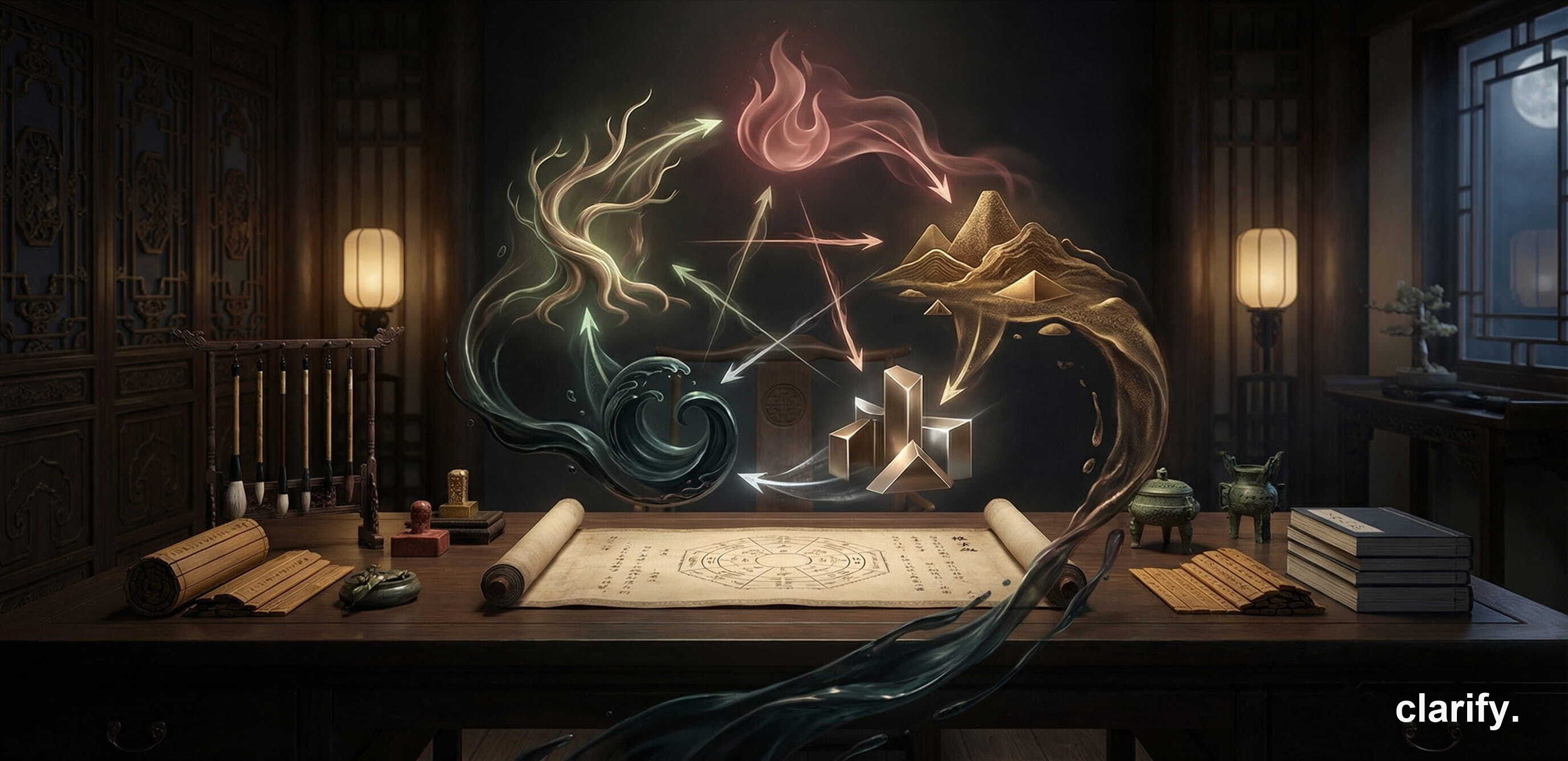
The Five Elements are traditional categories used to describe recurring phases and relations through generation and control. Historical texts treat them as more than physical substances, but they are not codes that dictate behavior, destiny, or timing.
Introduction
For many people, their first introduction to Chinese metaphysics starts with a simple list: Wood, Fire, Earth, Metal, Water. That is the Five Elements.
But that is also where confusion begins. Most people only learn the names. Some go one step further and memorize the generating and controlling cycle. Then they start hearing things like: "You are missing Water", "Your chart has too much Fire", "Your BaZi five elements are unbalanced", "If you lack an element, you should add it".
The Five Elements are not just a list to memorize. They are not a decorative system, and they are not a simple “missing element” checklist. They are a way of describing: relationship, movement, structure, balance, support, restraint, and transformation.
What Are the Five Elements?
The Five Elements are not five literal substances. They are five modes of movement and interaction.
In BaZi and classical Chinese thought, these are not just physical substances. They are broader functional categories.
Wood
Growth, expansion, direction, reaching upwardFire
Expression, heat, visibility, activationEarth
Stability, containment, support, conversionMetal
Structure, definition, judgment, contractionWater
Flow, adaptability, depth, downward movement
They are a system for describing how forces grow, interact, regulate, and balance one another.
The Five Elements Are About Relationship, Not Memorization
Why do so many people learn the Five Elements but still not understand how to use them? Because they remember the labels, but not the relationships.
The educational value comes from understanding how the categories generate, control, and receive different weights inside the traditional model. "Excess," "blockage," and "balance" are chart classifications, not diagnoses or remedies.
What Is the Generating and Controlling Cycle?
The generating and controlling cycle is the rule of how they operate.
The Generating Cycle
The generating cycle describes how one element supports, nourishes, or gives rise to another.
The Controlling Cycle
The controlling cycle describes restraint, regulation, or limiting force.
The Real Point of the Five Elements Cycle Is Balance
The cycle models support and control relations among the five categories. A balanced chart is a school-specific interpretation, not a universal requirement for a balanced life.
Instead of calling an element simply good or bad, ask which symbolic relation a stated method would classify as more balanced. This does not prescribe what a person should add to life.
What Do the Five Elements Mean in BaZi?
In BaZi, a person’s birth time is converted into four pillars (Year, Month, Day, Hour). Each pillar contains a Heavenly Stem and an Earthly Branch with elemental qualities.
BaZi five elements are not about perfect equality. They are about functional structure.
A chart does not require equal 20% shares. Methods instead compare visibility, seasonal weighting, support, control, and flow; these internal labels do not measure a person's capacity or stability.
How Do You Read the Five Elements in a BaZi Chart?
Step 1: Start with the Day Master
The Day Master represents the self. Look at whether it is strong or weak, rooted or rootless.Step 2: Look at overall distribution
See which elements are dominant, suppressed, or if there is obvious imbalance.Step 3: Look for flow
Can the elements form productive movement (Generation)?Step 4: Ask what the chart needs
State which element the selected method classifies as balancing, without presenting it as a real-world remedy.
Why “Missing an Element” Is Often Misleading
The assumption "missing wood means add wood" is too simplistic. Accuracy matters more than simplicity.
Missing does not mean needed
An element might still be active through hidden stems or seasonal context.Small amount != Favorable
Adding a weak element might actually worsen the balance.BaZi is structural
Not decorative. It is not just about colors or accessories.
What Does Five Element Balance Really Mean?
In BaZi vocabulary, Five-Element balance means the chart relations meet a selected method's criteria. It does not prove that a person or life is workable, functional, or sustainable.
What Each Element Usually Feels Like in BaZi
Wood: Growth, direction, expansion
Wood is traditionally associated with growth and direction; chart strength does not establish drive, persistence, or rigidity.Fire: Expression, heat, visibility
Fire is traditionally associated with expression and visibility; chart strength does not establish charisma, energy, or impulsiveness.Earth: Support, containment, stability
Earth is traditionally associated with containment and support; chart strength does not establish patience, realism, or stagnation.Metal: Structure, decision-making, efficiency
Metal is traditionally associated with structure and definition; chart strength does not establish clarity, discipline, or emotional coldness.Water: Flow, perception, depth
Water is traditionally associated with flow and depth; chart strength does not establish insight, flexibility, or indecision.
How Beginners Should Learn the Five Elements
Treat elements as "Functions"
Read structure, not stereotypes.Generation = "Support Chain"
Who is feeding or enabling another force.Control = "Regulation Chain"
Who is setting limits or cooling excess.Imbalance = "Systems Problem"
Is an element excessive, blocked, or unsupported?
Why the Five Elements Are the First Step in BaZi
Almost everything else in BaZi is built on top of them. Ten Gods, chart structure, Day Master strength.
The Most Practical Takeaway
BaZi Fundamentals Series
Final Thoughts: The Five Elements Are About Relationship
The difficult part is not memorizing the list, but understanding how they support, restrain, and balance each other.
The Five Elements are a system for describing relationship, movement, balance, and transformation.
That is where real learning begins.
FAQ
What are the Five Elements in BaZi?
What is the generating and controlling cycle?
Is BaZi just about missing an element?
What does Five Element balance mean?
How do I read the Five Elements in my BaZi chart?
Want to understand your BaZi Five Elements?
Do not stop at “missing element” summaries. Start with a properly calculated chart, then evaluate Day Master strength, elemental flow, and structural balance.
 Calculate My BaZi Chart →
Disclaimer: Divination and metaphysical systems are traditional cultural frameworks, not modern science or professional advice. Use this content for reference and make decisions from real-world facts and qualified guidance.