Birth time, place and calculation conventions
True Solar Time in BaZi
Civil clocks keep one legal time across a time zone. True solar time estimates the sun's local position for a specific longitude and date. Some BaZi methods use that adjustment when assigning the Hour Pillar.
What is true solar time?
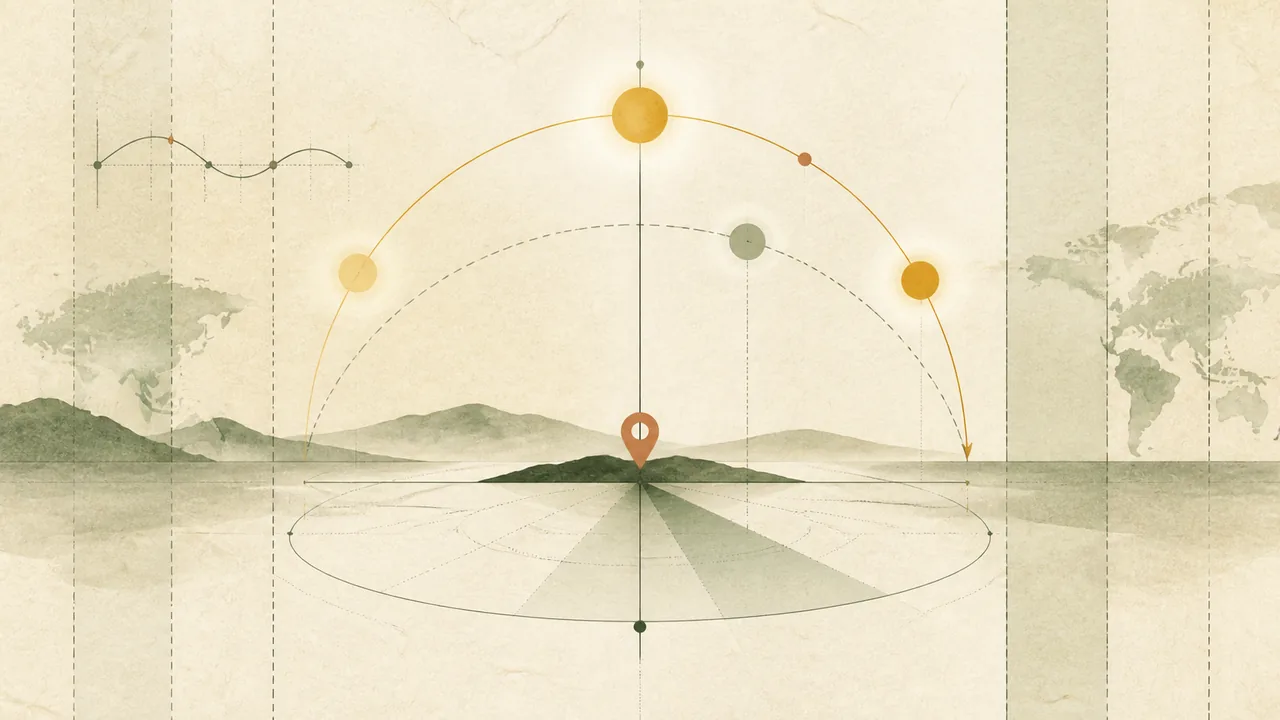
True solar time is a location- and date-specific estimate of time based on the sun's apparent passage across the local meridian. It can differ from the time printed on a civil clock because a time zone covers many longitudes and because apparent solar motion does not stay perfectly even through the year.
NOAA defines solar noon for a location as the time when the sun crosses that observer's meridian. Its calculation material combines longitude, the legal time-zone offset and the equation of time to estimate true solar time.
Civil time and solar time answer different questions
| Time concept | What it represents | What it needs |
|---|---|---|
| Civil time | The legal clock time used at the place of birth | Local date, clock time, time zone and historical daylight-saving rules |
| Mean solar time | A longitude-based day averaged around a uniform 24-hour clock | Longitude relative to the time-zone reference meridian |
| True or apparent solar time | The sun's estimated local meridian position for that date | Longitude plus the date-dependent equation of time |
None is a “more real” birth record. Civil time is the historical clock reading; solar time is a derived astronomical convention. A BaZi calculator must state which one it uses and where.
Why longitude creates a correction
Earth rotates 360 degrees in roughly 24 hours, so one degree of longitude corresponds to about four minutes of mean solar time. Legal time zones simplify daily life by assigning the same clock to a broad region. Locations east or west of the zone's reference meridian can therefore reach local solar noon before or after 12:00 civil time.
This matters most near the two-hour periods traditionally used for an Hour Branch. A correction of several minutes—or much more in a geographically wide legal time zone—can move a recorded time across one of those boundaries.
What is the equation of time?
The apparent sun does not cross the meridian at exactly uniform clock intervals throughout the year. NOAA's glossary attributes the variation represented by the equation of time to Earth's elliptical orbit and changing orbital speed. The correction varies by date and is expressed in minutes.
In plain language, longitude explains where a place sits within a time zone; the equation of time accounts for the date-dependent difference between a uniform mean-solar clock and the sun's apparent motion.
A transparent calculation sequence
- Start with the recorded local civil time. Preserve the date and time that appeared on the clock.
- Resolve the historical time zone. Convert the local time with the offset and daylight-saving rule in force on that date.
- Apply longitude. Account for the place's east–west position rather than assuming every city lies on the zone's reference meridian.
- Apply the equation of time. Use the birth date to add the astronomical correction.
- Compare the resulting Hour-Pillar period. If the adjusted time crosses a boundary, expose that difference instead of silently hiding it.
The NOAA reference expresses the time offset in minutes as the equation of time plus four times longitude, minus 60 times the time-zone offset. Software may organize the conversion differently, but signs and time-zone conventions must be handled consistently.
A synthetic example
Imagine a fictional birth recorded at 15:08 in a city far west of its legal time-zone reference meridian. Suppose the longitude component moves the local solar estimate earlier, while the equation of time adds a smaller date-specific adjustment. The resulting true solar time might fall before the Hour-Branch boundary that the civil clock had just passed.
The example does not show that every birth needs a large correction. It shows why the place, historical time zone, exact minute and stated convention matter near a boundary.
How Clarify uses true solar time
Clarify treats birth time and place as optional inputs. Its current published methodology applies the local time zone and longitude when both are supplied, then uses a true-solar-time adjustment to calibrate the Hour Pillar.
The Day Master remains tied to the civil birth date entered in the product. This keeps the identity used in the free Reading consistent with the Day Pillar in deeper reports, even when the solar adjustment crosses midnight. Clarify can flag a boundary case rather than silently changing that identity convention.
If no birth time is supplied, Clarify does not create an Hour Pillar. Read what remains available without an exact birth time. Once inputs and boundary notes are clear, continue with the step-by-step chart guide.
Why BaZi calculators can disagree
Differences do not always come from arithmetic mistakes. Two calculators may use different:
- civil-time or solar-time conventions;
- longitude sign and time-zone offset conventions;
- historical daylight-saving databases;
- day-change rules around 23:00 or midnight;
- policies for a solar adjustment that crosses the civil date;
- precision thresholds near solar-term or Hour-Pillar boundaries.
A trustworthy tool documents these choices. “Astronomically adjusted” is not enough detail on its own.
When the correction matters most
- Near an Hour-Branch boundary: even a modest correction may change the Hour Pillar.
- Far from the time-zone reference meridian: longitude may create a larger offset.
- During historical clock changes: daylight-saving or legal-zone history must be resolved first.
- Near midnight: products need an explicit policy for the civil date and Day Pillar.
- With approximate inputs: the result should preserve uncertainty instead of adding false precision.
If the birth time is remembered only as “around 3 p.m.,” reporting a solar-adjusted minute does not make the source input exact.
Common misunderstandings
- “True solar time is just longitude divided by 15.” That approximates mean-solar longitude difference but omits the equation of time and historical civil offset.
- “The time zone is enough.” A zone identifies the civil clock, not the exact longitude within it.
- “The adjustment always changes the chart.” It matters only if the result crosses a calculation boundary used by the chosen method.
- “Every BaZi school must use it the same way.” Day-change and solar-time conventions differ; the method should be disclosed.
- “A precise calculator fixes an uncertain memory.” Output precision cannot exceed the reliability of the birth record.
Calculation and interpretation boundary
Astronomical inputs do not validate a forecast
Longitude, time zones and the equation of time are calculable. Using them to assign an Hour Pillar belongs to a traditional BaZi convention. That does not scientifically validate personality claims or future predictions made from the resulting chart.
Good methodology can make a traditional calculation reproducible and honest about uncertainty. It cannot turn symbolic interpretation into diagnosis or certainty.
Check the method, not just the result
Keep birth-time uncertainty visible.
Clarify documents how time and place affect the Hour Pillar and keeps the Day Master convention consistent across the product.
Read Clarify's methodology