
Ten Gods Explained: Traditional Relation Categories and Their Limits
Core Answer
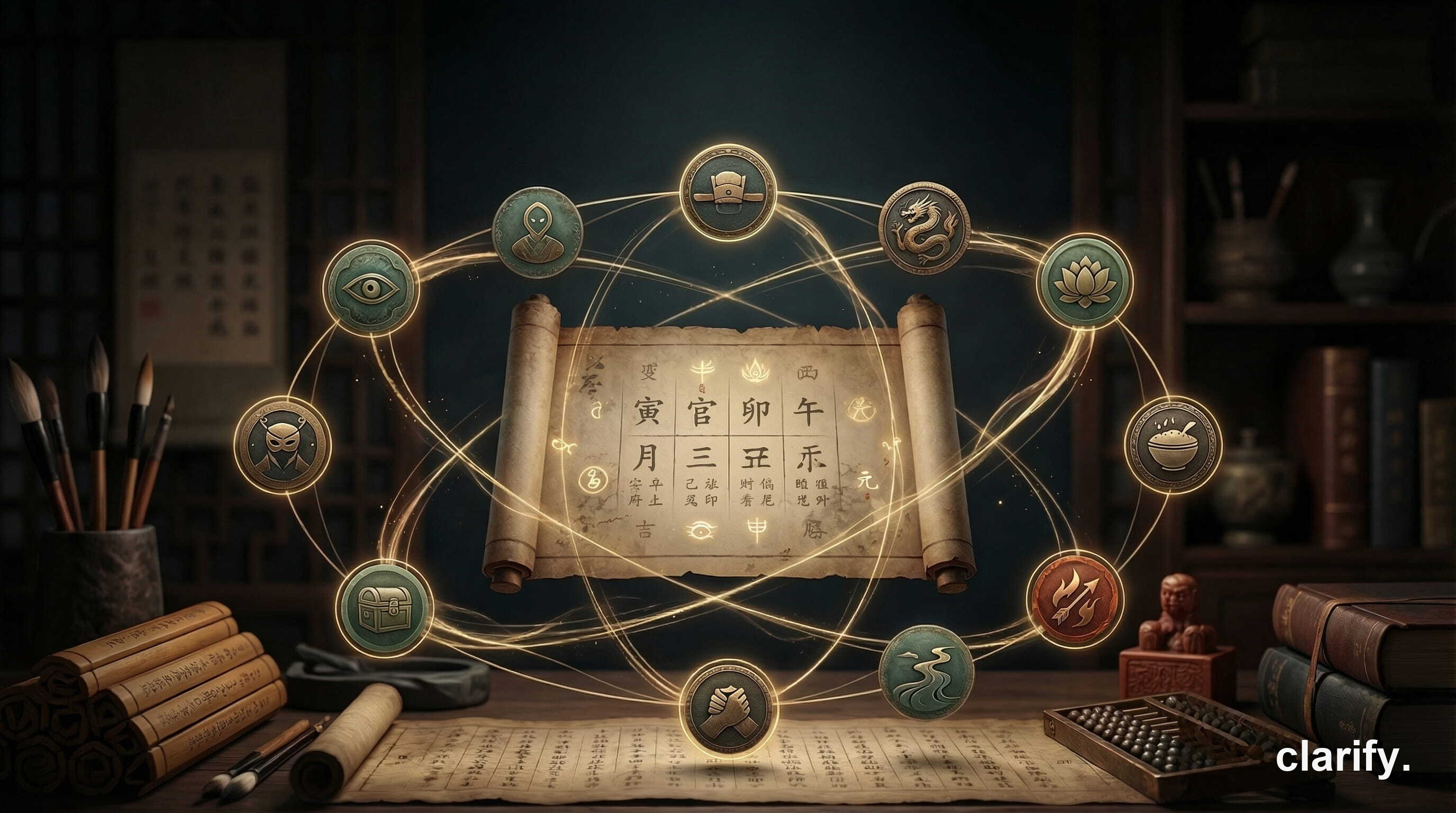
The Ten Gods are relation categories derived from elemental interactions with the Day Master. Historical schools associate them with social and psychological themes, but they do not decode career behavior, drives, or subconscious motivation.
Introduction
BaZi includes more than element counts; Ten Gods add relation labels to the chart model. They do not reveal an essence of destiny or real life forces.
Elements and Ten Gods provide different symbolic classifications. They do not measure energy, social persona, decision models, or true motivations in career, money, or networks.
The Ten Gods and Luck Pillars are traditional symbolic categories, not algorithmic parameters of a life and not projectors of future outcomes.
1. What Are the Ten Gods? The Language of Chart Relations
The Ten Gods classify relationships between the Day Master and other stems in the chart. "Self" and "external world" are teaching shorthand, not a validated personality or relationship model.
Historical schools attach life-domain associations to these relations. Treat the following as vocabulary, not a factual map of modern life:
Power & Rules
(Officer/Killings, 官杀)Resources & Learning
(Resources, 印星)Creativity & Output
(Output, 食伤)Desires & Results
(Wealth, 财星)Competition & Collaboration
(Peers, 比劫)
The Ten Gods are a traditional chart-relation vocabulary, not a validated model of a human being.
2. No Absolute Labels: Context is Everything
Ten Gods have no absolute moral weight. Seven Killings is historically associated with pressure and decisiveness, but it does not measure decision power or diagnose anxiety.
Analysis must return to three frameworks: Elemental Strength, Chart Structure, and Energy Flow.
3. Direct Officer (正官): Order, Responsibility, and Social Rules
Direct Officer is historically associated with rules, boundaries, responsibility, and discipline. It does not establish those traits, a government career, or institutional fit.
A supported Direct Officer is traditionally associated with order and institutions. It does not build reputation or establish sensitivity, self-restriction, or social outcomes.
4. Seven Killings (七杀): The High-Pressure Catalyst for Breakthroughs
Seven Killings is traditionally associated with pressure, authority, and conflict. It does not measure standards, crisis-management ability, or ability to break deadlock.
Supported and conflicted Seven-Killings relations are internal chart labels. They do not create decision power, agility, tension, conflict, pressure, or major breakthroughs.
5. Direct Resource (正印): Support Systems and Internal Stability
Direct Resource is historically associated with support, learning, and protection. It does not reveal a real support system, nourishment, protection, or ability to inherit knowledge.
Strong Resource is a chart classification, not a personality type. It does not establish systems thinking, a comfort-zone trap, thought patterns, or action level.
6. Indirect Resource (偏印): Asymmetric Insights and Intuition
Indirect Resource is historically associated with unconventional paths, non-linear learning, and intuition; it does not establish a learning style or insight.
Indirect Resource is historically associated with unconventional learning. It does not establish suitability for research, strategy, innovation, insight, or a survival advantage.
7. Output (Eating God/Hurting Officer, 食神/伤官): Influence and Expression
Output is a chart relation historically associated with expression and production; it does not measure technical skill, viewpoints, or creative work.
Eating God and Hurting Officer have different traditional expression associations. They do not measure refinement, rule-breaking, impact, or a person's exchange with the world.
8. Wealth (财星): The Control Over Results and Resources
Wealth symbols classify an element controlled by the Day Master. They do not measure resource awareness, management capability, motivation, or financial results.
A strong Wealth relation is not a personality type. It does not establish pragmatism, results orientation, exchange sensitivity, desire, overwhelm, or sustainable capacity.
9. A Practical Analysis Framework
Conclusion
Ask which chart relation is most emphasized under the stated method. Ten Gods do not reveal what dominates a person or their natural interaction style.
Ultimately, these are traditional relation categories. Combining them with Luck Pillars does not accurately project Career, Wealth, and Marriage outcomes or future events.
FAQ
Can I be wealthy without a wealth star?
Direct Officer vs Seven Killings?
Do these define my personality?
Ready to see your dominant variables?
Use the free BaZi generator to view a visual dashboard of Ten-God relations, not a behavioral, financial, career, or future assessment.
 Analyze My Actions
Disclaimer: Divination and metaphysical systems are traditional cultural frameworks, not modern science or professional advice. Use this content for reference and make decisions from real-world facts and qualified guidance.