ChatGPT BaZi Reading: A Copyable Prompt and Worked Check
Start with a checked chart, label every pillar, and ask ChatGPT to repeat the inputs before interpreting them. A useful BaZi prompt makes mistakes easier to notice. It does not prove that an interpretation is true or make a future prediction reliable.
If you already have a BaZi chart and want help with its vocabulary, the workflow below gives you a copyable prompt, a deliberately incomplete example and a repair message. You can use the prompt with a small excerpt instead of handing over an entire report. You do not need to ask for a sweeping account of your life.
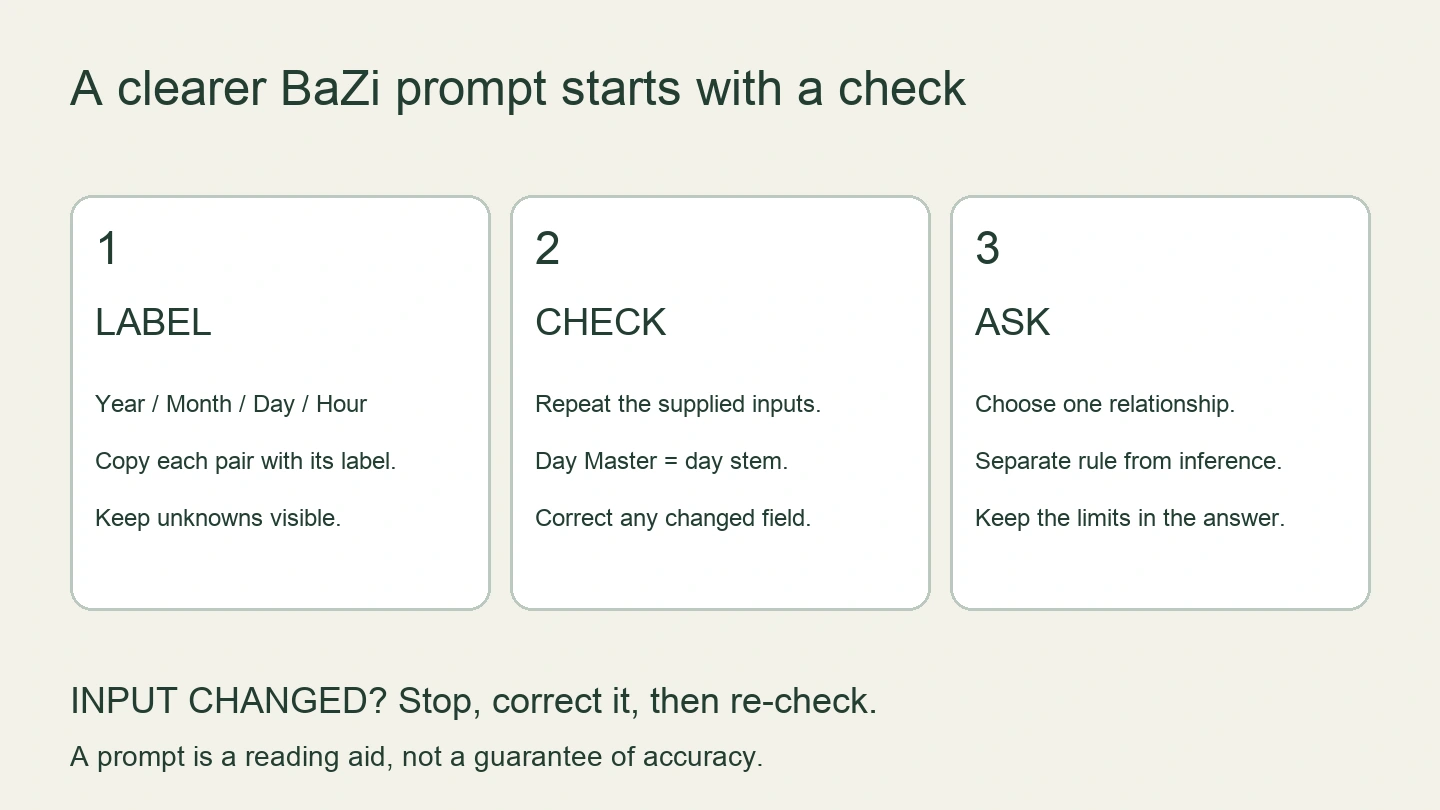
What this prompt is designed to do
There are two different jobs: calculating a chart from birth information and explaining symbols already on a chart. This guide focuses on the second. An answer that supplies eight characters has not, by that fact alone, shown how they were calculated.
ChatGPT may have tools available, depending on the experience you use. A tool-assisted calculation still needs identifiable inputs, conventions and an output you can inspect. Do not infer that a calendar was checked merely because the reply gives precise-looking pillars. If your charts disagree, resolve that disagreement before asking for another interpretation.
OpenAI's guidance on ChatGPT accuracy warns that responses can be confident while incorrect, including invented references. The checklist here applies that general limitation to a specific task. It is not a benchmark comparing AI systems or a claim that a particular prompt prevents errors.
Prepare a small, clearly labelled input
Copy the year, month, day and hour labels with their symbols. Do not paste an unlabeled row of four pairs: a chart may display columns in a different visual order from another chart. Keeping the labels makes the intended meaning explicit.
Include Chinese characters alongside romanization when available. For example, Wu can refer to the stem 戊 or the branch 午 when tone marks are omitted. A label such as “hour branch: 午 Wu” carries more information than the word “Wu” alone. The Hong Kong Observatory's stem-and-branch reference lists the ten stems, twelve branches and their pairings.
- Chart source: the calculator or report and any stated calculation settings.
- Pillars: one labelled pair per line; write “unknown” where a field is unavailable.
- Question: one term, relationship or short passage you want explained.
- Scope: whether you want a definition, a rule check or a reflective example.
For explanation of an existing chart, your name, email, address and order details are usually irrelevant. Birth details and report text can be personal; share only the material you intend the service to receive. Review the current ChatGPT data controls before pasting it. Settings vary by account and workspace; a privacy setting is not a reason to include unnecessary information.
A BaZi reading prompt you can copy
Replace the bracketed fields with information from your own checked chart. Leave an unknown field unknown. This is an original editorial template, not a Clarify chat feature or an official OpenAI prompt.
Help me understand the BaZi information below. Treat it as supplied input, not as independently verified birth data. Do not calculate or replace missing pillars.
Source and stated settings: [source; relevant settings or unknown].
Year pillar: [characters and romanization].
Month pillar: [characters and romanization].
Day pillar: [characters and romanization].
Hour pillar: [characters and romanization, or unknown].
Passage or term: [short excerpt or term].
My question: [one specific question].First repeat the four labelled pillars exactly and identify the Day Master from the day stem. List missing or ambiguous fields. If the labels or characters conflict, stop and explain the conflict before interpreting.
Next, explain only the requested term or relationship. Separate supplied chart information, the traditional rule being applied, and any interpretive suggestion. Name the characters used in each rule. Do not turn a symbolic relationship into a claim about events that happened to me or events that must happen.
If a conclusion depends on missing information, say what is missing and leave that conclusion open. Do not invent an hour, a favorable element, a luck-cycle date, a source quotation or a probability. Give a source I can inspect for a rule when available; otherwise mark the source unverified.
Finish with one ordinary reflection question and one limitation. Do not provide medical, legal or investment decisions. Keep the answer focused on my question.
The first response has a simple job: preserve the input. Read that part before the rest. If it changes the chart, a beautifully written interpretation built on the changed version is not a reason to continue.
Worked example: catching a switched Day Master
Use this synthetic teaching input. It is a set of example labels, not a customer's chart and not a claim that a particular birth date has been calculated:
- Year pillar: 甲子 Jia-Zi.
- Month pillar: 丙寅 Bing-Yin.
- Day pillar: 甲子 Jia-Zi.
- Hour pillar: unknown.
- Question: “In this input, how does the month stem Bing relate to the Day Master?”
There are three supplied pairs, so 3 × 2 = 6 supplied stem-and-branch positions. The two hour positions remain unavailable. Repeating Jia-Zi in two labelled positions does not make either label disposable; nor does it tell a chatbot what the hour must be.
The Day Master is Jia, because Jia is the supplied day stem. Bing is the month stem. If the response says “your Bing Fire Day Master,” it has moved a symbol into a different role. You can detect that error without accepting or rejecting any prediction.
For the bounded rule question, Jia is yang Wood and Bing is yang Fire. Wood generates Fire, and the polarity matches, so Bing is called Eating God, also translated as Food God, relative to Jia. That is a Ten-God relationship. It does not establish that this synthetic person is creative, will earn money or should change careers.
A useful answer could therefore say: “For the supplied Jia Day Master, Bing has the Eating God relationship. The hour is unknown, and this relationship alone is not a full chart assessment.” This is our authored example of a bounded answer, not a transcript or a measured result from testing ChatGPT.
For the larger distinction between chart facts and life claims, read how to read an AI BaZi interpretation. This tutorial adds the input template and error-repair workflow; the knowledge page explains the underlying boundary.
A repair message when the response changes your chart
You changed the labelled input. I supplied day pillar 甲子 Jia-Zi and month pillar 丙寅 Bing-Yin. Your response treated Bing as the Day Master. Restore the supplied labels, repeat them, and answer only the relationship question. Keep the hour unknown. Identify which statements in your previous answer depended on the changed Day Master and withdraw those statements rather than silently carrying them forward.
Compare the corrected response with the original input yourself. An apology does not demonstrate that the correction propagated into every later sentence. If the response still invents fields or switches labels, stop that reading and use a reference for the single rule instead of repeatedly expanding the conversation.
When only a phrase is unclear, narrow the task further: “Define Eating God as a relationship to Jia; do not infer a biography.” Smaller questions make it easier to locate what has been supplied, checked or merely suggested.
Five checks before you keep the answer
- Labels: Does every repeated pillar match its original year, month, day or hour label?
- Unknowns: Did an unknown hour remain unknown in the whole answer, including later examples?
- Rule: Can you locate the two characters used to assign a relationship, rather than only a personality adjective?
- Sources: Does a cited page or passage actually support that specific statement? A real link can still be irrelevant.
- Claim: Did the answer move from traditional symbolism to an unsupported certainty about your life?
You can tick five boxes, but do not convert “5 out of 5” into “100% accurate.” This checks how the explanation handles its inputs and claims. It does not validate the predictive power of BaZi or measure a person's future.
Where Clarify fits
Clarify's free Reading and Life Book offers a self-guided BaZi starting point. Follow the actual form's required fields and keep unknown birth time explicit. You can read the result within Clarify; using a separate chatbot is optional.
Clarify's methodology explains its approach. This article does not promise a copy-to-ChatGPT export button, an included interpretive chat or individual practitioner review. If you compare services, our AI versus human reading guide helps distinguish reports from conversations.
Common questions
Can I just upload a screenshot?
A screenshot may be convenient, but check the transcribed characters and column labels before interpretation. A cropped heading or a character read incorrectly can change the input. A short labelled text transcription gives you something straightforward to compare.
What if I do not know my birth time?
Write “hour pillar: unknown.” Ask a question that can be addressed from the available information. Do not let a prompt choose noon or invent an hour to make the reading feel complete.
Should I ask several chatbots and take the majority answer?
Several similar answers may still repeat the same mistake. Check the disputed input or rule against a relevant source. Agreement alone does not resolve a mislabeled pillar or establish a life prediction.
Will this prompt produce a complete professional reading?
No such outcome is promised. The template is designed for a focused explanation with visible limits. A full traditional chart interpretation involves choices about methods and context that one short prompt does not settle.
Sources and editorial scope
The linked Hong Kong Observatory reference supports the calendar terminology. OpenAI's linked help pages support general accuracy and data-control information, checked September 26, 2026. Clarify's linked knowledge page supports its explanation of traditional relationships. The prompt, repair message and synthetic example are original editorial material. No customer data, model-comparison experiment or claimed prediction-success rate was used.